
In short
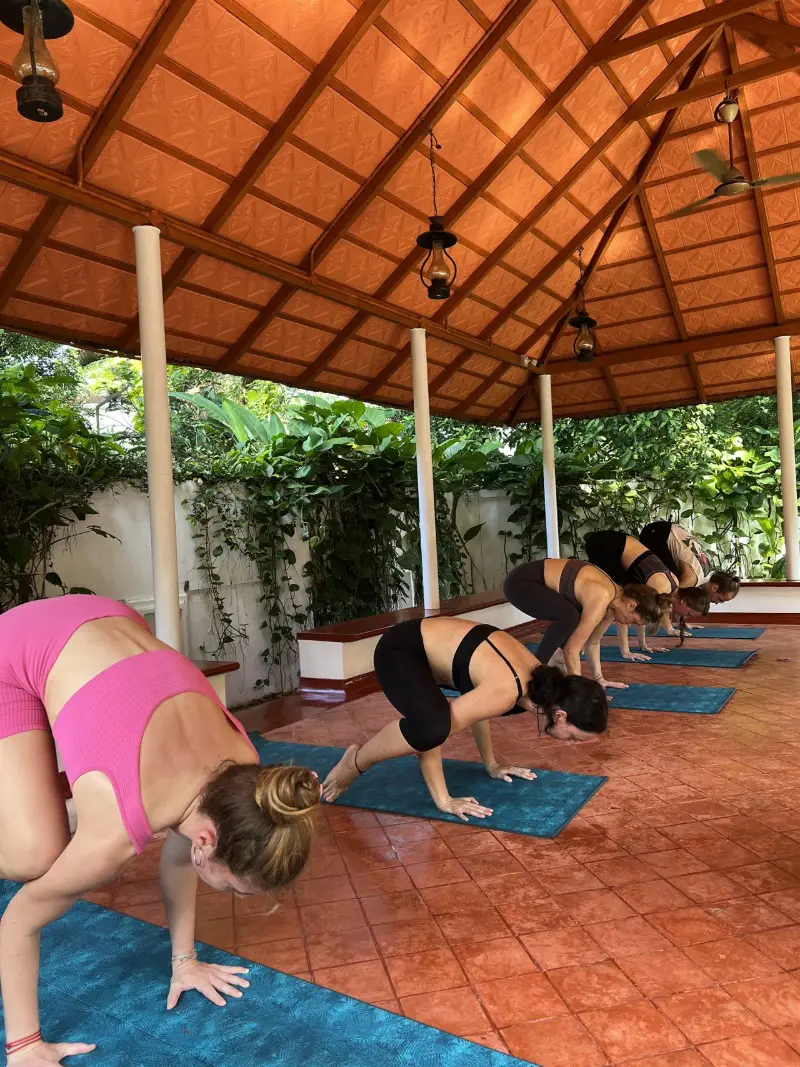
Fort Kochi has a small, unhurried yoga scene built around a handful of teachers rather than large studios. At Santhi School of Yoga & Vedanta Studies you can walk into a two-hour traditional Hatha class twice a day — 7:30–9:30 am and 3:30–5:30 pm — for ₹500 a class (normally ₹600), with no booking, no membership and no experience required. Mats are provided. Message the school before the morning class, because it sometimes moves to an open garden venue.
Most people who practise with us in Fort Kochi did not plan to. They came to Kerala for the backwaters, the food, the Chinese fishing nets at sunset — and then found themselves with a free morning and a feeling that their body had spent too long on trains and buses.
This guide is written for exactly that person. It covers what practising yoga here is genuinely like, the class times you can rely on, what to bring, and how to decide between a single drop-in class and something longer. Where it mentions our school, it does so plainly: I teach here, and the details are first-hand. Everything else is simply what I would tell a friend arriving in Kochi next week.
- Morning class
- 7:30–9:30 am at the school
- Afternoon class
- 3:30–5:30 pm, daily
- Drop-in price
- ₹500 per class (offer; normally ₹600) · ₹700 from Nov 2026 · 30% off stays over a week
- Style
- Traditional Hatha Yoga
- Level
- All levels, mixed in one room
- Language
- English
- Booking
- Walk in; message first for mornings
- Where
- House No 1/1790, Chirattapalam Road, Fort Kochi, Kochi, Kerala 682001, India
What the yoga scene in Fort Kochi is actually like
If you have practised in Rishikesh or Goa, adjust your expectations. Fort Kochi is a working neighbourhood of a working port city, not a yoga town. There is no street of studios, no wall of flyers, no drop-in app. What there is instead is a small number of teachers who have been here a long time, teaching small groups in garden spaces, rooftops and homes.
In practice that means three kinds of class are available to a visitor:
- Schools. Places that teach year-round to locals and travellers alike, and also run longer training. Classes are usually traditional, longer, and cheaper than anything tourist-facing. This is what we are.
- Studios and rooftop spaces. A handful, mostly morning and early-evening sessions, often quite good, often seasonal.
- Hotel and tour-booked sessions. Bookable through travel platforms, typically 60–90 minutes, priced for tourists and sometimes bundled with a breakfast. Convenient, but rarely the same depth.
The practical upshot: you will almost never need to book weeks ahead, but you should message the day before. Schedules here move with the season, the monsoon and the size of the group.
Class times at Santhi School of Yoga & Vedanta Studies
These are our actual times. The only thing that varies is the morning venue — some mornings we move the class to Secret Garden, an open garden space nearby, for the pleasure of practising under trees. When we do, the class starts half an hour later.
| Class | Time | Venue | Notes |
|---|---|---|---|
| Morning | 7:30 – 9:30 am | Santhi Yoga, Chirattapalam | The usual morning class |
| Morning | 8:00 – 9:30 am | Secret Garden | Some mornings only, open-air. Ask before you come |
| Afternoon | 3:30 – 5:30 pm | Santhi Yoga, Chirattapalam | Every day, venue never changes |
A drop-in class costs ₹500 at the moment. That is a limited-time offer on the usual ₹600, and from November 2026 the class will be ₹700. There is no package or membership — you pay for the classes you come to. If you practise with us for more than a week, classes are 30% off; just mention it when you message us. For context, yoga sessions in Kochi booked through travel platforms generally start around ₹3,000.
Before the morning class
Because the morning venue moves, send a quick message the evening before and we will tell you where to come and at what time. The afternoon class needs no checking — 3:30 pm at the school, every day.
Message us on WhatsApp or see all the ways to reach us on the contact page.
What a two-hour traditional Hatha class involves
Two hours sounds long if your reference point is a 60-minute studio class. It is the single thing visitors ask about most, and the single thing they thank us for afterwards. Here is where the time goes.
A traditional Hatha class is not a continuous flow. It is a sequence of held postures with genuine rest between them, so the nervous system has time to register what the body just did. In order:
- Opening relaxation. Class begins lying down in savasana, letting the body and mind settle and creating the atmosphere for practice before anything is asked of you.
- Breathing. Pranayama — breathing practice — to steady the breath and bring attention inward.
- Sun salutations. Surya Namaskar, at a pace where you can still breathe through your nose. We have written the full sequence out step by step.
- Asanas for all levels. Postures held and then rested from, with easier and stronger versions so that beginners and experienced students work in the same room.
- Deep relaxation. A long final savasana, lying still. Not an afterthought; it is where the practice is absorbed.
Across more than five thousand classes, the comment I hear most from travellers is that they expected to be exhausted and instead left calm. That is what the rests are for. As one visitor put it in a review: the two hours are not intimidating, because a good amount of the class is spent lying down.
Do you need experience? And what if you are not flexible?
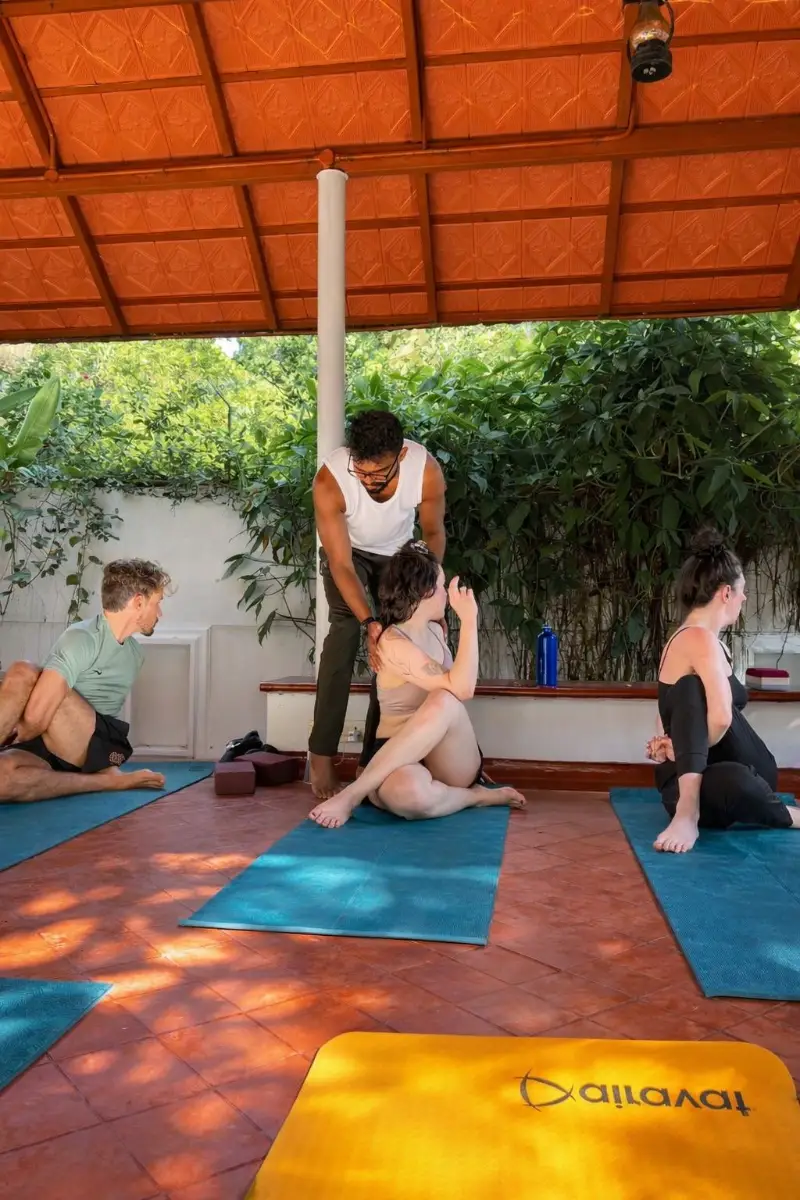
No, and it does not matter. Classes here are deliberately mixed-level, which works because the teaching is hands-on. In a room of eight or ten people, a beginner and someone with ten years of practice can do the same posture at completely different depths and both be working correctly.
Two things genuinely help, though:
- Tell the teacher before class. If it is your first class ever, if you have a bad knee, a recent injury, high blood pressure, or you are pregnant — say so in the first minute. It changes what you will be offered, quietly and without fuss.
- Ignore the person next to you. The most common mistake travellers make is pushing to match someone else in the room. Flexibility is an outcome of practice, not a prerequisite for it.
If you would rather start one-to-one before joining a group, that is often the better path — see the full list of ways to practise with us, which includes private sessions shaped around a single body and a single set of goals.
What to bring, and when to eat
Very little. Mats are provided; so is everything else you need.
| Bring | Why |
|---|---|
| Loose clothing | Something you can fold forward and twist in. Cotton beats synthetics in Kerala humidity. |
| Water | For before and after rather than during. |
| A light layer | For savasana. The body cools fast when it stops moving. |
| An empty-ish stomach | Three hours after a full meal, two after something light. This matters more than anything else on this list. |
Leave shoes at the door, as you would entering any home in Kerala. Nobody will mind if you do not know the Sanskrit names for anything.
When to come: Kerala season by season
Kerala's climate shapes how practice feels far more than most visitors expect. None of these seasons is bad for yoga — they are simply different kinds of practice.
| Season | Months | What practice is like |
|---|---|---|
| Dry and cool | Nov – Feb | The most comfortable months, and the busiest. Around 30 °C, low humidity, perfect mornings. Book longer courses early. |
| Hot | Mar – May | Warm and bright. The body opens easily; the afternoon class is the one to choose. Fewer visitors. |
| Monsoon | Jun – Sep | Humid, green, dramatic and quiet. Traditionally the season for restorative practice and Ayurvedic treatment, when the body absorbs care best. |
| Retreating rains | Oct | Clearing skies, everything still green, very few tourists. Quietly one of the best months to be here. |
If you are choosing dates for a longer stay rather than a single class, the four teacher training batches deliberately sit in January, February, April and June — two in the cool season, one in the bright months, one at the edge of the monsoon.
Finding the school
We are at House No 1/1790, Chirattapalam Road, Fort Kochi, Kochi, Kerala 682001, India — in the old seaside quarter, walking distance from most of the guesthouses in Fort Kochi and a short auto-rickshaw ride from the Chinese fishing nets.
- From Cochin International Airport (COK): roughly 1 hour 15 minutes by taxi, or the airport bus to Ernakulam and a ferry across.
- From Ernakulam: the ferry to Fort Kochi is cheap, frequent and far more pleasant than the road.
- Within Fort Kochi: almost everything is walkable. Auto-rickshaws know Chirattapalam.
Exact directions, a map and every way of reaching us are on the contact and directions page. For everything else to fill your days, see our local’s guide to things to do in Fort Kochi.
Beyond a single class
Plenty of people come for one morning and that is exactly right. But if Kochi has given you more time than you expected, there are three natural next steps.
- Come back daily. The most underrated option. Five consecutive mornings will teach you more than five classes spread over a year, and there is no package to buy — just turn up. Stay more than a week and your classes are 30% off.
- A private session. One or two hours on your own body: alignment, a specific limitation, or building a home practice you will actually keep. Details on the services page.
- A retreat, or the 200-hour training. Our 28-day 200-hour Yoga Teacher Training runs four times in 2027 at €899, all-inclusive of accommodation, three sattvic meals a day and cultural excursions — for people who want a traditional foundation, whether or not they intend to teach. If you are comparing schools, our guide to what a 200-hour teacher training in India really costs lays out the whole market, our own fee included.
You can see what all of this looks like in the school's photo gallery — the pavilion, the meals, the excursions, the ordinary days.
More guides for practising in Kochi
This page covers the essentials. For the questions people ask us most, we have written separate guides:
Practise with us tomorrow morning
Send a message tonight and we will tell you where the morning class is and what time to arrive. No booking, no commitment.
If you are comparing schools, the best yoga in Fort Kochi, and how to judge it sets out what is worth looking for. For somewhere to sleep within walking distance of the morning class, see where to stay in Fort Kochi.
Common questions
Can I join a yoga class in Fort Kochi without booking?
Yes. Classes are walk-in, with no membership or course commitment. Message the school the evening before or the morning of, because the morning class sometimes moves to the Secret Garden venue and the start time shifts by thirty minutes.
How long is a class?
Two hours. Morning is 7:30–9:30 am at the school, or 8:00–9:30 am when held at Secret Garden. The afternoon class is 3:30–5:30 pm at the school every day.
How much does a yoga class in Fort Kochi cost?
A drop-in class at Santhi School of Yoga & Vedanta Studies is ₹500 (a limited-time offer; normally ₹600, and ₹700 from November 2026). There is no membership or package — you pay per class. If you practise with us for more than a week, classes are 30% off.
Do I need yoga experience?
No. Classes are mixed-level and taught with hands-on guidance, so complete beginners and experienced practitioners work in the same room at their own depth. Tell the teacher before class if you are new or carrying an injury.
What should I bring?
Loose clothing you can fold forward in, water, and a light layer for the final rest. Mats are provided. Leave about three hours between a full meal and class.
When is the best time of year for yoga in Kerala?
November to February is the most comfortable, with dry days around 30 °C. June to September is the monsoon — humid but quiet, green, and the traditional season for restorative practice and Ayurvedic treatment.
Is the class taught in English?
Yes. Classes are taught in English, with Sanskrit names for postures given alongside plain descriptions.

Known to his students as Achu, Aksharanand has taught Hatha Yoga, Pranayama, Meditation and Vedanta philosophy in Fort Kochi for over fifteen years, leading more than 5,000 group classes and 70 international teacher training batches. He trained in the Sivananda tradition and holds an Advanced Teacher Training Certificate.
More about Achu and the school · See the 2027 teacher training