

The short answer
Ask the maximum batch size first. It is the single biggest predictor of quality and the one schools disclose least often. Then check who teaches the daily sessions, decide whether you need Yoga Alliance registration, and get the syllabus, the exclusions and the refund policy in writing. Those five answers eliminate most bad courses before price ever enters the conversation.
Every school describes itself as traditional, authentic and transformative. None describe themselves as crowded, rushed or taught by whoever was available. So the words on the website tell you almost nothing, and most "how to choose" advice — check the curriculum, read the reviews — is too vague to act on.
This is the list I would use. It comes from running more than seventy international batches and, more usefully, from fifteen years of hearing what people say about the training they did before they came to me. The complaints are remarkably consistent, and almost all of them trace back to one of the twelve things below.
Two companion pieces if you need them: what a 200-hour training in India actually costs, and Kerala compared with Rishikesh. This page is about choosing the school itself, which matters more than either.
- Checks that matter most
- Points 1–3
- Workable batch size
- 10–20 students
- Practice teaching, minimum
- 5 times with feedback
- Book ahead
- 3–4 months for peak season
- Get in writing
- Syllabus · exclusions · refunds
- Time to run all 12 checks
- About a week of emails
1. What is the maximum batch size?
Start here. Everything else follows from it.
A course with thirty students earns three times what a course with ten earns, from the same teacher in the same room. That is why large batches exist. It is also why they are a worse training: nobody can correct thirty bodies, practice-teaching slots shrink to fit, and questions go unasked because there is no space to ask them.
Ask: "What is the maximum number of students you take per batch?"
A good answer is a specific number, given immediately, ideally with the average too. Ten to twenty is workable. Six to ten is intimate, though very small groups give you fewer peers to learn from when they teach.
A bad answer is a deflection — "it varies", "we keep it small", or a change of subject. A school that will not give you the number has given you the number.
2. Who actually teaches the daily sessions?
Marketing photographs routinely feature a senior teacher who appears once a week for a philosophy talk. The person you will actually spend four hours a day with may be someone else entirely, sometimes a recent graduate of that same school.
Ask: "Who leads the daily asana and pranayama sessions, how many hours a week do they teach, and how long have they been teaching?"
A good answer names a person, states their hours, and gives a number of years. Being able to find that person independently — a lineage, a school, a traceable training — is a strong signal.
A bad answer is a roster of five names with no indication of who does what, or a founder's biography offered in place of an answer about daily teaching.
3. Do you actually need Yoga Alliance registration?
Decide this before you compare schools, because it removes most of the field either way.
Yoga Alliance is a US membership organisation, not a government accreditor. A school pays to become a Registered Yoga School (RYS); graduates then pay about US$115 in the first year to register as RYT 200. It is widely recognised by studios, gyms and insurers in the US, UK and Australia — and some will not consider you without it.
What it does not do is audit teaching quality. Yoga Alliance reviews a submitted syllabus, not the classroom. There are excellent unregistered schools and poor registered ones.
The test is practical: where do you intend to teach, and will anyone there ask? If you plan to apply to studio chains or need liability insurance in a Western country, treat RYS as a requirement and filter for it now. If you are training to deepen your own practice, or to teach privately or in communities where the credential carries no weight, it may matter very little.
Our own position
Santhi School of Yoga & Vedanta Studies is not a Registered Yoga School. Our graduates receive our own 200-hour certificate and cannot register as RYT 200. If the credential is what you need, this checklist should point you somewhere else, and we would rather it did that now than after you arrived.
4. What do the 200 hours actually contain?
"200 hours" is a total, not a description. Two courses with the same number can be wildly different: one spends 150 hours on asana, another gives real time to anatomy, philosophy and how to teach.
Use the Yoga Alliance 200-hour standard as a yardstick even if the school is not registered — it is the closest thing the industry has to a benchmark, and it is a reasonable shape for any serious course:
| Subject area | Hours | What it covers |
|---|---|---|
| Techniques & practice | 75 | Asana, pranayama, kriyas, mantra, meditation — your own practice and the techniques themselves |
| Teaching skills & professional essentials | 50 | Cueing, observing, sequencing, adjusting, ethics, and the practicalities of teaching |
| Anatomy & physiology | 30 | How bodies move, what to avoid, why a posture hurts someone |
| Yoga philosophy & humanities | 30 | The tradition behind the practice, ethics, history |
| Allocated by the school | 15 | Wherever the school places its emphasis |
Ask: "Can you send the syllabus with hours per subject?"
A good answer is a document. If the split is unusual, a good school will explain why — a traditional Hatha school may weight pranayama and philosophy more heavily, which is a legitimate choice, openly made.
A bad answer is a bulleted list of topics with no hours attached.
One more thing worth knowing: under current Yoga Alliance standards up to 40 of the 200 hours may be completed online, with 160 in person. If a residential course quietly includes pre-course online modules in its 200, you are getting fewer days in the room than you thought.
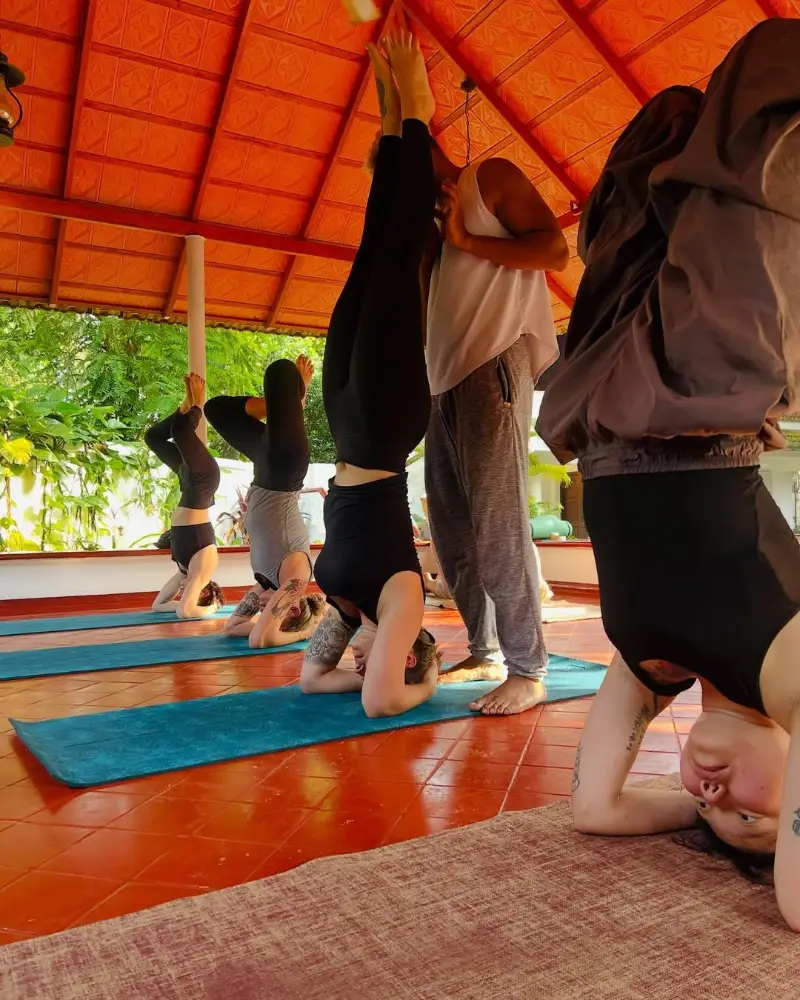
5. How much will you actually teach?
This is the difference between leaving with a certificate and leaving able to hold a room. It is also the first thing large batches quietly cut, because thirty students teaching a full class each does not fit in twenty-eight days.
Ask: "How many times will I teach in front of the group, and will I get feedback each time?"
A good answer describes a progression: a single posture early on, then a short sequence, then a section of a class, then a full class near the end — with feedback after each. Five or more separate occasions is a reasonable floor. Our guide to sequencing a yoga class shows what you should be able to do by the end.
A bad answer is "you will teach at the end", meaning once, in a group, for ten minutes.
6. Is the style the one you want to teach?
People choose a course for its location and then discover they have spent a month learning a style they do not enjoy and will not teach. Hatha, Vinyasa, Ashtanga and Iyengar-influenced trainings produce genuinely different teachers.
Ask: "What style is the daily practice, and what will I be qualified and prepared to teach afterwards?"
If the website lists four styles, ask which one the daily sessions actually are. A course can introduce several and still be grounded in one, which is fine — but you should know which.
7. What does a day actually look like?
Twenty-eight days is a long time to be in a schedule that does not suit you. Some courses run from 5 am to 9 pm with forty minutes free; others build in real rest.
Ask: "Can you send a sample daily schedule with times, and how many days off are there?"
Look for: gaps between sessions, a proper break after lunch, and at least one day off a week. Also count the hours of physical practice — two sessions a day plus teaching practice is a lot of asana for a body that is not used to it, and the injury rate in trainings is not low.
A bad answer is a schedule with no white space, or none offered at all.
8. What is excluded from the fee?
Ask this as a direct question, phrased in the negative. "What is included?" gets you the marketing list. "What is not included?" gets you the truth.
The usual surprises are a separate certificate fee, manuals, excursion entry tickets and transport, airport transfers in one direction only, and meals at weekends. Flights, visa and insurance are never included and are, together, roughly half the real cost of the month — our full cost breakdown has the numbers.
9. What are the room and the food really like?
You will sleep there for a month, and you will eat three meals a day from the same kitchen.
Ask: "Can you send photographs of the actual rooms students stay in? Is the bathroom shared? Do meals run at weekends and on days off?"
A good answer includes real photographs, not stock images of the region, and a straight answer about what is basic. Simple is fine. Undisclosed is not.
If you have dietary needs, ask specifically. Most Indian schools serve sattvic vegetarian food; vegan, gluten-free and allergy provision varies enormously and "we can manage that" is worth testing with a follow-up question.
10. What happens with injuries and limitations?
Tell them what you are carrying — a knee, a back, high blood pressure, a pregnancy, an eating disorder history, anything — and see what comes back.
A good answer is specific: what they would modify, what you would be offered instead, whether the teacher has worked with that before. It may also be an honest "this course would not suit that", which is a school worth trusting.
A bad answer is "no problem, yoga is for everybody". That is a slogan, not a plan, and it is how people get hurt in week two.
11. What are the refund and postponement terms?
You are paying a deposit months ahead for a course in another country. Things happen: illness, a refused visa, a family emergency, a cancelled batch.
Ask: "What is your refund and postponement policy? What happens if I fall ill, if my visa is refused, or if you cancel the batch?"
A good answer arrives as a written policy, because a school that has run many batches has already needed one. Credit towards a future course is common and reasonable; a cash refund is rarer.
A bad answer is a vague reassurance, or a policy that appears only after you ask twice.
12. What evidence exists away from the school's own website?
Testimonials on a school's own site are selected by the school. Look elsewhere.
- Independent platforms. Google, Tripadvisor, retreat marketplaces. Read the three-star reviews, not the five-star ones — that is where the specifics live.
- Recency and pattern. Ten reviews over five years reads differently from ten in one week. Look for the same complaint recurring.
- Ask to speak with a graduate. "Could you put me in touch with someone who finished a recent batch?" A confident school says yes. This is the single most revealing request on this list and almost nobody makes it.
Scoring a school
Run every school you are seriously considering through the same twelve. Two or three failures in the top half should end it.
| # | Check | Weight |
|---|---|---|
| 1 | Maximum batch size, stated in writing | Critical |
| 2 | Named daily teacher, with hours and years | Critical |
| 3 | Yoga Alliance status matches your need | Critical |
| 4 | Syllabus with hours per subject | High |
| 5 | Five or more practice-teaching slots | High |
| 6 | Style matches what you want to teach | High |
| 7 | Schedule with rest and a day off | Medium |
| 8 | Exclusions listed explicitly | Medium |
| 9 | Real photographs of rooms; food answered | Medium |
| 10 | Specific answer on your injury or limitation | Medium |
| 11 | Written refund and postponement policy | Medium |
| 12 | Independent reviews; graduate contact offered | Medium |
The email to send
Send this to every school on your shortlist. The replies will sort them faster than any amount of website reading, and how quickly and directly a school answers is itself part of the answer.
Copy from here
Hello,
I am considering your 200-hour training for [month/year] and have a few questions before I apply:
1. What is the maximum number of students per batch?
2. Who leads the daily asana and pranayama sessions, and how long have they been teaching?
3. Could you send the syllabus with hours per subject, and a sample daily schedule?
4. How many times will I teach in front of the group, with feedback?
5. What is not included in the fee?
6. Could you send photographs of the student accommodation?
7. I have [injury / condition / dietary need] — how would that be handled?
8. What is your refund and postponement policy?
9. Would you be able to put me in touch with a recent graduate?
Thank you,
[name]
Red flags, in order of how much they should worry you
- No stated maximum batch size, or a number above twenty-five.
- A separate certification fee that appears after the deposit.
- No named lead teacher for the daily sessions.
- Reviews only on the school's own website.
- Manufactured urgency — "two places left" on a course three months away.
- No written refund policy, or one you have to ask for twice.
- "No problem" as the answer to a specific question about an injury.
The reassuring signals are duller: a school in the same place for years, a named teacher with a traceable lineage, a clear schedule, and straight answers about what is excluded.
When to book
Three to four months ahead is comfortable for a peak-season course — enough time for a visa, and roughly when flights are at their best. Small schools in quieter months often have places far later than that.
Urgency created by a school for a course months away is a sales technique, not information. The exception is genuinely small batches in high season, which do fill — but a school in that position will tell you calmly, and usually offer you the next date.
Put this list to us
Send us the nine questions above. You will get specific answers from the person who teaches the course — including an honest "this would not suit you" if that is the truth.
Once you have chosen, six weeks before your teacher training is a plan for arriving ready.
Common questions
What matters most when choosing a training?
Batch size. It determines whether teaching can be hands-on and how much practice teaching you get, and it is the figure schools disclose least willingly. Ask for the maximum in writing before anything else.
How many students should a batch have?
Ten to twenty is workable. Above about twenty-five the teaching becomes a lecture. Under six can be limiting, because you learn a lot from watching other trainees teach.
What should the syllabus cover?
As a benchmark: roughly 75 hours techniques and practice, 50 teaching skills, 30 anatomy, 30 philosophy, and 15 allocated by the school. Any serious syllabus should look broadly like that, registered or not.
How much practice teaching is enough?
At least five separate occasions with feedback, progressing from one posture to a full class. Teaching once at the end leaves you certified but not able to hold a room.
What are the clearest warning signs?
No stated batch size, a separate certificate fee revealed late, no named daily teacher, reviews only on the school's own site, manufactured urgency, and no written refund policy.
How far ahead should I book?
Three to four months for peak season. Quieter months often have places much later. Pressure to decide quickly for a course months away is a warning sign, not a reason to hurry.

Known to his students as Achu, Aksharanand has taught Hatha Yoga, Pranayama, Meditation and Vedanta philosophy in Fort Kochi for over fifteen years, leading more than 70 international teacher training batches. He trained in the Sivananda tradition and holds an Advanced Teacher Training Certificate.
More about Achu and the school · See our 200-hour teacher training in Kerala