
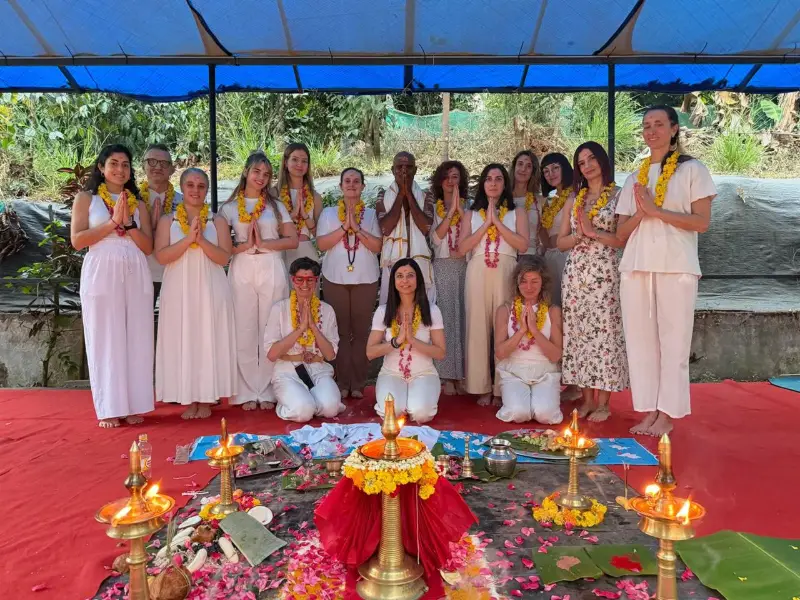
The short answer
Most residential 200-hour yoga teacher trainings in India are advertised between US$900 and US$2,200, covering tuition, shared accommodation and three meals a day for 21–28 days. Budget courses start near US$600; premium retreat-style programmes reach US$3,000. Add flights, visa and insurance and a realistic all-in total is US$1,800–$4,000.
This is one part of a larger question. If you are still weighing schools rather than budgets, start with our 12-point checklist for choosing a teacher training — price should be close to the last thing you decide on.
That range is uselessly wide, which is the problem. Two courses awarding the same 200-hour certificate, in the same country, in the same month, can differ by a factor of four. Nothing on either website explains why.
I have run more than seventy international teacher training batches in Kerala, and I set our own prices, so I know exactly where the money goes in a course like this. This piece lays it out: what drives the number, what is quietly excluded, what the total really comes to once you have flown home, and how to tell a low price from a bad one. Our own fee is published at the end, with the same scrutiny applied to it.
- Typical advertised range
- US$900 – $2,200
- Full market spread
- US$600 – $3,000
- Realistic all-in total
- US$1,800 – $4,000
- Usual course length
- 21 – 28 days, residential
- Yoga Alliance RYT 200
- ≈US$115 first year, then $65/yr
- Prices current as of
- September 2026
What a 200-hour course in India actually costs
Strip away the photography and Indian trainings fall into three fairly consistent tiers. The tier tells you far more than the headline number does.
| Tier | Typical fee | What it usually buys |
|---|---|---|
| Budget | US$600 – $900 | Larger batches, simple shared rooms, often a junior or rotating teaching team. Quality is genuinely variable here — some are excellent small schools, some are volume operations. |
| Standard | US$900 – $1,600 | The bulk of the market. Twin-shared room with attached bathroom, three vegetarian meals, manuals, certificate, usually some excursions. Batch sizes of roughly 10–25. |
| Premium | US$1,600 – $3,000 | Retreat-style properties, private rooms, smaller groups, well-known lead teachers, Ayurvedic treatments or spa access bundled in. |
For comparison, the same certification in Europe, North America or Australia is typically US$3,000–$5,000 and rarely includes anywhere to sleep. That gap — not any difference in the certificate — is why so many people train in India.
Why the same certificate costs $600 in one place and $2,500 in another
Five things move the number. Only two of them are about teaching.
1. Property and location
A school that owns its building has a completely different cost base from one renting a resort for the month. Rishikesh, Goa and Kerala all have cheap and expensive property; the difference within a town is usually larger than the difference between towns.
2. Batch size
This is the single biggest lever, and the one least often disclosed. A course with 30 students earns three times what a course with 10 earns from the same teacher and the same room. It is also a meaningfully worse training: you cannot correct thirty bodies, and practice teaching slots get shorter. Always ask the maximum batch size in writing. A school that will not answer has told you the answer.
3. Who actually teaches
Marketing photographs frequently show a senior teacher who appears for one philosophy session a week. Ask who leads the daily asana and pranayama sessions, for how many hours, and how long they have taught.
4. What is genuinely included
Two courses at US$1,100 are not the same course if one excludes the certificate fee, manuals, airport pickup and excursions. See the checklist below.
5. Booking-platform commission
Most trainings you find through the big retreat marketplaces carry a commission, commonly in the region of 15–25 per cent. That money buys you a booking guarantee and reviews in one place, which has real value — but it is built into the price you pay, and booking directly with a school is often cheaper for exactly this reason.
The three questions that reveal most
What is the maximum number of students in the batch? Who teaches the daily asana and pranayama sessions, and for how many hours? What is not included in the fee?
Ask all three by email or WhatsApp before paying a deposit, and keep the replies.
What "all-inclusive" should actually mean
The phrase is unregulated, so it means whatever the school wants. Use this as a checklist and ask about anything the website does not state explicitly.
| Item | Usually included? | Watch for |
|---|---|---|
| Tuition, 200 hours | Yes | Contact hours vs self-study hours |
| Accommodation for the course | Yes | Shared vs private; nights before and after the course |
| Three vegetarian meals a day | Yes | Weekends and rest days sometimes excluded |
| Study manual | Usually | Occasionally charged separately |
| Certificate | Usually | A separate "certification fee" is a red flag |
| Excursions and cultural visits | Sometimes | Entry tickets and transport are often extra |
| Airport transfer | Sometimes | Often one way only |
| Laundry | Rarely | Budget ₹400–800 a week |
| Yoga Alliance registration | No | Always paid by you, directly to Yoga Alliance |
| Flights, visa, insurance | No | The largest excluded cost by far |
The costs nobody puts on the sales page
This is where budgets break. The tuition is the number people compare; these are the numbers that decide what the month actually costs.
| Cost | Typical amount | Notes |
|---|---|---|
| Return flights | US$430 – $1,400 | Europe to South India is usually cheaper than to the north. Booking 3–4 months ahead matters more than the day of the week. |
| Indian e-visa | US$25 – $100 | Depends on nationality and duration. Apply through the official government portal only. |
| Travel insurance | US$55 – $165 | Check it covers medical evacuation. Not optional in practice. |
| Domestic transport | US$15 – $80 | Much lower if the school is near an international airport. |
| Laundry | US$20 – $40 | Four weeks of practice clothes is more laundry than you expect. |
| Personal spending | US$100 – $300 | Cafés, SIM card, gifts, a massage on a rest day. |
| Yoga Alliance RYT 200 | US$115 first year | A one-time US$50 application fee plus US$65 annual membership, then US$65 a year. Only possible if your school is registered. |
| Teaching insurance | US$100 – $400 / yr | Only once you begin teaching, and only in some countries. |
Three worked budgets
Putting it together, for a European traveller doing a 28-day course. Round numbers, September 2026.
| Line | Careful | Typical | Comfortable |
|---|---|---|---|
| Course fee | US$900 | US$1,400 | US$2,400 |
| Flights | US$500 | US$750 | US$1,200 |
| Visa | US$40 | US$40 | US$100 |
| Insurance | US$60 | US$100 | US$165 |
| Transport on the ground | US$20 | US$50 | US$80 |
| Laundry and personal | US$120 | US$220 | US$400 |
| Yoga Alliance, year one | US$115 | US$115 | US$115 |
| Total | ≈US$1,755 | ≈US$2,675 | ≈US$4,460 |
The useful insight in that table is proportional, not absolute: the course fee is usually only about half the real cost. Choosing a school US$300 cheaper changes your total by roughly ten per cent — which is not nothing, but it is a poor reason to accept a batch of thirty students.
Does Yoga Alliance registration change the cost?
Indirectly, and it is worth understanding properly rather than treating the logo as a quality mark.
Yoga Alliance is a United States membership organisation, not a government accreditor. A school pays to become a Registered Yoga School (RYS); its graduates can then pay to register themselves as RYT 200. Registration costs you roughly US$115 in the first year — a one-time US$50 application fee plus US$65 annual membership — and US$65 a year to maintain. The school's own registration costs are folded into its fee.
What that credential does: it is recognised by many studios, gyms and insurers, particularly in the US, UK and Australia, and some employers will not consider you without it. What it does not do: it does not audit teaching quality. Yoga Alliance reviews a submitted syllabus, not the classroom. There are excellent unregistered schools and poor registered ones.
The practical test is simply where you intend to teach. If you plan to apply to studio chains or need liability insurance in a Western country, treat RYS registration as a requirement and filter for it early. If you are training to deepen your own practice, or to teach privately or in communities where the credential carries no weight, it may matter very little.
Where we stand, plainly
Santhi School of Yoga & Vedanta Studies is not a Registered Yoga School. Our graduates receive our own 200-hour certificate and cannot register as RYT 200 with Yoga Alliance.
If that credential matters for where you intend to teach, choose an RYS-registered school — that is a real consideration and we would rather you weighed it now than discovered it after arriving. If what you want is a traditional foundation taught in a small group, read on.
Where cheap becomes expensive
A low fee is not a warning sign in itself. A school that owns its building, teaches its own syllabus, fills its batches by word of mouth and pays no platform commission can charge far less than a marketplace listing and still teach well. What matters is how the low price was achieved.
Genuine warning signs, in rough order of how much they should worry you:
- No stated maximum batch size, or a number above about twenty-five. Everything else follows from this.
- A separate certification fee revealed after the deposit.
- Vague teaching staff. No named lead teacher, or a roster of five with no indication of who teaches what.
- Reviews only on the school's own website. Look for the school on independent platforms, and read the three-star reviews rather than the five-star ones.
- Pressure to pay quickly — "two places left" on a course three months out.
- No written refund or postponement policy. Ask for it; a school that has run many batches will have one ready.
Conversely, the reassuring signals are dull ones: a school that has been in the same place for years, a named teacher with a traceable lineage, a clear daily schedule, and straight answers about what is excluded.
Does the region change the price?
Less than people assume. The spread within any one town is wider than the difference between towns.
| Region | Typical fee | Character |
|---|---|---|
| Rishikesh | US$600 – $2,500 | By far the most schools and the widest price spread. Highly structured, strongly devotional, and busy. The cheapest courses in India are here, and so are some of the best. |
| Kerala | US$900 – $2,200 | Fewer schools, fewer very cheap options, Ayurveda woven in, a gentler daily rhythm. Warm year-round; quiet in monsoon. |
| Goa | US$1,000 – $2,500 | Seasonal — most courses run November to March. Beach setting, more international and more social. |
| Mysore | US$1,000 – $2,000 | The centre of gravity for Ashtanga. Specific, and excellent if that is the practice you want. |
If you are weighing Kerala against Rishikesh specifically, the honest summary is that the price ranges overlap almost entirely and the decision should be made on atmosphere and teaching style instead — we compare the two properly in Kerala or Rishikesh: an honest comparison. Our own guide to practising yoga in Fort Kochi gives a feel for what the Kerala rhythm is actually like day to day.
Our own numbers, since we are asking you to scrutinise everyone else's
The 200-hour training we run in Fort Kochi is €899 — roughly US$1,000 at recent rates — for 28 days. That sits at the lower edge of the standard tier while including things that are usually premium-tier inclusions. Here is the honest accounting of how.
| Item | Status |
|---|---|
| Fee | €899, all-inclusive |
| Duration | 28 days |
| 2027 batches | 1–28 Jan · 1–28 Feb · 1–28 Apr · 1–28 Jun |
| Accommodation in Fort Kochi | Included |
| Three sattvic vegetarian meals daily | Included |
| Ayurvedic tea | Included |
| Study materials | Included |
| 200-hour certification | Included — school certificate, not Yoga Alliance |
| Cultural excursions | Included |
| Flights, visa, insurance | Not included |
| Yoga Alliance RYT 200 eligibility | Not available — we are not an RYS |
Why it can be that price: the school has taught in Fort Kochi for over fifteen years and is not renting a resort; batches are deliberately small; the course is taught by me rather than a rotating staff; and students come directly or by word of mouth, so there is no platform commission built in. Those are the same four factors listed at the top of this article — they simply happen to run in the student's favour here.
What you are trading for that is the Yoga Alliance credential. For some people that is the wrong trade, and they should go elsewhere with our blessing. For the sincere practitioner who wants a traditional foundation in Hatha Yoga, pranayama, meditation and Vedanta philosophy — whether or not they intend to teach professionally — it is usually the right one.
Ask us anything about the numbers
Batch size, what a day looks like, what is excluded, whether the course suits where you are in your practice. You will get a reply from the person who teaches the course.
Common questions
How much does a 200-hour yoga teacher training in India cost?
Most residential courses are advertised between US$900 and US$2,200, covering tuition, shared accommodation and three meals a day for 21–28 days. Budget courses start near US$600 and premium programmes reach US$3,000. All-in, including flights, visa and insurance, expect US$1,800–$4,000.
Why do prices vary so much?
Property costs, batch size, who actually teaches, what is genuinely included, and booking-platform commission. Batch size is the biggest lever and the least often disclosed.
What is usually not included in the fee?
Flights, the Indian e-visa, travel insurance, laundry, personal spending and Yoga Alliance registration. Certificates, manuals, excursions and airport transfers vary by school — ask for the exclusions in writing.
How much is Yoga Alliance registration?
About US$115 in the first year — a one-time US$50 application fee plus US$65 annual membership — then US$65 a year. You can only register if your school is a Registered Yoga School.
Is a cheap training worth it?
It depends entirely on how the price was achieved. Thirty students in a batch is a bad saving; a school that owns its building and pays no platform commission is a good one. Ask the batch size first.
Is Kerala cheaper than Rishikesh?
The ranges overlap almost completely. Rishikesh has the widest spread and the cheapest entry points; Kerala has fewer schools and fewer very cheap courses. Decide on atmosphere and teaching, not price.

Known to his students as Achu, Aksharanand has taught Hatha Yoga, Pranayama, Meditation and Vedanta philosophy in Fort Kochi for over fifteen years, leading more than 70 international teacher training batches. He trained in the Sivananda tradition and holds an Advanced Teacher Training Certificate.
More about Achu and the school · See our 200-hour yoga teacher training in Kerala