
The short answer
Neither place is better — they suit different people. Choose Rishikesh for structure, devotional immersion, the widest choice of schools and the lowest prices in India. Choose Kerala for a gentler daily rhythm, Ayurveda alongside practice, warm weather all year and far fewer other trainees around. Teaching quality overlaps almost completely; the atmosphere does not.
Where I am writing from
I teach in Fort Kochi, Kerala, and I run a teacher training here. You should read everything below knowing that. I have tried to write the piece I would want if I were choosing — which means saying clearly where Rishikesh wins, because on several counts it does.
Region is the second question, not the first. If you have not yet worked out what separates a good school from a poor one, our 12-point checklist for choosing a teacher training covers that, and it matters more than geography.
Most comparisons of these two places are written by schools in one of them, and read like it. The usual move is to describe your own region as "authentic" and the other as "commercialised". Both regions contain excellent teachers and both contain certificate mills. Geography does not determine either.
What geography does determine is everything around the practice: how hot you are, what you eat, how many other foreigners you see, how long it takes to get there, and what the town does to your head over twenty-eight days. Those things are genuinely different, and they are what this article compares.
Quick verdict: who should choose which
If you read nothing else, read this.
| Choose Rishikesh if… | Choose Kerala if… |
|---|---|
| You want a Yoga Alliance registered school and the widest choice of them | You want Ayurveda woven into the month rather than added on |
| You are on a tight budget — the cheapest credible courses in India are here | You do not do well in cold, or want to train outside the Nov–May window |
| You want devotional immersion — aarti, ashrams, chanting, temple culture | You want a quieter place with far fewer other trainees around |
| You like structure and discipline — early bells, tight schedules, rules | You prefer an unhurried rhythm with room to rest and absorb |
| You want a large peer community of fellow trainees to fall in with | You want simpler travel — one flight to Kochi and you are nearly there |
| You are drawn to the Himalayas and the Ganges | You are drawn to the coast, backwaters and green |
Climate, and why it decides more than people expect
This is the single most underrated factor. You will spend four to six hours a day in a body, in a room, in a climate. It matters.
Rishikesh has real seasons. It sits in the Himalayan foothills, and winter is genuinely cold — January averages around 7–8 °C, and unheated rooms and 5 am starts make that colder than the number suggests. Spring, roughly March to June, is the sweet spot at 15–30 °C, and April and May are the most sought-after months. Late spring turns hot before the monsoon arrives in July.
Kerala is warm all year. Roughly 24–33 °C, never cold. November to February is dry and comfortable; March to May is hot and bright; June to September is the monsoon — humid, green, dramatic and quiet.
| Months | Rishikesh | Kerala |
|---|---|---|
| Nov – Feb | Cold, clear, calm. January around 7–8 °C. Good for meditation, hard on stiff bodies at dawn. | The most comfortable months. Dry, around 30 °C. Busiest season. |
| Mar – May | Peak season. 15–30 °C and rising. April and May are the most booked months of the year. | Hot and bright. The body opens easily. Fewer visitors. |
| Jun – Sep | Monsoon, 16–26 °C. Fewer students, smaller groups, but hill roads can be disrupted. | Monsoon. Humid and quiet. Traditionally the season for restorative practice and Ayurvedic treatment. |
| Oct | Clearing, pleasant, courses restarting. | Clear skies, everything green, very few tourists. |
The practical consequence: Rishikesh effectively has a season; Kerala does not. If your only free month is July, Kerala is the easier answer. If you can travel in April, Rishikesh is at its best — and so is its competition for places.
Getting there
Kerala is simpler, and for a first trip to India that is worth something.
| Rishikesh | Fort Kochi, Kerala | |
|---|---|---|
| Nearest airport | Jolly Grant, Dehradun (DED), about 21 km | Cochin International (COK), about 40 km |
| From the airport | 35–45 minutes by taxi | Around 1 hour 15 minutes by taxi |
| International flights | Usually via Delhi, then a domestic hop | Direct from the Gulf, plus one-stop from Europe and Asia |
| Overland option | Overnight train from Delhi to Haridwar, then 45 min by road | Rarely needed — the airport is close |
| Typical total from Europe | Two flights plus a transfer | Often one connection, then a taxi |
Neither is difficult. But arriving in Delhi at 2 am to connect onward is a different start to a month than landing in Kochi and being on the coast before lunch.
Food, drink and daily life
Here the two places genuinely diverge, and it catches people out.
Rishikesh is a holy city with rules. The sale of meat, fish and eggs has been banned there since 1956, and alcohol is prohibited within the municipal area. This is not a school policy you can step outside of — it is the town. For many people that is precisely the appeal: the environment does the discipline for you. For others, four weeks of it is a longer commitment than they realised they were making.
Kerala has no such restriction, though nearly every yoga school serves sattvic vegetarian food anyway, ours included. The difference is that in Kerala the choice stays yours, and the food itself is different — coconut, curry leaf, rice, and a cuisine that happens to be vegetarian rather than one built to be.
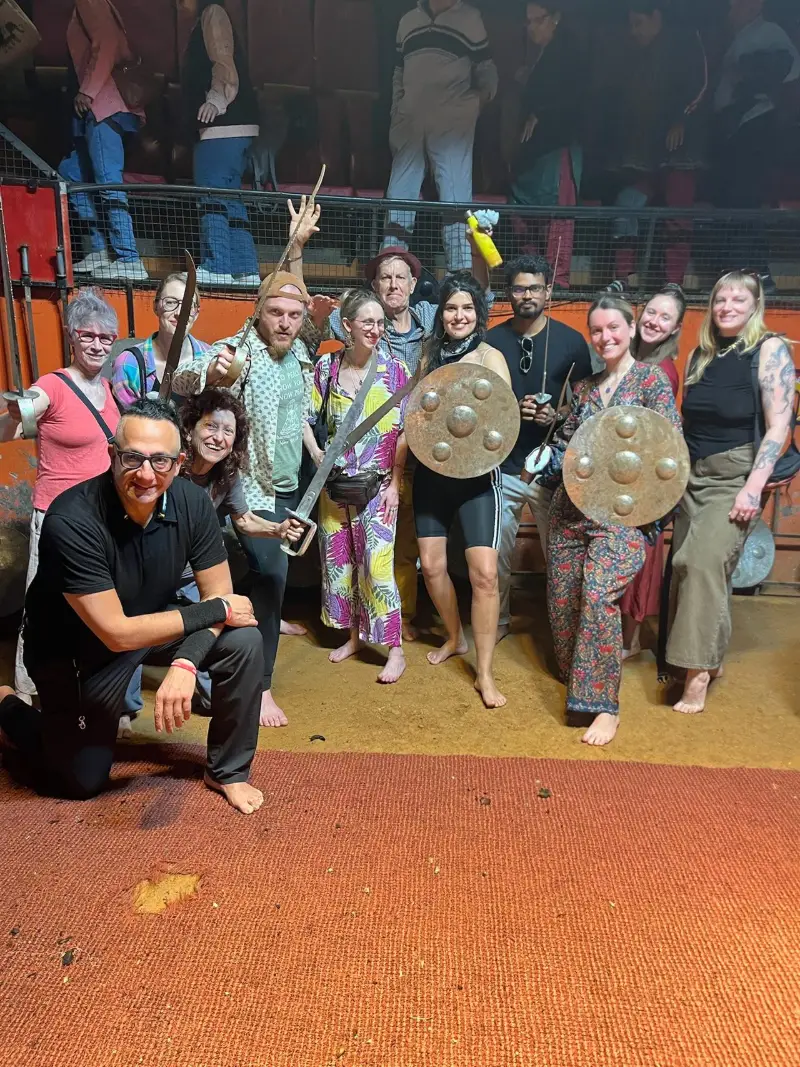
The daily texture differs too. Rishikesh evenings belong to the Ganga aarti, the river ceremony that draws crowds nightly; the town hums with ashrams, sadhus, cafés full of trainees and the constant company of other people doing what you are doing. Kerala is quieter. Fort Kochi is a working neighbourhood with Chinese fishing nets, Portuguese churches, Kathakali theatres and ordinary Indian life going on around a practice, not organised around it.
Rishikesh surrounds you with yoga. Kerala surrounds you with Kerala, and leaves the yoga to the room you practise in.
Neither is better. But if you want to be carried along by an atmosphere, Rishikesh does that. If you want to step out of the room and be somewhere ordinary, Kerala does that.
Cost
The ranges overlap more than the reputations suggest.
| Region | Typical range | What drives it |
|---|---|---|
| Rishikesh | US$600 – $2,500 | The widest spread in India. Many schools competing on volume pushes the bottom end far lower than anywhere else. |
| Kerala | US$900 – $2,200 | Fewer schools, less price-cutting, and fewer very cheap options. The middle and top overlap with Rishikesh entirely. |
So: Rishikesh is cheaper at the bottom, equivalent in the middle. If your budget is under US$800, Rishikesh is realistically where you will find something. Above that, price should not decide the region.
Remember too that tuition is only about half the real cost once flights, visa and insurance are counted. We have written a full breakdown of what a 200-hour training in India actually costs, with three worked budgets and our own fee published alongside everyone else's.
Choice of schools, and the Yoga Alliance question
Rishikesh has by a wide margin the greatest concentration of yoga schools in India, and the greatest number registered with Yoga Alliance. If holding an RYT 200 credential matters for where you intend to teach — and in the US, UK and Australia it often does — Rishikesh simply gives you more to choose from. That is a real, practical advantage and I would not pretend otherwise.
It cuts both ways. A large market means more excellent schools and more bad ones, and the marketing is loud enough that telling them apart takes work. Kerala's smaller market is easier to survey but gives you fewer options, and a higher chance that the school you like is fully booked for the month you are free.
Our own position, stated plainly
Santhi School of Yoga & Vedanta Studies is not a Registered Yoga School. Our graduates receive our own 200-hour certificate and cannot register as RYT 200.
So if the credential is what you need, this comparison points you to Rishikesh, and we would rather say so here than let you find out later. More about how we teach and why.
Does the yoga itself differ?
Less than the branding implies, and more than nothing.
Rishikesh's traditions lean towards Ashtanga, Vinyasa and a strong devotional and philosophical component — chanting, Sanskrit, the Ganges and the ashram lineage are close at hand. Kerala leans towards Hatha, Ayurveda and a slower structure, with philosophy taught in a less devotional register.
But these are tendencies, not rules. There are traditional Hatha schools in Rishikesh and Ashtanga schools in Kerala. The individual school matters far more than the region, which is why the questions to ask are the same in both places: what is the maximum batch size, who teaches the daily sessions, and what is excluded from the fee.
How to actually decide
In order, because the first question usually settles it:
- Do you need an RYT 200 credential? If yes, filter for Registered Yoga Schools first. That decision outranks the region.
- When are you free? If it is June to September, or you dislike cold, Kerala. If it is April or May and you want peak conditions, Rishikesh.
- What is your budget? Under US$800 points to Rishikesh. Above that, ignore price as a regional factor.
- What do you want around the practice? Immersion and company, or quiet and ordinary life. This is the question most people should weigh hardest, and the one they consider last.
- Then compare individual schools, not regions. Batch size, teacher, inclusions.
If Kerala is where you are landing, our guide to practising yoga in Fort Kochi will give you a feel for the daily rhythm here — and you can always come to a single drop-in class before committing to anything longer.
Ask us, even if you choose Rishikesh
If you tell us what you are looking for, we will tell you honestly whether our training fits — and if it does not, what to look for instead.
Common questions
Is Kerala or Rishikesh better for yoga teacher training?
Neither overall. Rishikesh suits structure, devotional immersion, the widest choice of schools and the lowest prices. Kerala suits a gentler rhythm, Ayurveda alongside practice, warm weather year-round and far fewer other trainees.
Is Rishikesh cheaper?
At the bottom of the market, yes — courses start around US$600 there, which Kerala rarely matches. In the middle, roughly US$900–$2,200, the two are equivalent.
Can you drink alcohol or eat meat in Rishikesh?
Not within the municipal area. The sale of meat, fish and eggs has been banned since 1956 and alcohol is prohibited. Kerala has no such restriction, though most yoga schools serve sattvic vegetarian food regardless.
What is the weather like in each?
Rishikesh has real seasons — January around 7–8 °C, spring 15–30 °C, hot before the monsoon. Kerala is warm all year at roughly 24–33 °C, with a humid monsoon from June to September.
Which is easier to reach?
Kerala, usually. Cochin International takes direct international flights and Fort Kochi is about 75 minutes away. Rishikesh has no airport of its own — you fly to Jolly Grant in Dehradun, normally via Delhi, or take an overnight train to Haridwar.
Does Rishikesh have more Yoga Alliance schools?
Yes, considerably. If registering as an RYT 200 matters to you, Rishikesh offers far more options — though registered schools exist in Kerala too.

Known to his students as Achu, Aksharanand has taught Hatha Yoga, Pranayama, Meditation and Vedanta philosophy in Fort Kochi for over fifteen years, leading more than 70 international teacher training batches. He trained in the Sivananda tradition and holds an Advanced Teacher Training Certificate.
More about Achu and the school · See our yoga teacher training in Kerala