
In short
A well-sequenced yoga class follows an arc: arrive and settle, breathe, warm up, build to the most demanding poses, then cool down with forward bends and twists, and end with at least ten minutes of rest. Within that arc, move the spine in every direction, warm a joint before loading it, follow every strong pose with its counterpose, and teach fewer poses well rather than many quickly. Plan timings so the final relaxation is never cut.
- The arc
- Settle → breathe → warm → build → cool → rest
- Final relaxation
- At least 10 minutes in 60–90
- Counterposes
- After every strong backbend, inversion or twist
- Poses per hour
- Roughly 10–15, held well
- Plan around
- One peak pose or theme
- Biggest mistake
- Too many poses, too fast
Sequencing is one of the subjects trainees find hardest in a teacher training, and one of the most useful. If you are still choosing a course, our checklist for choosing a teacher training lists teaching methodology as one of the things to check. This article is the method itself.
What is the structure of a good yoga class?
Every good class, in any style, follows roughly the same arc. The details change. The shape does not.
- Arrive. A few minutes lying or sitting still. People come in from traffic, phones and work. Until they have landed, nothing else lands.
- Breathe. A short pranayama practice brings attention inward and sets the pace for the rest of the class.
- Warm up. Sun salutations, joint movements or simple dynamic poses raise heat and prepare the spine and big joints.
- Build. The demanding work: standing poses, inversions, backbends, balances. This is where the class peaks.
- Cool down. Forward bends, twists, hip openers on the floor. The nervous system starts to come down.
- Rest. A long final relaxation. Not an afterthought, but the part in which the practice is absorbed.
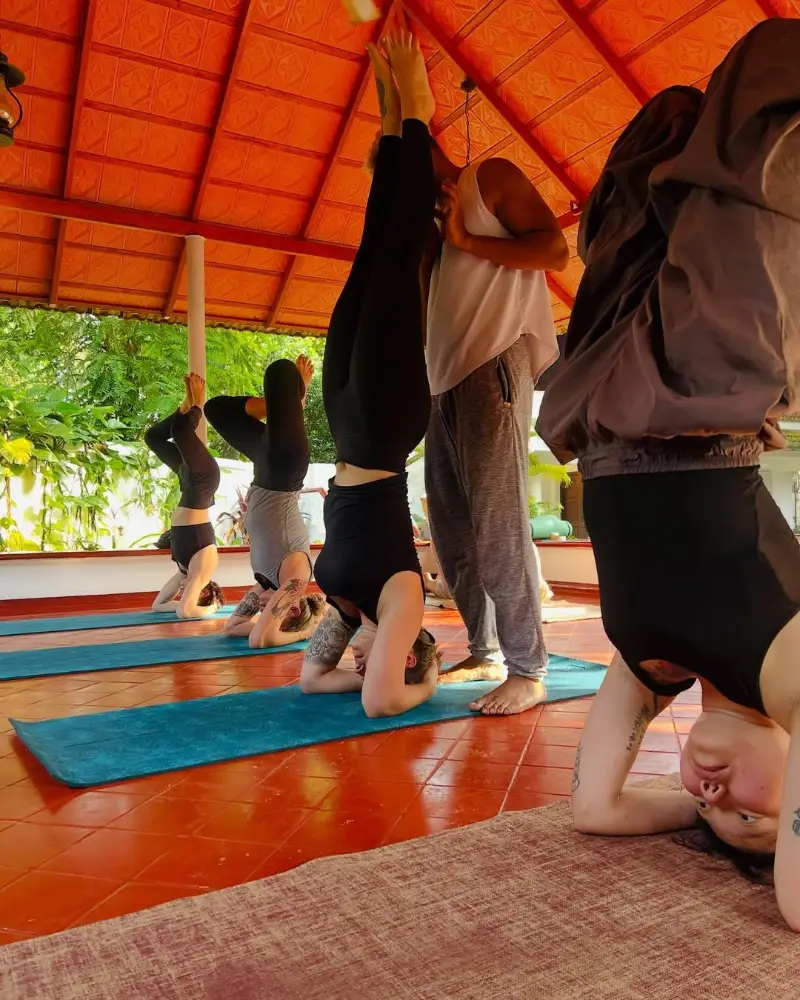
At our school a class follows exactly this order: an opening savasana to settle, pranayama, Surya Namaskar, asanas for all levels, then a deep final savasana. You can read about it from the student’s side in inside a two-hour Hatha class.
What are the rules for putting yoga poses in order?
Eight rules cover almost everything. Break them only when you know why.
- Warm before you load. Never ask a cold body for a deep backbend, a full split or a headstand. Heat and movement first.
- Simple before complex. Teach the parts of a pose before the whole. Low lunge before warrior I, half forward bend before full.
- Move the spine in every direction. Forward, back, sideways and twisting. A class that only folds forward, or only backbends, leaves the body lopsided.
- Counterpose every strong pose. After a deep backbend, a gentle forward fold. After shoulderstand, fish pose. After a strong twist, a neutral rest. The counterpose should be milder than the pose it balances.
- Twists come after backbends, not before. A twist neutralises the spine after backbending. Twisting a spine that is about to backbend hard can strain it.
- Inversions when the body is warm and the mind is still fresh. Not in the first minutes, and not at the very end when people are tired.
- Standing work before floor work. Standing poses build heat and effort; floor poses let it settle. Getting up and down repeatedly breaks the rhythm.
- Balance left and right. Every one-sided pose is done on both sides, normally right first, for the same time.
What is the traditional Sivananda sequence?
The Sivananda tradition, which we teach, has a fixed basic order that has been used for decades. It is a useful model, because each pose is placed for a reason.
| Order | Practice | Why it is here |
|---|---|---|
| 1 | Relaxation, then pranayama | Arrive, then set the breath |
| 2 | Sun salutations and leg raises | Warm the whole body; strengthen the abdomen for inversions |
| 3 | Headstand | The most demanding pose, placed while energy and attention are high |
| 4 | Shoulderstand, then plough | Inversion continues; plough deepens the neck and back stretch |
| 5 | Fish | The counterpose to shoulderstand and plough, opening the throat and chest |
| 6 | Seated forward bend | Stretches the back of the body after the inversions |
| 7 | Cobra, locust, bow | Three backbends in rising intensity, counterposing the forward bend |
| 8 | Half spinal twist | Neutralises the spine after the backbends |
| 9 | Crow | Arm balance and concentration |
| 10 | Standing forward bend, triangle | Standing work to finish, stretching legs and the side body |
| 11 | Final relaxation | Absorb the practice |
Our article on the 12 basic postures of Sivananda yoga explains each pose in detail. Notice that this order puts standing poses near the end, which breaks rule seven above. It works because the tradition gives a long warm-up and treats the end of class as a gentle stretch rather than a peak. Every tradition makes choices like that. Learn one well before you start mixing.
How long should each part of a yoga class be?
| Section | 60 min | 75 min | 90 min |
|---|---|---|---|
| Arrive and settle | 3 | 5 | 5 |
| Pranayama | 5 | 8 | 10 |
| Warm-up and sun salutations | 10 | 12 | 15 |
| Main poses (build) | 22 | 28 | 35 |
| Cool-down on the floor | 8 | 10 | 12 |
| Final relaxation | 10 | 10 | 12 |
| Closing (sitting, a word, Om) | 2 | 2 | 1 |
The relaxation row is the one to protect. When a class runs late, cut a standing pose, never the final rest. Our article on savasana explains why it matters as much as any pose.
How do you sequence towards a peak pose?
Many teachers build a class around one demanding pose, the peak, and work backwards from it. The method is simple:
- Choose the peak. For example, wheel pose, a full backbend.
- List what it needs. Wheel needs open shoulders, open hip flexors, open front of the chest, strong legs and wrists ready to bear weight.
- Find one pose for each need. Downward dog with the hands wide for the shoulders, low lunge for the hip flexors, cobra and bridge for the chest, chair and warrior for the legs.
- Order them from simple to complex, each preparing the next, and place the peak about two-thirds of the way through the class.
- Plan the way down. After wheel: knees to chest, a gentle twist, a seated forward fold. Then rest.
- Plan the easier option for anyone not ready. For wheel, bridge pose is a full alternative, not a consolation prize.
For inversions as peaks, read our guides to headstand and shoulderstand. Both need specific preparation and specific counterposes.
A 60-minute yoga class template
A general, mixed-level class you could teach tomorrow:
| Minutes | Practice |
|---|---|
| 0–3 | Lie down, settle, notice the breath |
| 3–8 | Seated slow breathing, then a few rounds of nadi shodhana |
| 8–18 | Neck, shoulder and hip circles; six rounds of Surya Namaskar, the first two slow |
| 18–30 | Triangle, warrior II, standing forward bend, tree pose |
| 30–38 | Bridge, then shoulderstand or legs up the wall, then fish |
| 38–44 | Cobra and locust; child’s pose to rest |
| 44–48 | Seated forward bend and half spinal twist |
| 48–58 | Final relaxation, guided from feet to head |
| 58–60 | Sit up slowly, a moment of silence, close |
That is about fifteen poses. It will feel like too few when you write it, and exactly right when you teach it.
How do you adapt a sequence to the students in front of you?
Your plan is a starting point. Within the first ten minutes you will know whether it fits the room.
- Mostly beginners: fewer poses, longer explanations, more rests between poses. Drop the inversion or offer legs up the wall.
- Older students: more warm-up, more time on balance, fewer transitions between standing and floor. Our guide to starting yoga over 50 covers what changes.
- Early morning: bodies are stiff. Lengthen the warm-up.
- Evening: people are tired and wound up. Calmer poses, longer holds, a longer relaxation.
- Hot days: in Kerala in April this is most days. Fewer sun salutations, more floor work, water breaks.
- Someone injured: give them a parallel version of the class rather than a list of things to skip.
What sequencing mistakes do new teachers make?
- Too many poses. Thirty poses in an hour is a workout video, not a class. Fewer, held longer, taught better.
- No counterposes. A deep backbend followed straight by relaxation leaves lower backs complaining.
- Getting up and down constantly. Standing, floor, standing, floor. It tires people and breaks concentration.
- The peak too late. Placing the hardest pose in the last ten minutes, when people are tired and there is no time to come down.
- Unequal sides. Teaching the right side carefully and rushing the left.
- Squeezing the relaxation. Three minutes of savasana while packing up mats.
- Teaching your own practice. The sequence you love doing may be wrong for a room of beginners.
How do you get better at sequencing?
- Write every class down before you teach it, with timings. Afterwards, note what ran over and what fell flat.
- Practise your sequence yourself at the speed you will teach it. You will find the awkward transitions immediately.
- Teach one sequence many times. Repetition shows you what a sequence actually does better than variety does.
- Take classes from good teachers and write down their sequences afterwards. Ask yourself why each pose was where it was.
- Learn the anatomy that explains the rules: which muscles a pose lengthens, which it loads, and what it asks of the spine.
In a 28-day course like ours, evenings are given to teaching practice in small groups, which is where most of this is learned. Our article on what actually happens in a 28-day training describes how the teaching practice is built up.
Learn to teach in Fort Kochi
A 28-day, 200-hour training in the Sivananda tradition with daily teaching practice, Vedanta philosophy and anatomy, at €899 all-inclusive. 2027 batches in January, February, April and June.
Common questions
What is the correct order of a yoga class?
Most classes follow the same arc: settle, breathe, warm up, build to the most demanding poses, cool down with forward bends and twists, and finish with a long relaxation. The traditional Sivananda order is relaxation, pranayama, sun salutations, inversions, forward and back bends, a twist, a balance, standing poses and final relaxation.
How many poses should be in a 60-minute yoga class?
Roughly ten to fifteen, held long enough to be taught properly. Thirty poses in an hour leaves no time for alignment, breathing or rest.
Should twists come before or after backbends?
After. A gentle twist helps neutralise the spine after backbending. Twisting hard immediately before a deep backbend can strain the lower back.
How long should savasana be at the end of class?
At least ten minutes in a class of an hour or more, and ideally around a sixth of the class. When a class runs late, shorten a standing sequence instead of the relaxation.
What is a counterpose in yoga?
A milder pose that moves the body in roughly the opposite direction after a strong one, to rebalance it. Fish after shoulderstand, a gentle forward fold after a backbend, and child’s pose after cobra are common examples.
What is peak pose sequencing?
Building a class around one demanding pose. You list what the pose needs, choose a preparatory pose for each need, order them from simple to complex, place the peak about two-thirds through, and plan a gradual way down afterwards.

Known to his students as Achu, Aksharanand trained in the Sivananda tradition and holds an Advanced Teacher Training Certificate. He has taught Hatha Yoga, pranayama, meditation and Vedanta philosophy in Fort Kochi for over fifteen years, across more than 5,000 group classes and seventy international teacher training batches.
More about Achu and the school · Book a class or ask a question