
In short
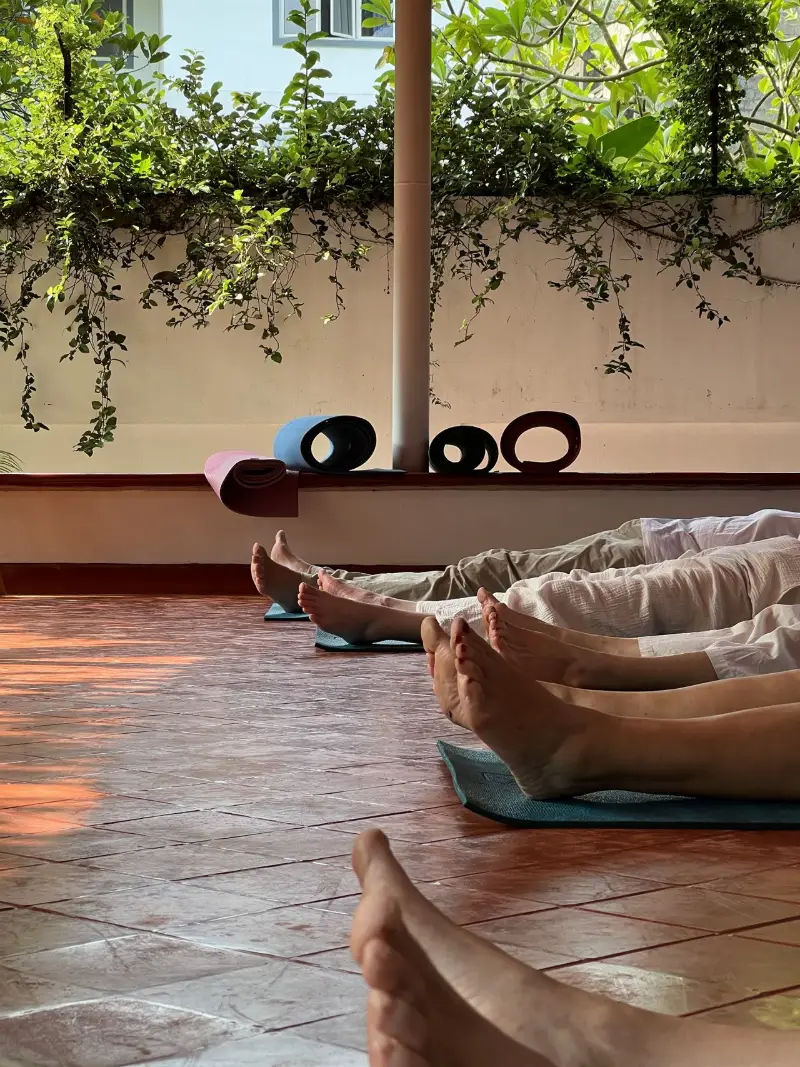
Savasana is the guided relaxation at the end of a Hatha class, usually around fifteen to twenty minutes. It is difficult because deep rest is a skill most modern lives never teach: the body is rarely quite comfortable, the mind treats stillness as a gap to fill, and we confuse relaxing with collapsing. Set the body up properly, move attention slowly through it, and practise it like any other posture.
It is the posture everyone thinks they can already do. Lie down. Close your eyes. Stay there.
And yet savasana — the “corpse pose” at the end of a Hatha class — is the one students most often find difficult. The legs twitch. The mind starts writing a shopping list. Someone checks the time. Deep, deliberate rest turns out to be a skill that most modern lives never teach.
In a traditional class it gets around twenty minutes. Here is why, and how to practise it.
Why rest is part of the practice
Hatha yoga has always included relaxation as one of its core elements, not as a reward for finishing the hard part. The reasoning is simple: postures and breathing create change — in the muscles, the nervous system, the attention — and relaxation is where the body absorbs that change.
There is a more ordinary reason too. Most of us carry a background level of tension we have stopped noticing: a tight jaw, raised shoulders, a belly held in. Savasana is the one time in the day when you are asked to find that tension and put it down. Do it often enough and you start being able to do it standing in a queue.
Why it is harder than it looks
Three things tend to get in the way:
- The body is not quite comfortable. A cold floor, an arching lower back, a neck at an odd angle. Small discomforts keep the nervous system alert.
- The mind treats stillness as a gap to fill. Without a posture to manage, attention grabs the nearest thought.
- We confuse relaxing with collapsing. Sleep is not the goal. The practice is to be deeply relaxed and awake.
Set up properly
Take a minute to arrange yourself — it is time well spent.
- Lie on your back with your feet a little wider than your hips, toes falling outwards.
- Let the arms rest a little away from the body, palms facing up.
- If your lower back aches, place a rolled blanket under your knees.
- If your chin tips up towards the ceiling, put a thin folded towel under your head.
- Cover yourself if the room is cool. Body temperature drops as you relax.
A simple guided relaxation
This is the kind of relaxation used at the end of a class. Read it through once, then try it — or record yourself reading it slowly.
Tense and release. Lift the right leg a few centimetres, tighten every muscle in it, hold, then let it drop. Repeat with the left leg, then each arm, then lift the hips and let them fall, squeeze the shoulders up towards the ears and let them go, then scrunch the whole face and release it. The contrast teaches the body what “relaxed” feels like.
Move through the body. Now, without moving, take your attention slowly from the feet upwards: toes, soles, ankles, calves, knees, thighs, hips, belly, chest, back, hands, arms, shoulders, neck, jaw, tongue, eyes, forehead, scalp. At each place, silently suggest: relax. Notice what changes and what does not. Do not force anything.
Let the breath go. Stop managing the breath. Let it become small and soft, the belly rising and falling by itself.
Rest in the quiet. Stay here for several minutes. When thoughts arrive, notice them and return to the feeling of the body lying heavy on the floor.
Come back slowly. Deepen the breath, move the fingers and toes, stretch, roll onto your right side and pause there before sitting up. Getting up too quickly undoes a surprising amount of the benefit.
If you would like the same thing guided for longer and with a clearer structure, that practice has its own name: yoga nidra.
How it changes a practice
Students who learn to rest well usually notice the effect elsewhere first — sleeping better, being less jumpy, reacting a beat more slowly. In the postures, they start using less effort for the same shape, because they can finally feel which muscles are working unnecessarily.
That is why the relaxation in a traditional Hatha class is never skipped, even when the class runs late. You can read how it fits into the whole session in inside a two-hour Hatha class, or experience it properly at one of our daily classes in Fort Kochi.
Common questions
How long should savasana last?
In a traditional Hatha class the final relaxation lasts around fifteen to twenty minutes. At home, ten minutes is a good minimum; less than five rarely gives the body time to let go.
Is it all right to fall asleep in savasana?
It happens, especially after travel, and it is nothing to feel bad about. But the practice is to stay awake while the body sleeps — relaxed, yet aware.
What is the difference between savasana and yoga nidra?
Savasana is the posture and the relaxation done at the end of a class. Yoga nidra is a longer, more structured guided practice done in the same posture, with a set sequence of stages. Savasana is where most people begin.
Why do my legs twitch in savasana?
Usually because the nervous system is still winding down from effort, or because the body is not quite comfortable. Tensing and releasing each limb once before settling, and supporting the knees with a rolled blanket, both help.

Known to his students as Achu, Aksharanand trained in the Sivananda tradition and holds an Advanced Teacher Training Certificate. He has taught Hatha Yoga, pranayama, meditation and Vedanta philosophy in Fort Kochi for over fifteen years, across more than 5,000 group classes and seventy international teacher training batches.
More about Achu and the school · Book a class or ask a question