
In short
A traditional two-hour Hatha class begins with settling and pranayama, moves through sun salutations into an hour of classical postures held with steady breath and rest between them, and ends with around twenty minutes of guided relaxation and a short meditation. Almost a third of the class is spent breathing, resting or sitting, which is why beginners manage it comfortably.
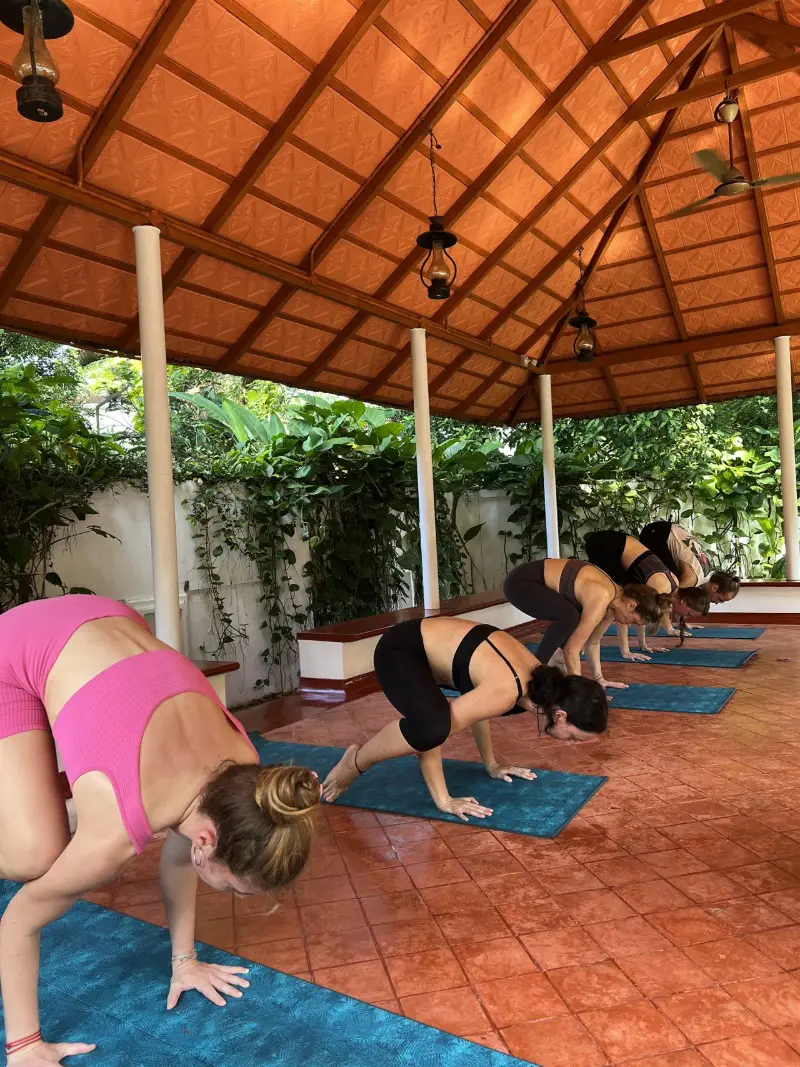
Most people who walk into the shala in Chirattapalam for the first time ask the same question before they have found a mat: two hours? By the end they usually ask a different one: where did it go?
A traditional Hatha class is long because it is not only a sequence of postures. It is a complete practice — breath, movement, rest and stillness — and each part needs room. Here is what actually happens inside those two hours, and why the order matters.
The first ten minutes: arriving
Shoes come off outside. Mats are already here. For the first few minutes nobody moves much. Some mornings there is a short chant; some mornings there is just silence and the sound of the lane waking up.
This is not a warm-up for the body. It is a warm-up for attention. A mind that is still halfway through the walk from the guesthouse cannot notice what a hamstring is doing.
Ten minutes to half an hour: pranayama
Breathing comes before posture, not after it. Most classes begin with kapalabhati — short, active exhalations that wake the belly and clear the head — followed by anuloma viloma, alternate-nostril breathing, slow and even.
There are two reasons for putting pranayama first. The practical one: a steady, conscious breath makes every posture afterwards safer and more honest, because you can hear your own strain. The traditional one: in Hatha yoga the breath is the bridge between body and mind, and the whole practice is built on it.
If you have only ever breathed “naturally” in yoga, this part can feel strange. Stay with it. It is the part students most often keep doing at home, and there is more on it in pranayama for beginners.
Half an hour in: sun salutations and warm-ups
Then movement. Surya namaskar — the sun salutation — is repeated at a pace you can breathe through, never faster. After that come the small joint-freeing movements for neck, shoulders, hips and ankles that bodies stiff from long flights are grateful for.
This section is where the room gets warm, and where the teacher is watching most closely: how you step forward, where your weight falls, whether your shoulders are creeping up to your ears. The twelve positions are broken down in Surya Namaskar step by step.
The long middle: the classical postures
The heart of the class is a sequence of classical asanas — inversions or their preparations, backbends, forward bends, twists and standing postures — built up over roughly an hour.
Two things make this different from a flowing, fitness-led class:
- Postures are held. Not for bravado, but long enough to settle into, breathe in and learn from. Holding is where strength quietly builds and where you start noticing habits.
- There is rest between them. A few breaths lying down between postures lets the heart rate settle and lets the effect of each posture land before the next.
Every posture is offered in more than one shape. If headstand is not for you today, there is a preparation that gives you most of the benefit and none of the risk. Nobody is waiting for you to “get there”.
Twenty minutes: deep relaxation
Then comes the part people remember. Savasana, guided slowly through the body — feet, legs, belly, hands, face — until there is nothing left to hold.
It is tempting to treat this as the end of class, the moment to check your phone. In a traditional class it is one of the main events. There is a whole piece on why rest is a skill, but the short version is this: most people have never actually let go on purpose, and twenty minutes of practising it changes how the rest of the day feels.
The last few minutes: stillness and one idea
The class closes sitting up. A short meditation, sometimes a chant, and often one idea from yoga philosophy to take out into the afternoon — something about attention, or effort, or the difference between comfort and ease. If the chant is Om shanti shanti shanti, there is a reason peace is asked for three times.
Then you roll up your mat, step back into the lane, and notice that Fort Kochi is quieter than it was two hours ago. It is not. You are.
If you are coming for the first time
- Arrive ten minutes early and tell the teacher about any injuries.
- Eat lightly, and not in the two hours before class.
- Wear cotton you can bend in. Bring water.
- Expect to be corrected, kindly and more than once. That is the point.
Classes run twice a day, every day — see the times and prices, or if you would rather learn the basics one-to-one first, a private session is the gentlest way in.
The sharp belly breathing at the start of class has its own guide, including who should leave it out: kapalabhati breathing.
Common questions
Why is a traditional Hatha class two hours long?
Because it holds more than postures. Breathing practice, a full sequence of asanas held with steady breath, a long guided relaxation and a short meditation each need their own time; squeezing them into sixty minutes usually means dropping the breath and the rest.
Can a beginner manage two hours?
Yes. The pace is steady rather than fast, postures are offered in easier versions, and almost a third of the class is spent breathing, resting or sitting.
Do I need to book a place?
No. Classes in Fort Kochi are walk-in: come to the pavilion in Chirattapalam for the 7:30 am or 3:30 pm class and pay for the class you attend. Message us the evening before a morning class, because it sometimes moves to Secret Garden nearby.
What should I eat before class?
Very little. Practise on an empty or nearly empty stomach, leaving two to three hours after a proper meal. Morning classes are easiest before breakfast.

Known to his students as Achu, Aksharanand trained in the Sivananda tradition and holds an Advanced Teacher Training Certificate. He has taught Hatha Yoga, pranayama, meditation and Vedanta philosophy in Fort Kochi for over fifteen years, across more than 5,000 group classes and seventy international teacher training batches.
More about Achu and the school · Book a class or ask a question