
In short
A good 20-minute beginner routine follows the order of a traditional class: 2 minutes of relaxation, 3 minutes of breathing, about 4 minutes of sun salutations, 8 minutes of simple postures, and 3 minutes of deep relaxation. Practise on an empty stomach, move slowly, breathe through the nose, bend your knees whenever you need to, and skip anything that causes sharp pain.
Many students ask what they can do at home between classes, or after they leave Kerala. The answer is not a random set of stretches from a video, but a short version of the same structure they learnt in class. The order matters: settle first, breathe, warm up, move, then rest.
If you have never practised with a teacher, read our beginner’s guide to a first class first; its advice on pain and pacing applies at home too.
- Total time
- 20 minutes
- Order
- Relax, breathe, warm, move, relax
- When
- Same time daily, empty stomach
- You need
- A mat and a quiet space
- Rule
- Effort yes, sharp pain no
- Aim for
- Five days a week
Before you start
- Empty stomach: about three hours after a full meal, two after something light.
- Space: the length of a mat, plus room to stretch your arms out.
- Clothes you can bend and lie down in.
- Phone on silent, face down, or in another room.
- If you have a health condition, injury or are pregnant, check with a doctor first.
The routine at a glance
| Part | Practice | Minutes |
|---|---|---|
| 1 | Opening relaxation | 2 |
| 2 | Breathing practice | 3 |
| 3 | Sun salutations, two rounds | 4 |
| 4 | Six simple postures | 8 |
| 5 | Deep relaxation | 3 |
1. Opening relaxation — 2 minutes
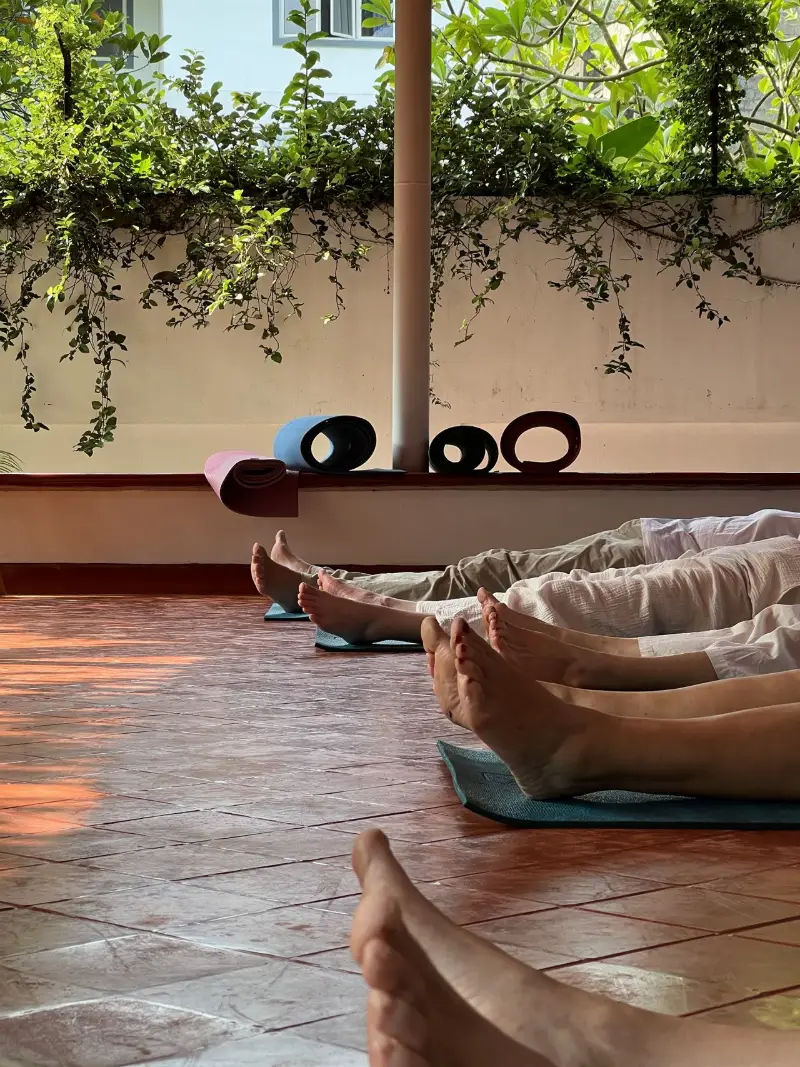
Lie on your back, legs slightly apart, arms a little away from the body, palms up. Close your eyes. Let the floor take your weight and let the breath slow down on its own. This is savasana, and it is how our classes begin: it gives the mind a moment to arrive.
2. Breathing practice — 3 minutes
Sit upright. Take eight slow full breaths — belly, ribs, then chest — and breathe out in reverse. Then do five rounds of alternate nostril breathing. Both are explained step by step in pranayama for beginners.
3. Sun salutations — 4 minutes
Do two rounds of Surya Namaskar, each round leading once with the right leg and once with the left. Move with the breath and slowly enough to breathe through your nose. Bend the knees in the forward bends. The full sequence is in Surya Namaskar step by step.
4. Six simple postures — 8 minutes
Triangle — about 1½ minutes
Stand with feet wide. Turn the right foot out, and reach the right hand down to the shin or a block, left arm up. Hold for five breaths, then change sides. Keep both legs active but not locked.
Standing forward bend — 1 minute
Feet hip-width apart, fold forward from the hips with knees bent as much as you like. Let the head and arms hang. Roll up slowly.
Cobra — 1 minute
Lying on your front, hands under the shoulders, lift the chest a little using the back muscles rather than pushing hard with the arms. Hold for three to five breaths, lower, and repeat once.
Child’s pose — 1 minute
Kneel and fold forward, forehead to the floor or a cushion, arms resting by your sides. Breathe into the back of the ribs.
Bridge — 1½ minutes
Lie on your back, knees bent, feet flat. Press through the feet and lift the hips a comfortable height. Hold for five breaths, lower slowly, and repeat once or twice.
Gentle supine twist — 2 minutes
Lying on your back, bring the knees towards the chest and let them lower gently to one side, arms out, for five to eight breaths. Change sides. Keep it comfortable, not deep.
5. Deep relaxation — 3 minutes
Return to savasana. Cover yourself with a light layer if you cool down quickly. Stay completely still. Do not skip this part: it is where the practice settles in, and it is often what people miss most when they stop.
Making it a habit
- Same time, same place. Early morning before the phone is easiest for most people.
- Five days a week is a realistic target; daily is fine if you feel good.
- Keep the order even on short days: a five-minute version is still relax, breathe, move, relax.
- After two weeks, add a third round of sun salutations or hold postures a breath longer.
Common mistakes at home
- Skipping the opening and closing relaxation because “nothing is happening”.
- Holding the breath in effortful postures.
- Locking the knees in forward bends and triangle.
- Copying the depth of a flexible person in a video.
- Practising straight after a meal.
When to get a teacher’s eye
A home routine goes further with occasional correction. If you are in Fort Kochi, a morning or afternoon class will show you the full version of this sequence. If you are elsewhere, online classes or a private session can check your alignment and build a routine around your body.
Practise with us in Fort Kochi
Traditional two-hour Hatha Yoga classes, mornings 7:30–9:30 am and afternoons 3:30–5:30 pm. All levels, no booking needed. Message us for the day’s schedule.
Wondering how many times a week to do this? How often should you do yoga has a realistic answer. Starting later in life? Starting yoga over 50 covers how to adapt it.
Common questions
Can a beginner learn yoga at home?
Yes, with a simple routine done slowly and consistently. It helps to have a teacher check your postures occasionally, in person or online, so mistakes do not become habits.
How long should a beginner do yoga at home?
Twenty minutes is plenty to start, five days a week. Consistency matters more than length, and even five minutes in the right order is worthwhile on busy days.
What order should a home yoga routine follow?
Follow the traditional order: opening relaxation, breathing practice, sun salutations, postures, and a deep final relaxation.
Is 20 minutes of yoga a day enough?
For a beginner, yes. Twenty minutes practised regularly builds flexibility, strength and calm over weeks, and is easier to sustain than long, occasional sessions.
What if I cannot touch my toes?
Bend your knees in forward bends and reach only as far as is comfortable. Flexibility is an outcome of practice, not a requirement for it.
Should I do yoga every day?
Gentle daily practice is fine for most people. If you feel sore or tired, keep the breathing and relaxation and make the postures lighter.

Known to his students as Achu, Aksharanand trained in the Sivananda tradition and holds an Advanced Teacher Training Certificate. He has taught Hatha Yoga, pranayama, meditation and Vedanta philosophy in Fort Kochi for over fifteen years, across more than 5,000 group classes.