
In short
Tight hamstrings respond to regular, moderate stretching held for 30 to 60 seconds, several times a week, with the knees slightly bent and the movement coming from the hips rather than the lower back. Six poses do most of the work: standing forward bend, low lunge, half splits, seated forward bend, reclining hand-to-big-toe with a strap, and downward dog. Expect small changes over weeks. Sharp pain or tenderness at the sitting bone means stop rather than stretch harder.
"My hamstrings are tight" is the single most common thing a new student says. Sometimes it is true in the obvious way. Often the muscle is not short at all; the nervous system is simply protective, or the pull is coming from somewhere else entirely.
This is a practical guide to what helps. It is not medical advice: if you have pain rather than tension, see a physiotherapist or doctor first.
Why they feel tight
The hamstrings run from the sitting bones down the back of the thigh to below the knee, crossing two joints. Four things commonly produce the feeling of tightness:
- Sitting. Hours in a chair keep the muscle in a shortened position and the hip flexors at the front tight too.
- Protective tension. The nervous system limits range it does not trust. This is why you are looser at the end of a class than at the start, without the tissue having changed.
- Pelvic position. If the pelvis cannot tip forward, every forward bend becomes a round of the lower back instead, and the hamstrings never lengthen.
- Nerve sensitivity. Sciatic nerve tension can feel exactly like a tight hamstring, and gets worse if you stretch into it.
That mix is why forcing rarely works and patience usually does. How long flexibility takes covers the timescales.
The three rules
- Bend the knees. A micro-bend lets the pelvis tip forward so the stretch reaches the hamstring rather than the lower back. Straight legs at any cost is the single most common error.
- Move from the hip. Think of the movement as tipping the top of the pelvis forwards, chest leading, spine long. When the back starts to round, you have gone past the useful range.
- Stay moderate. A stretch you would rate four or five out of ten, where you can still breathe normally. Pain does not accelerate anything.
Six poses that work
| Pose | How | Hold |
|---|---|---|
| Standing forward bend Uttanasana | Feet hip width, knees generously bent, belly on thighs. Slowly straighten the legs only as far as the contact stays. | 60 seconds |
| Low lunge Anjaneyasana | Back knee down, hips sinking forward. Stretches the hip flexors, which lets the pelvis move in the poses that follow. | 45 seconds each side |
| Half splits Ardha hanumanasana | From low lunge, hips back over the back knee, front leg straightening, front foot flexed. Chest forward, back long. | 45 seconds each side |
| Reclining hand-to-big-toe Supta padangusthasana | On your back, strap around the foot, other leg bent or straight. The safest of all, because the floor supports the back. | 60 seconds each side |
| Seated forward bend Paschimottanasana | Sit on a folded blanket, knees bent, hinge from the hips. Height under the sitting bones changes everything. | 60 seconds |
| Downward dog Adho mukha svanasana | Knees bent, sitting bones lifting, then slowly pedal the heels. A stretch and a warm-up at once. | 45 seconds |
Warm up first — a few rounds of Surya Namaskar, or this sequence after a walk. Cold hamstrings do not respond well.
How long, how often
- 30 to 60 seconds per hold, two or three rounds per pose.
- Four to six days a week, ten to fifteen minutes. Frequency beats duration here.
- Breathe normally. Holding the breath is a reliable sign you are past the useful range.
- Add strength. Hamstrings that are strong through their range — bridges, single-leg deadlifts, the locust posture — hold length far better than stretched ones alone. This is the part that flexibility routines usually leave out.
The mistakes that keep you stuck
- Straight legs and a rounded back. Feels virtuous; stretches the lumbar ligaments instead.
- Bouncing. Triggers the reflex that tightens the muscle you are trying to lengthen.
- Going to your maximum every time. The nervous system guards harder, not less.
- Pulling with the arms in seated poses instead of hinging at the hips.
- Stretching cold, first thing, straight out of bed.
- Comparing. Bone shape at the hip decides a good deal of range, and no amount of practice changes it. Depth is not the goal; the sensation is.
When stretching is the wrong answer
Two situations where more stretching makes things worse:
Proximal hamstring tendinopathy. A deep, localised ache right at the sitting bone, worse when you sit on a hard chair or stretch, common in people who stretch aggressively and in runners. Stretching aggravates it; it needs loading and rest, and a physiotherapist.
Nerve tension. Burning, tingling, or a sharp line down the back of the leg, sometimes past the knee, rather than a broad muscular pull. This needs gentle nerve gliding and assessment, not a deeper forward bend. Yoga for back pain is relevant reading.
In both cases: stop the stretch, and get it looked at. Yoga is patient enough to wait a fortnight.
What to expect, and when
Some change within one session, from the nervous system settling rather than any tissue lengthening — which is why you are looser at the end of a class. Real, kept range takes six to eight weeks of consistent work, and longer if you sit at a desk all day. Progress is not linear and it will feel slower than it is.
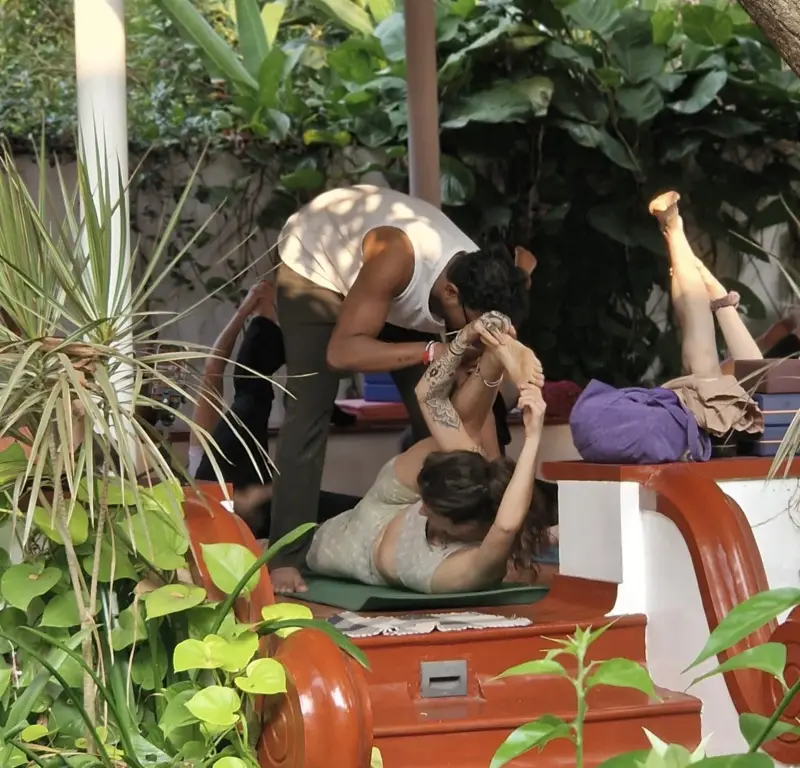
If you would rather have someone watch you do it than guess from a screen, our daily classes include long holds with hands-on guidance, and a private session will tell you in half an hour whether what you have is a muscle, a nerve or a pelvis that will not tip.
The joint above is the one most people ask about next: yoga for tight hips.
Common questions
How do you fix tight hamstrings with yoga?
Stretch moderately and often: 30 to 60 seconds a hold, two or three rounds, four to six days a week, with the knees slightly bent and the movement coming from the hips. Add strength work as well, because strong hamstrings hold their length better.
Should you bend your knees in a forward bend?
Yes, if straight legs make your back round. A bent knee lets the pelvis tip forward so the stretch reaches the hamstring rather than the lower back, which is where most people feel forward bends.
How long does it take to loosen tight hamstrings?
You will feel looser within one session, but that is the nervous system relaxing. Lasting change takes six to eight weeks of consistent practice, and longer if you spend the day sitting.
When should you stop stretching your hamstrings?
If you feel a sharp, localised ache at the sitting bone, or burning and tingling down the back of the leg, stop. Those suggest tendon irritation or nerve tension, and both get worse with more stretching. See a physiotherapist.

Known to his students as Achu, Aksharanand trained in the Sivananda tradition and holds an Advanced Teacher Training Certificate. He has taught Hatha Yoga, pranayama, meditation and Vedanta philosophy in Fort Kochi for over fifteen years, across more than 5,000 group classes and seventy international teacher training batches.
More about Achu and the school · Book a class or ask a question