
In short
Yoga suits men well, especially stiff, strong or stressed ones. It improves mobility in the hips, hamstrings and upper back, builds strength through a range that gym training often misses, and calms the nervous system. In the US women are more than twice as likely to practise as men, but flexibility is not required to start. Begin with a slower, traditional class or a short home routine two or three times a week, and expect to feel the difference within a month.
- US adults practising (2017)
- Women 19.8%, men 8.6%
- Flexibility needed to start
- None
- Biggest gains for men
- Hips, hamstrings, upper back, stress
- Best first class
- Slow, traditional Hatha
- How often
- 2–3 times a week to start
- First results
- Usually within a month
This guide belongs alongside our general beginner’s guide to your first yoga class. It is for the man who has been told yoga would help his back, his golf, his sleep or his temper, and has not yet walked into a room to find out.
Why do so few men do yoga?
The numbers are lopsided. In the US National Health Interview Survey for 2017, 19.8% of women had practised yoga in the past year, against 8.6% of men. The 2016 Yoga in America study found that 72% of practitioners were women.
That is a modern pattern, not a traditional one. In India, yoga was for centuries taught and practised mostly by men, and nearly all the twentieth-century teachers who shaped modern practice — Krishnamacharya, Sivananda, Iyengar, Pattabhi Jois — were men. Yoga’s reputation as something for flexible women is recent, and largely Western.
The reasons men give for staying away are fairly consistent: “I’m not flexible”, “it’s not a real workout”, “I’ll be the only man there”, and “I don’t want to chant”. None of them survives a first class.
What does yoga do for men?
- Mobility where men are stiffest. Hips, hamstrings, calves and the upper back tend to tighten with desk work, driving, running and lifting. These are exactly the areas a traditional class works on. Our guides to tight hamstrings and tight hips go into detail.
- Strength through range. Holding a warrior pose or a plank builds strength at long muscle lengths and in positions the gym rarely trains. It is also hard work. Most men are surprised by how much they shake.
- Back care. Yoga is one of the non-drug treatments recommended for chronic low back pain. See our guide to yoga for back pain.
- Stress and sleep. Slow breathing and long relaxation are the parts men are most sceptical of and most often say they value. Our review of what the research shows grades these benefits honestly.
- Balance and body awareness, which matter more every decade after forty.
Five myths that keep men away from yoga
| Myth | Reality |
|---|---|
| “I need to be flexible first.” | That is like needing to be fit before going to the gym. Stiffness is the reason to start. See how long flexibility really takes. |
| “It isn’t a real workout.” | Hold a chair pose for a minute and decide. A two-hour traditional class is demanding, in a different way from lifting. |
| “I’ll be the only man.” | Sometimes you will. Nobody minds, and nobody is watching you — they are busy with their own balance. |
| “It’s religious, and I don’t want to chant.” | Chanting is always optional. See is yoga a religion? |
| “I’ll get hurt.” | Injury rates in yoga are low. The main risk for men is ego: forcing a pose to keep up. Go at your own pace. |
What are the best yoga poses for men starting out?
These eight target the places men are usually stiffest. Hold each for five to eight slow breaths, and never force.
- Downward-facing dog (adho mukha svanasana): calves, hamstrings and shoulders. Bend the knees as much as you like.
- Low lunge (anjaneyasana): hip flexors, which sitting shortens.
- Standing forward bend (uttanasana), knees bent: hamstrings and lower back.
- Warrior II (virabhadrasana II): leg strength and hip opening.
- Reclining figure-four: outer hips and glutes, gently, on your back.
- Cobra (bhujangasana): upper back extension, the opposite of hunching.
- Seated twist (ardha matsyendrasana): spinal rotation.
- Savasana: five full minutes lying still. The hardest pose for most men. See savasana is a skill.
A blanket under the hips for seated poses and a strap for the hamstrings help enormously. Our guide to yoga props shows how to use them.
Should men do yoga alongside the gym or sport?
Yes, and it is one of the best combinations there is. Lifting and most sports build strength in a limited range; yoga restores the range and adds control at its ends.
- Lifters: yoga helps squat depth, overhead shoulder position and thoracic mobility. Practise on rest days, or after a session rather than before heavy lifts.
- Runners and cyclists: hips, hamstrings and the upper back. Our guide to yoga for runners has a post-run sequence.
- Golf, tennis and racket sports: rotation through the spine and hips.
Two sessions a week alongside training is enough to make a noticeable difference.
How do you get through your first yoga class?
- Choose a slow class. Traditional Hatha, with longer holds and clear instruction, is easier to learn from than a fast flow or a hot class. Our guide to types of yoga classes explains the differences.
- Tell the teacher it is your first class, and about any injuries.
- Wear shorts or tracksuit bottoms you can move in and a T-shirt that does not ride up when you bend forward.
- Leave the competitive instinct outside. The man who forces the forward bend to match the person next to him is the man who pulls a hamstring.
- Bend your knees. In almost every forward-bending pose, bent knees are not cheating. They are correct for stiff hamstrings.
- Stay for savasana. Do not slip out early. It is part of the class.
What does a simple weekly yoga plan for men look like?
| Week | What to do |
|---|---|
| 1 | One class, plus our 20-minute home routine once |
| 2 | One class, home routine twice |
| 3 | Two classes, home routine once |
| 4 | Two classes, home routine twice, and five minutes of slow breathing on the other days |
Most men notice better sleep and less stiffness within the first few weeks. Our guide to how often to practise explains how to build from there.
Try a class in Fort Kochi
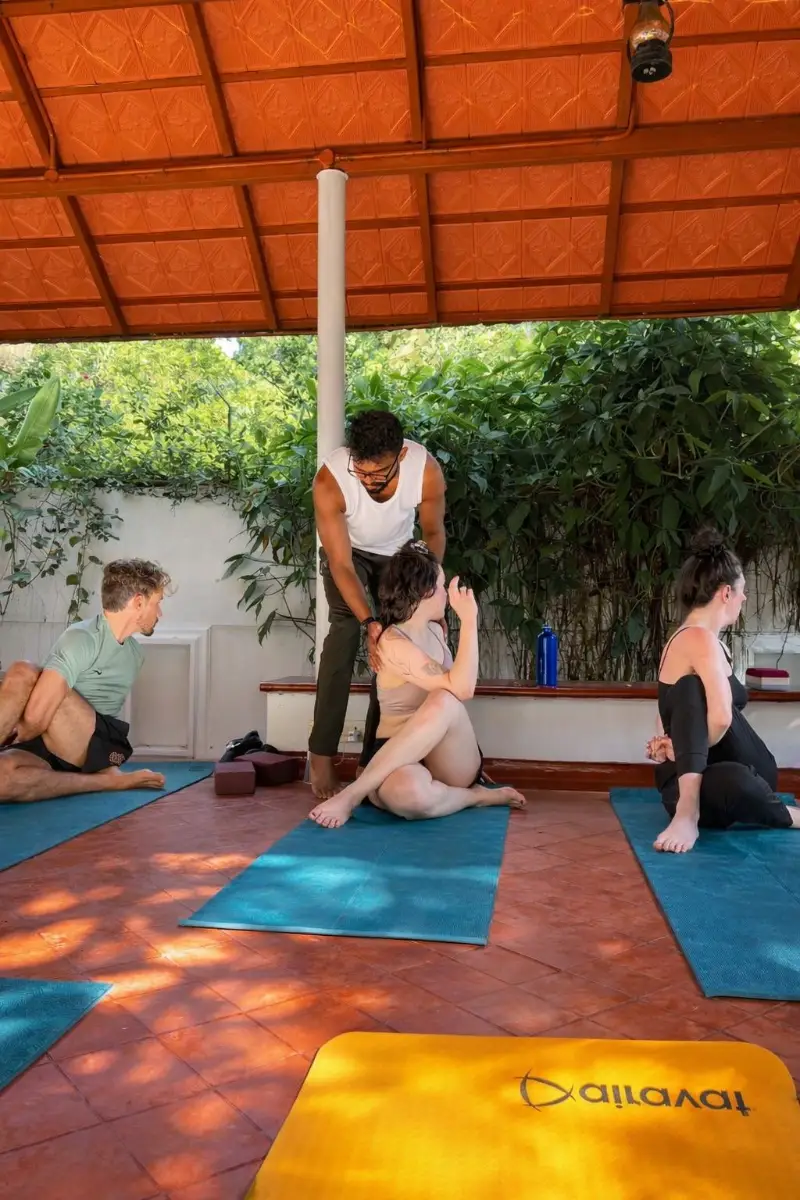
Traditional two-hour Hatha classes for all levels, every day at 7:30 am and 3:30 pm. Stiff beginners very welcome. No booking needed, mats provided.
Common questions
Is yoga good for men?
Yes. Yoga improves mobility in the hips, hamstrings and upper back where men are often stiffest, builds strength through a full range of movement, helps chronic back pain, and reduces stress. Flexibility is not needed to start.
Why do fewer men do yoga than women?
Mostly because of a modern image of yoga as something for flexible women. In the US in 2017, 19.8% of women had practised yoga in the past year against 8.6% of men. Historically, yoga in India was taught and practised mostly by men.
What type of yoga is best for men who are beginners?
A slower, traditional Hatha class with longer holds and clear instruction. It is easier to learn from than fast flowing or hot classes, and it gives stiff bodies time to open.
Can yoga replace the gym for men?
It can build real strength and mobility, but it does not load muscles as heavily as lifting. Most men get the best results by combining the two, with yoga two or three times a week.
What should a man wear to yoga?
Shorts or tracksuit bottoms you can move freely in, and a fitted T-shirt that does not fall over your face in forward bends. Practise barefoot.

Known to his students as Achu, Aksharanand trained in the Sivananda tradition and holds an Advanced Teacher Training Certificate. He has taught Hatha Yoga, pranayama, meditation and Vedanta philosophy in Fort Kochi for over fifteen years, across more than 5,000 group classes and seventy international teacher training batches.
More about Achu and the school · Book a class or ask a question