
In short
For most people, a short practice on most days beats two or three long sessions a week. Twenty minutes daily builds the habit, keeps the body adapted and produces the changes to sleep and stress that longer, rarer sessions do not. Beginners should aim for three or four sessions in the first month while the body adjusts, then increase frequency rather than length. Daily practice is safe if the intensity varies; what needs rest days is hard effort, not movement.
This question almost always arrives phrased as frequency — three times a week? five? — and the honest answer is that frequency is the wrong variable to optimise first.
The short answer
Most days, for a shorter time, beats a few days for a longer time.
Twenty minutes six days a week is two hours. Two ninety-minute classes is three hours. The two hours will do more for you, and it is not close.
Why daily wins
The habit stops being a decision. A practice you do every day requires no negotiation. A practice you do on Tuesdays and Thursdays gets renegotiated every Tuesday, and loses about half the time.
The body stays adapted. Flexibility in particular is not banked. Gains from Monday have substantially faded by Friday. Frequent small inputs hold the ground; infrequent large ones keep recovering the same territory.
The nervous-system effects need repetition. The changes people actually value — sleeping better, being less reactive, breathing more easily — come from teaching the body a pattern. Patterns come from repetition, not intensity.
Shorter sessions are gentler. The classic beginner injury is the enthusiastic ninety-minute class after a fortnight off.
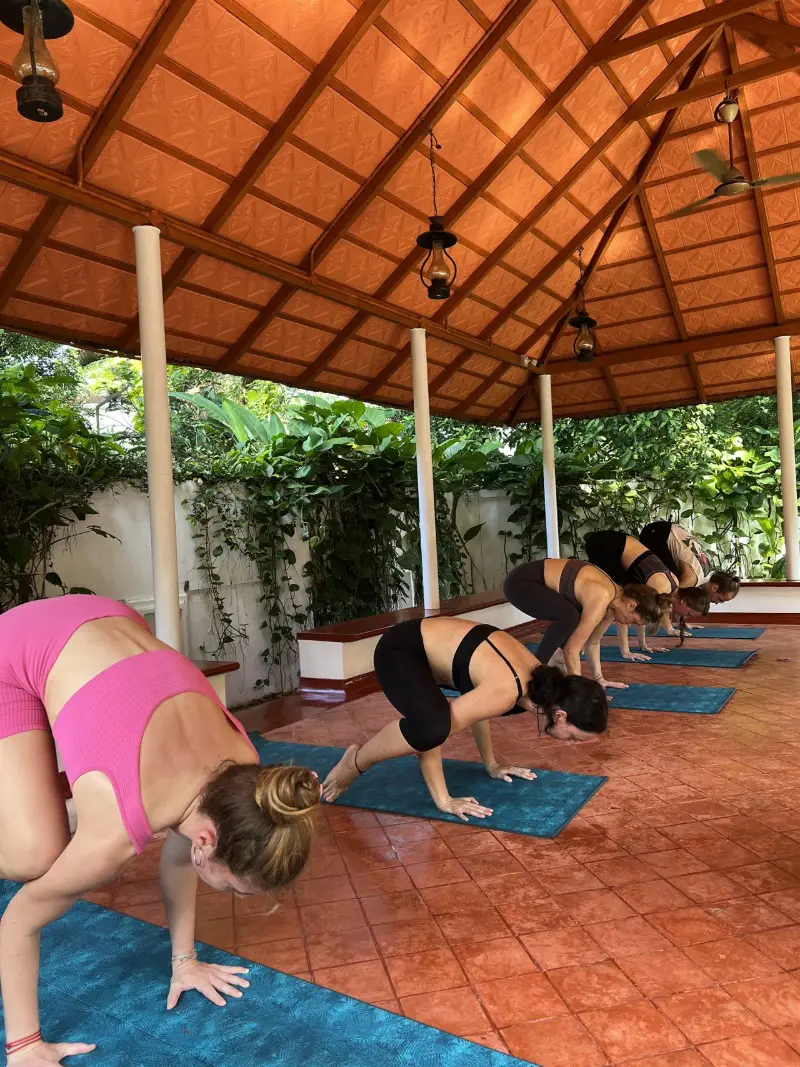
This is why traditional schools run daily. The classes in Fort Kochi run twice a day, every day, with no day off — not out of severity, but because that is simply how the practice was taught.
If you are starting out
Three or four times in the first two or three weeks, with a day between at least some of them. The soreness of the first fortnight is real and there is nothing to gain from pushing through it.
After that, add days rather than minutes. Go from four short sessions to six short sessions before you go from twenty minutes to forty.
A reasonable first month: week one, three sessions of twenty minutes. Week two, four. Week three, five. Week four, most days, and one longer class if you can get to one. There is a twenty-minute sequence here to use for the short days, and what to expect from a first class if you are going to a studio.
Do you need rest days?
Not from yoga as such. You need rest from hard effort, which is not the same thing.
If every session is demanding — strong backbends, arm balances, long holds at your limit — then yes, take a day or two a week, or you will accumulate rather than adapt. If you vary the intensity, daily practice is fine indefinitely, and a gentle day is itself a form of rest.
Traditional practice builds this in. A day when you feel flat is a day for breathing, a few easy postures and a long relaxation. That still counts. It is arguably the most useful practice of the week.
Do take a genuine break when you are ill, running a fever, or injured in a way that hurts during practice rather than just after it.
Three realistic schedules
Busy, and new to it. Twenty minutes before breakfast, five or six days. Sun salutations, three or four standing postures, a forward bend, a twist, five minutes of relaxation. One longer class at the weekend if it fits.
Established practice, working full time. Thirty to forty minutes on most days, with two of those days heavier and one deliberately gentle. Ten minutes of pranayama on at least three of them.
On holiday or on a course. Twice a day is genuinely possible for a few weeks and is the fastest way to change anything. Morning stronger, afternoon slower. This is the rhythm of a week of daily classes, and it is why people are surprised by how much shifts in seven days.
When you miss a week
You will. Travel, work, illness, a stretch where it simply does not happen.
The only thing that matters is what you do on the day you come back. Do not try to make up for it, and do not restart at the level you left. Twenty easy minutes, and the streak is running again.
People who practise for decades are not people who never stopped. They are people who never treated stopping as the end of it.
Two questions usually follow this one: how long it takes to become flexible, and whether yoga helps with weight loss. If you run as well, yoga for runners covers how the two fit around each other, and yoga and your period answers the question people are usually too polite to ask.
Common questions
Is it OK to do yoga every day?
Yes, provided the intensity varies. What needs rest days is hard effort, not movement. A gentle day of breathing, easy postures and a long relaxation is itself a form of rest and still counts as practice.
How many times a week should a beginner do yoga?
Three or four times for the first two or three weeks, with a day between at least some of them, then add days rather than minutes. Six short sessions beat three long ones once the initial soreness has passed.
Is 20 minutes of yoga a day enough?
For most people, yes — and it is more effective than two long classes a week. Twenty minutes daily is two hours a week, keeps the body adapted, and builds the habit that longer occasional sessions never quite do.
How long before I see results from yoga?
Most people notice better sleep and less tension within one to two weeks of near-daily practice. Visible changes in flexibility and strength usually take six to eight weeks, and they hold much better with frequent short practice than with occasional long sessions.

Known to his students as Achu, Aksharanand trained in the Sivananda tradition and holds an Advanced Teacher Training Certificate. He has taught Hatha Yoga, pranayama, meditation and Vedanta philosophy in Fort Kochi for over fifteen years, across more than 5,000 group classes and seventy international teacher training batches.
More about Achu and the school · Book a class or ask a question