
In short
You can practise yoga during your period. The traditional rule against inversions comes from the idea of apana, a downward-moving energy that inversions are said to reverse — it is a philosophical argument, not a medical finding, and there is no good evidence that turning upside down during menstruation causes harm. Practise if you feel like it, rest if you do not, skip anything that hurts, and favour gentle forward bends, supported twists and long rest on the heavy days. Severe pain that stops you living normally is worth seeing a doctor about, not breathing through.
This is the question I am asked most often by women in their first week at the school, usually quietly, after class. It deserves a straight answer rather than a mystical one.
There are two separate things tangled together here: what tradition says, and what is actually known. They are not the same, and a teacher who presents the first as the second is not being honest with you.
The short answer
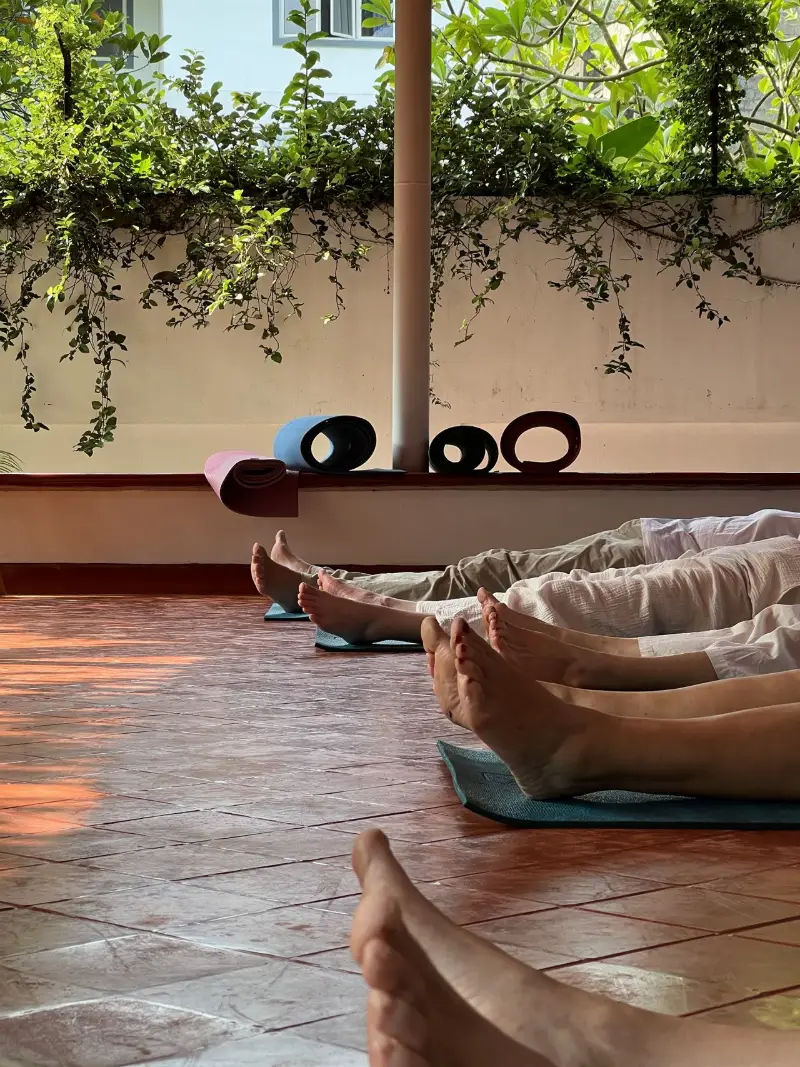
Come to class. Practise what feels good. Leave out what does not. Rest whenever you want to, including for the whole class, and nobody here will ask why.
That is genuinely the whole policy. What follows is why it is the policy, because you may be told something quite different elsewhere and should know what you are hearing.
Where the inversion rule comes from
In most traditional schools — Iyengar, Sivananda, Ashtanga — students are told not to invert during menstruation. Headstand, shoulderstand, and often plough are off the list for those days.
The reasoning is energetic. In yogic physiology, prana moves in five currents, and the one governing the lower abdomen is apana — the downward, eliminating movement, responsible for menstruation, urination, defecation and birth. Menstruation is apana doing its job. Turning the body upside down is understood to reverse that current, obstructing a process that should be allowed to complete.
It is an internally consistent argument within a system, and it is worth understanding on its own terms. It is also, and this is the part usually left out, not a claim anyone has tested.
What the evidence says
There is no good evidence that practising inversions during menstruation causes harm. There is also none showing it is beneficial. It is an under-researched question, which is a more honest summary than either camp usually offers.
The one specific medical claim that circulates is worth addressing, because it frightens people: that inverting causes retrograde menstruation, blood flowing backwards through the fallopian tubes, and therefore endometriosis.
Retrograde menstruation is real. It also happens in roughly ninety per cent of women, in every position, as a matter of ordinary physiology — and the overwhelming majority never develop endometriosis. Endometriosis is a complex condition involving immune and genetic factors, and there is no evidence that a few minutes upside down causes it.
Two other points, for completeness:
- B. K. S. Iyengar, whose school is strictest about this, nevertheless prescribed certain supported inversions for menstrual problems including heavy or irregular bleeding — during the rest of the cycle, not during bleeding. Even within the tradition, the position is more nuanced than "never".
- Flow does sometimes pause when women invert, and restart afterwards. This is reported often enough to take seriously as an observation. Whether it matters is unknown.
What we teach here, and why
We do not enforce the rule. We explain it, and then the choice is yours.
Three reasons for that position. First, it is your body and your cycle, and you have more information about both than I do. Second, the traditional reasoning is philosophical rather than medical, and it should be presented that way rather than dressed up as a safety warning. Third, and most practically: in a two-hour class there are perhaps four minutes of inversion, and the days when a woman feels wretched are not usually the days she was longing to do a headstand anyway.
What I do ask is that you tell the teacher, if you are comfortable doing so — not so that anything is forbidden, but so that nobody comes over to adjust you deeper into a pose on a day you would rather be left alone. A word at the start is enough.
If you were trained in a school with a firm rule and it sits badly with you to break it, then keep it. Consistency with your own practice is worth something, and there is no cost to skipping four minutes.
What actually helps
More useful than the inversion debate is the question of what to do instead, which almost nobody writes about.
| Pose | Why | Hold |
|---|---|---|
| Supported child’s pose Balasana | Knees wide, a bolster or folded blanket under the chest so the belly is unsqueezed. Eases the lower back. | 2-3 min |
| Cat and cow Marjariasana | Slow, breath-led movement of the lower back. Better than any static stretch for cramping. | 10 rounds |
| Supported bound angle Supta baddha konasana | On your back over a bolster, soles together, cushions under both knees. The single most useful pose on this list. | 5 min |
| Reclining twist | Knees dropping to one side with a cushion between them. Gentle, not deep. | 90s each side |
| Legs up the wall Viparita karani | A mild inversion by anyone’s definition, and widely taught as acceptable during menstruation because the pelvis barely lifts. Skip it if your school says otherwise. | 5 min |
| Savasana | With something warm over the abdomen. Rest properly — this is the pose, not the interval afterwards. | 10 min |
Add bhramari if you are sore and tense. Leave out kapalabhati and any strong abdominal work — that one is not tradition, it is simply that forceful pumping of the belly during a heavy flow is unpleasant and nobody enjoys it.
If a heating practice does not appeal, chandra namaskar is the cooling alternative to sun salutations and suits these days well.
What to leave out
- Anything that hurts. This is not the week to test your edge.
- Strong abdominal work — uddiyana bandha, nauli, boat pose held to exhaustion.
- Deep closed twists that squeeze the abdomen hard. Open, supported twists are fine.
- Long held standing poses on a day you feel drained. There is nothing to prove.
- Hot rooms. Not relevant here, where the room is hot anyway, but relevant if you practise hot yoga at home.
When it is not a yoga question
One thing I would rather say too often than not at all. Period pain that stops you working, sleeping or leaving the house is not something to breathe through, and it is not a sign that your practice is insufficient.
Pain that has got worse over the years, bleeding heavy enough to soak through protection hourly, pain during sex, or pain that painkillers do not touch — these are worth a doctor. Endometriosis takes an average of years to diagnose, largely because women are told that severe period pain is normal. It is common. That is a different thing.
Yoga can help with ordinary cramping and with the tension that comes with it. It is not a treatment for a condition, and any school that tells you otherwise is overselling.
Practising here
Our daily classes are small, which means there is room to take a quiet version of the class without it becoming an event. Mats, blankets and bolsters are here. If you would rather not say anything out loud, say it on WhatsApp before you come and the teacher will simply know.
Common questions
Can you do yoga on your period?
Yes. Practise what feels good, rest when you want to, and leave out anything painful. Gentle forward bends, supported reclining poses, slow cat and cow, and a long savasana suit the heavy days better than a strong standing sequence.
Why are inversions not allowed during menstruation?
The traditional reason is energetic: menstruation is governed by apana, the downward-moving current, and inversions are held to reverse it. That is a philosophical argument within yogic physiology rather than a medical finding, and there is no good evidence that inverting during a period causes harm.
Do inversions during your period cause endometriosis?
No evidence supports this. The claim rests on retrograde menstruation, which does occur — in around ninety per cent of women, in every position, as ordinary physiology — and the great majority never develop endometriosis, which involves immune and genetic factors.
Which yoga poses help period cramps?
Supported child’s pose, slow cat and cow, supported bound angle over a bolster, a gentle reclining twist and a long savasana with something warm over the abdomen. Slow breath-led movement of the lower back tends to help cramping more than any static stretch.
Should I tell my yoga teacher I am on my period?
It helps, if you are comfortable doing so — mainly so nobody adjusts you deeper into a pose on a day you would rather be left alone. Here it changes nothing about what you are allowed to do; it simply means the teacher knows.

Known to his students as Achu, Aksharanand trained in the Sivananda tradition and holds an Advanced Teacher Training Certificate. He has taught Hatha Yoga, pranayama, meditation and Vedanta philosophy in Fort Kochi for over fifteen years, across more than 5,000 group classes and seventy international teacher training batches.
More about Achu and the school · Book a class or ask a question