
In short
The best-supported benefits of yoga are real but modest: small improvements in chronic low back and neck pain, lower perceived stress, better sleep quality, better balance and mobility after 60, and blood pressure falls of around 4 mmHg. Evidence for depression and anxiety is promising but uneven. Detoxing, curing disease and boosting immunity are not supported. Most trials are small and short, so treat any single headline with care.
- Strongest evidence
- Chronic back and neck pain, stress, balance after 60
- Typical effect
- Small to moderate, similar to other exercise
- Blood pressure
- About −4 mmHg systolic on average
- Usual trial dose
- 60–90 minutes, 1–3 times a week, 8–12 weeks
- Not supported
- Detox, cures, “boosting immunity”
- Injury risk
- Low; higher over 65 and in extreme poses
Yoga has been studied far more than most people realise. There are hundreds of randomised trials and dozens of systematic reviews, the kind of research that pools many trials together to see what holds up. This guide reads those reviews so you do not have to, and it sits alongside our plain-English guide to Hatha Yoga, which explains the practice itself.
A warning first, from someone who teaches yoga for a living. I would love every claim on a studio poster to be true. Most of them are not tested, and some have been tested and failed. What is left is still a good reason to practise.
How should you read yoga research?
Yoga is hard to study well, and four problems turn up in almost every review.
- “Yoga” means different things. A trial of gentle Viniyoga for back pain and a trial of hot power yoga for weight are both “yoga trials”. Their results cannot simply be added together.
- Nobody can be blinded. You know whether you are doing yoga. That makes placebo and expectation effects hard to separate from the practice itself.
- Trials are small and short. Many have fewer than a hundred people and follow them for three months or less.
- The comparison matters. Yoga often beats “waiting list” or “usual care”. Against other exercise, the difference usually shrinks or disappears.
So the honest question is rarely “does yoga work?” It is “does this kind of yoga beat doing nothing, and does it beat other exercise?” The answer to the second is usually: about the same. That is not a failure. It means yoga is a real form of exercise, with some extras.
What are the proven benefits of yoga? The evidence at a glance
| Benefit | Best evidence | What it found | Strength |
|---|---|---|---|
| Chronic low back pain | Cochrane review, 2022: 21 trials, 2,223 people | Small improvement in pain and function versus no exercise; similar to other exercise | Moderate |
| Neck pain | Review, 2019: 10 trials, 686 people | Less pain and disability, better range of motion | Moderate |
| Perceived stress | Review, 2020: 12 trials, 672 people | All trials found lower stress | Moderate |
| Balance after 60 | Review, 2016: 6 trials, 307 people | Small gain in balance, medium gain in mobility | Moderate |
| Blood pressure | Review, 2013: 17 trials | About −4 mmHg systolic, −3.6 mmHg diastolic | Low to moderate |
| Sleep quality | Review, 2020: 19 trials, 1,832 women | Better sleep quality than inactive controls | Low to moderate |
| Depression | Review, 2013: 12 trials, 619 people | Short-term improvement; useful alongside treatment | Low to moderate |
| Anxiety | Trial, 2021: 226 people with GAD | Helped, but less than cognitive behavioural therapy | Low to moderate |
| Weight | Review, 2022: 22 trials, 1,178 people | Reductions in weight, BMI and waist, with enough practice | Low |
| Detox, immunity, curing disease | — | No good evidence | None |
“Strength” here is my plain-English summary of how much the reviewers themselves trusted their findings. The summaries follow the US National Center for Complementary and Integrative Health, which keeps a careful public digest of the yoga literature.
Does yoga help back pain and neck pain?
Yes, modestly, and this is the best-studied benefit of all.
The 2022 Cochrane review pooled 21 trials with 2,223 people with chronic low back pain. Yoga improved pain and function by a small amount compared with no exercise. Compared with other exercise, it did about as well. The reviewers rated much of the evidence as low certainty, and most trials followed people for only a few months.
Clinical guidelines take that seriously. The American College of Physicians’ 2017 guideline lists yoga among the non-drug treatments to try first for chronic low back pain, next to exercise, tai chi and mindfulness. Our guide to yoga for back pain covers which poses help and which to leave alone.
Neck pain looks similar. A 2019 review of 10 trials with 686 people found less pain, less disability and better range of motion. If your neck pain comes from a desk, our neck and shoulder guide is the practical version.
Two details matter. The yoga in these trials was usually designed for back pain and taught by experienced teachers. A random fast-paced class is not the same intervention.
Does yoga reduce stress, anxiety and depression?
Stress: the clearest result. A 2020 review of 12 trials with 672 people found that every one of them showed lower perceived stress. It is also what students report most often in our classes. That is not evidence, but it is consistent with it.
Depression: a 2013 meta-analysis of 12 randomised trials with 619 people found moderate short-term improvement compared with usual care. The authors were careful to call yoga an ancillary treatment: something to add, not something to replace care with. Later reviews say much the same.
Anxiety: the most useful single study is a 2021 trial of 226 adults with generalised anxiety disorder, published in JAMA Psychiatry. Kundalini yoga helped more than stress education. It helped less than cognitive behavioural therapy, the standard psychological treatment. That is a fair summary of the whole field: genuinely helpful, not a substitute for treatment.
Our article on yoga for anxiety and stress describes the practices we use, especially slow breathing and long relaxation.
Does yoga improve sleep?
Probably, for many people. A 2020 meta-analysis of 19 studies with 1,832 women found better sleep quality with yoga than with inactive control groups. Reviews in older adults, people with cancer and people with arthritis point the same way.
What we cannot yet say is which part does the work. A gentle evening practice, slow breathing and a long savasana are the likeliest candidates. Our evening practice for sleep is built around those three.
Does yoga lower blood pressure?
A little. A 2013 meta-analysis of 17 studies in adults with hypertension found an average fall of about 4.2 mmHg systolic and 3.6 mmHg diastolic.
Two findings inside that review are worth knowing. First, the effect was larger, about 8 mmHg systolic, when the yoga included all three elements: postures, breathing and meditation. Posture-only programmes did less. Second, yoga did not beat ordinary exercise. All 17 studies also had unclear or high risk of bias.
A few millimetres matters at the scale of a population. For you, it means yoga is a reasonable part of looking after your blood pressure, not a replacement for medication your doctor has prescribed.
Does yoga improve balance and mobility as you age?
Yes. A 2016 review in Age and Ageing pooled six trials of relatively high quality, with 307 people aged 60 and over. Yoga produced a small improvement in balance and a medium improvement in mobility. A broader 2014 review found better balance in 11 of 15 studies.
Balance is one of the things that keeps an older person independent, so this result matters more than its size suggests. If you are starting later in life, read starting yoga over 50 before your first class.
Does yoga help you lose weight?
Sometimes, with enough of it. A 2022 review of 22 studies with 1,178 people found reductions in weight, BMI, body fat and waist size. The programmes that worked tended to run at least 75 to 90 minutes, at least three times a week, for three months or more, with practice at home as well.
That is a lot more yoga than most people do. Our honest answer on yoga and weight loss explains why the effect probably owes as much to habit and appetite as to calories burned.
What about other conditions?
Smaller bodies of research suggest yoga may help with:
- Knee osteoarthritis: pain, function and stiffness, in a small number of trials.
- Tension headaches and migraine: fewer and shorter headaches, in early studies.
- Menopause: both hot flushes and psychological symptoms, in a 2018 analysis of 13 studies.
- Cancer care: quality of life, fatigue, sleep and mood during and after treatment, particularly breast cancer.
- Pregnancy: lower anxiety and stress, with sensible precautions such as no hot yoga and no long periods lying flat on the back later in pregnancy.
In each case yoga sits alongside medical care. It is never the treatment for the disease itself.
What does the research not support?
Several claims are repeated so often in classes that people assume they are established. They are not.
- Twists “detox” the liver or “wring out” organs. There is no evidence for this and no plausible mechanism. Your liver and kidneys do the detoxifying, and they do it whether you twist or not.
- Yoga “boosts immunity”. A few small studies show changes in blood markers of inflammation. A change in a marker is not fewer infections, and no trial has shown that.
- Yoga cures disease. No condition is cured by yoga. Several are helped by it.
- Inversions reverse ageing or “flush the brain”. Not tested, and headstand carries real risk for some people. See our safe headstand guide.
- Particular poses balance particular hormones. Traditional teaching says so. The research does not show it.
None of this makes traditional teaching worthless. It makes it tradition, which is a different thing from medicine. We teach both, and we try to say which is which.
What we notice in the room
Over fifteen years of classes in Fort Kochi, the change students describe first is not flexibility. It is that they slept well, or felt calmer that afternoon. That matches the research better than the posters do: the early benefits of yoga are mostly in the nervous system, and the physical ones take months.
Is yoga safe?
Generally, yes, when it is taught well and practised sensibly. The most common injuries are sprains and strains.
The best data come from US emergency departments. A 2016 study estimated about 29,590 yoga-related injuries treated in those departments between 2001 and 2014. The rate rose from 9.55 to 17.01 per 100,000 practitioners over that time. People aged 65 and over had the highest rate, at about 58 per 100,000. Nearly half the injuries were to the trunk, and sprains and strains made up 45%.
Those are low numbers for a physical activity. They still point to three sensible rules:
- Learn headstand, shoulderstand, lotus and forceful breathing from a teacher, not a video. Our kapalabhati guide lists who should not do the fast breaths.
- If you are older, pregnant, or have glaucoma, uncontrolled high blood pressure or a spinal problem, tell the teacher and adapt.
- Be wary of hot yoga if you are prone to overheating or dehydration.
How much yoga do you need to see benefits?
Most trials that found benefits used sessions of 60 to 90 minutes, once to three times a week, for eight to twelve weeks. Weight loss needed more. Stress and sleep changes are often reported within a few weeks.
A practical reading of that: two or three real sessions a week, kept up for three months, is roughly the dose the research tested. Our guide to how often to practise turns that into a weekly plan, and the beginner’s guide to pranayama covers the breathing half of the work, which the blood pressure findings suggest matters.
Practise with us in Fort Kochi
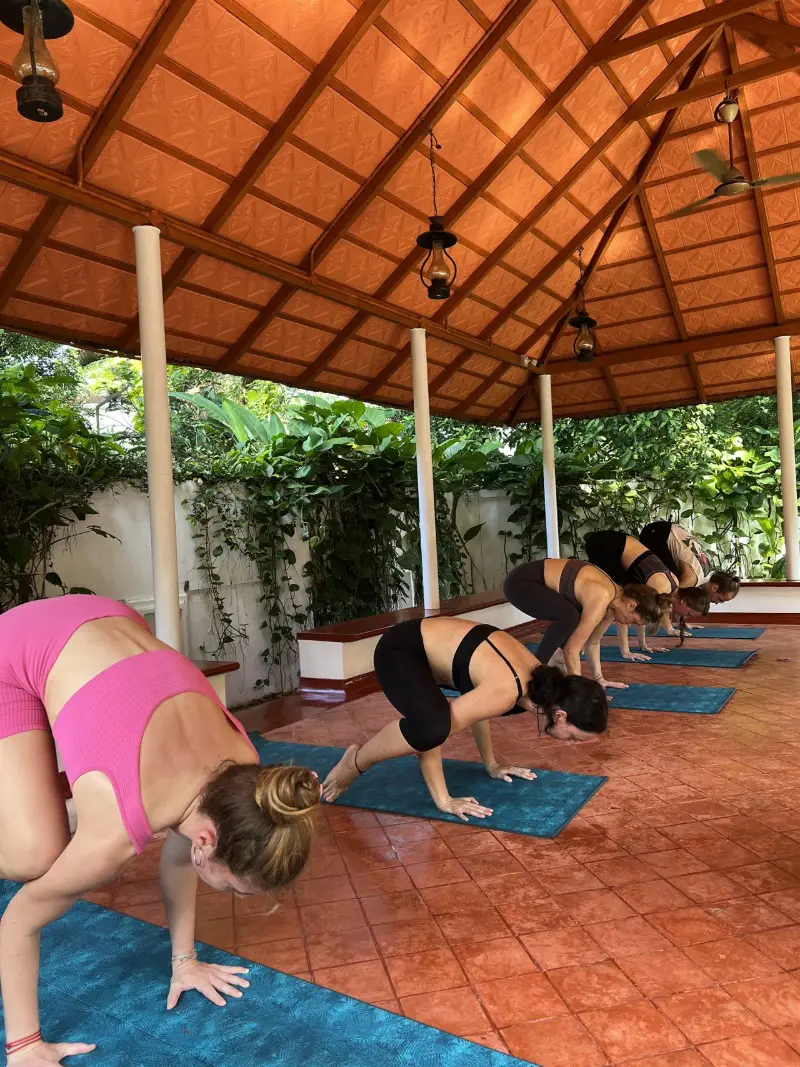
Traditional two-hour Hatha classes with postures, breathing and a long relaxation, every day at 7:30 am and 3:30 pm. All levels, no booking needed.
This article summarises published research for general information. It is not medical advice. If you have a health condition, speak to your doctor before starting a new exercise programme.
Common questions
What are the scientifically proven benefits of yoga?
The best-supported are small improvements in chronic low back and neck pain, reduced perceived stress, better balance and mobility in people over 60, better sleep quality, and modest falls in blood pressure. Benefits for depression and anxiety are promising but less certain, and yoga works best alongside treatment rather than instead of it.
Is yoga better than other exercise?
Usually not, and usually not worse. In trials for back pain and blood pressure, yoga performs about as well as other forms of exercise. Its distinctive extras are the breathing and relaxation, which seem to matter most for stress and sleep.
How long does it take to feel the benefits of yoga?
Most trials that found benefits ran for eight to twelve weeks, with one to three sessions a week. Many people notice calmer moods and better sleep within the first few weeks; changes in pain, balance and flexibility take longer.
Does yoga detox your body?
No. There is no evidence that twists or any other pose detoxify organs. The liver and kidneys clear waste from the body continuously, with or without yoga.
Can yoga replace medication for blood pressure or depression?
No. Yoga can be a useful addition, and the research supports that role, but it should not replace medication or therapy your doctor has recommended. Talk to them before changing any treatment.
Is yoga safe for older adults?
Generally yes, and balance and mobility are among its best-supported benefits after 60. Injury rates are higher over 65, so choose a slower class, tell the teacher about any conditions, and leave headstand and deep forward bends until you have guidance.

Known to his students as Achu, Aksharanand trained in the Sivananda tradition and holds an Advanced Teacher Training Certificate. He has taught Hatha Yoga, pranayama, meditation and Vedanta philosophy in Fort Kochi for over fifteen years, across more than 5,000 group classes and seventy international teacher training batches.
More about Achu and the school · Book a class or ask a question