
In short
For ongoing lower back pain, yoga is one of the non-drug treatments the American College of Physicians recommends trying first. Slow, gentle movements — knees to chest, cat–cow, supported child’s pose — often help, while deep forward folds, fast twists and strong backbends often aggravate. See a doctor first if pain follows an injury or comes with numbness, weakness or fever.
Back pain is one of the most common reasons people come to yoga, and one of the most common reasons they get hurt doing it. The difference is almost always in the choice of movements and the pace, not in yoga itself.
This is general guidance from a yoga teacher, not medical advice, and it cannot replace an assessment of your own back. If you have back pain, one-to-one teaching is usually the safest way to start; see private yoga classes in Kochi.
- Guideline
- American College of Physicians, 2017
- Yoga recommended for
- Chronic low back pain
- Often helps
- Slow, gentle, supported movement
- Often aggravates
- Deep folds, fast twists, strong backbends
- Rule
- Stay in a pain-free range
- First
- Check warning signs with a doctor
What the evidence says
In its 2017 guideline on noninvasive treatments for low back pain, the American College of Physicians recommends that people with chronic low back pain first try non-drug treatments, and lists yoga among them, alongside exercise, tai chi, mindfulness-based stress reduction and others. For recent back pain, it recommends approaches such as heat, massage, acupuncture or spinal manipulation.
In other words, yoga has a respectable place in back care — especially for pain that has lasted a while — but it is one option among several, and it works best as gentle, regular practice rather than an intense class.
For how back pain compares with everything else yoga has been studied for, see what the research shows about yoga’s benefits.
See a doctor first if…
- The pain started after a fall, accident or other injury.
- You have numbness, tingling or weakness in a leg or foot.
- You have any change in bladder or bowel control, or numbness around the groin or buttocks — seek urgent medical care.
- You have a fever, feel unwell, or have lost weight without trying.
- The pain is severe, worsening, or wakes you at night.
- You have a history of cancer, osteoporosis or spinal surgery.
Gentle postures that often help
Move slowly, breathe through the nose, and stay well within a pain-free range. A mild stretch is fine; pain is not.
1. Constructive rest
Lie on your back with knees bent and feet flat, hip-width apart. Let the lower back rest. Breathe slowly for two to three minutes. Many people find this alone eases tension.
2. Knees to chest
From constructive rest, hug one knee, then both, gently towards the chest. Rock very slightly side to side if it feels good.
3. Cat–cow
On hands and knees, slowly round the back as you breathe out, then gently let the belly lower as you breathe in. Keep the range small.
4. Supported child’s pose
Kneel with knees apart and fold forward over a cushion or folded blanket. If it strains your knees or back, skip it.
5. Gentle knee drops
Lying with knees bent, let both knees drift a little to one side, then the other. Keep it small and slow; this is not a deep twist.
6. Sphinx
Lying on your front, rest on your forearms with elbows under the shoulders. This gentle extension suits some backs and not others — if it increases pain, stop.
Movements to treat with caution
| Movement | Why to be careful |
|---|---|
| Deep forward folds with straight legs | Loads the lower back; bend the knees generously |
| Fast or deep twists | Can irritate an already sensitive back |
| Strong backbends | Wheel, bow and deep camel compress the lower back |
| Sit-up style core work | Repeated forceful flexion under load |
| Unsupported inversions | Headstand and shoulderstand load the spine |
| Pushing into pain | Pain is a signal to stop, not a stretch to breathe through |
How to practise safely
- Little and often: ten gentle minutes daily beats one long session.
- Pain-free range only, and stop at once if pain travels down a leg.
- Breathe slowly. Holding the breath tenses the back.
- Tell the teacher before any group class, every time.
- Keep moving between sessions. Gentle walking usually helps backs more than resting completely.
Why one-to-one teaching helps with back pain
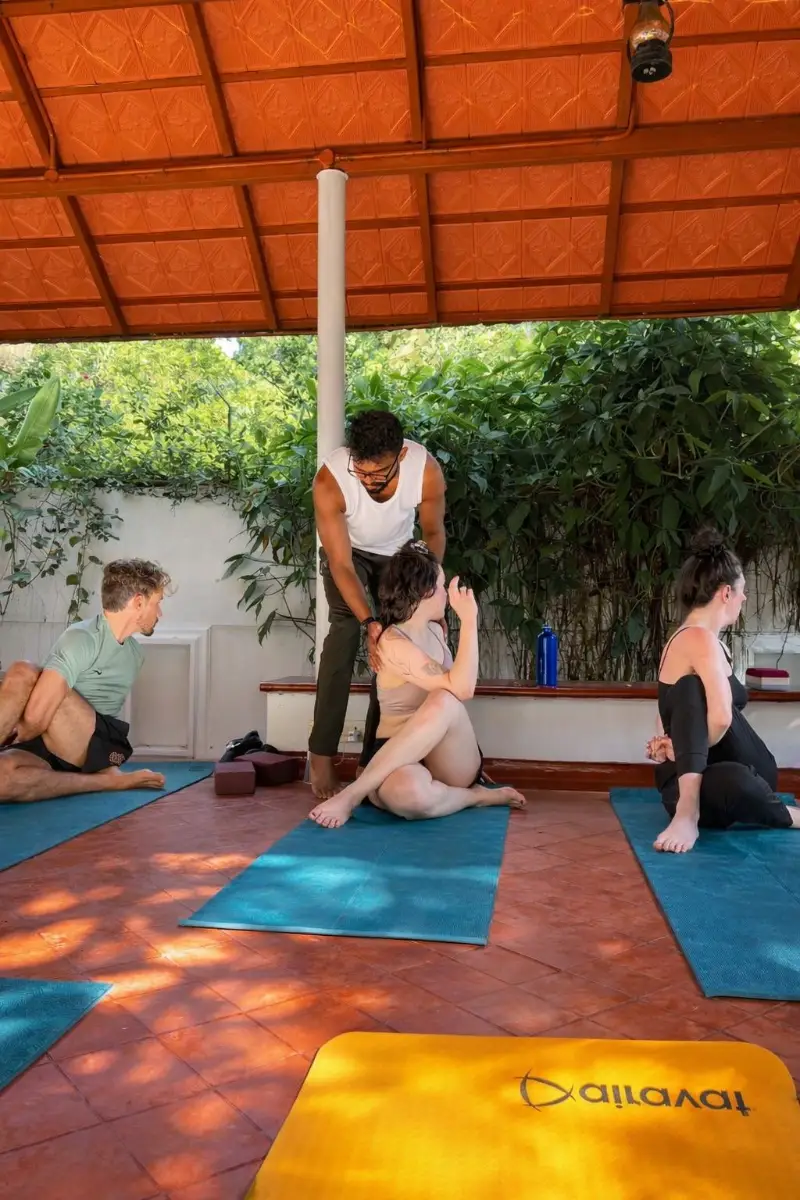
Two backs that hurt in the same place can need opposite movements. In a private session, a teacher can see how you move, find which directions ease the pain and which aggravate it, and give you a short practice built for your back. At our school in Fort Kochi, private sessions are ₹1,500, rising to ₹2,000 in November 2026. If you join a daily group class instead, tell the teacher about your back when you arrive, and rest whenever you need to.
Start gently, with guidance
Tell us about your back. We will suggest whether a private session or a group class is the right starting point, and how to practise safely.
If the pain sits higher, between the shoulder blades and up into the neck, yoga for neck and shoulder pain covers the desk-worker version.
Common questions
Is yoga good for back pain?
For chronic low back pain, yoga is among the non-drug treatments the American College of Physicians recommends trying first. Gentle, regular practice is more helpful than intense classes, and it is best to rule out serious causes with a doctor.
Which yoga poses are best for lower back pain?
Gentle, supported movements often help: lying with knees bent, knees to chest, small cat–cow movements, supported child’s pose and small knee drops. Stay in a pain-free range.
Which yoga poses should I avoid with back pain?
Be cautious with deep forward folds on straight legs, fast or deep twists, strong backbends such as wheel and bow, sit-up style core work and unsupported inversions.
Can yoga make back pain worse?
Yes, if movements are too deep, too fast or pushed into pain. Stop anything that causes sharp pain or pain travelling down a leg, and start with gentle, guided practice.
Should I do yoga with sciatica or a slipped disc?
Only after medical advice, and ideally with a teacher experienced in back problems. Avoid deep forward folds and stop immediately if symptoms in the leg increase.
When should I see a doctor about back pain?
Before starting yoga if the pain followed an injury, or comes with numbness, tingling or weakness in a leg, fever or unexplained weight loss, or is severe at night. Seek urgent care for any change in bladder or bowel control.

Known to his students as Achu, Aksharanand trained in the Sivananda tradition and holds an Advanced Teacher Training Certificate. He has taught Hatha Yoga, pranayama, meditation and Vedanta philosophy in Fort Kochi for over fifteen years, across more than 5,000 group classes.