
In short
For anxiety, the useful parts of a yoga practice are slow breathing with a long exhale, a small number of gentle postures held without strain, and a proper guided relaxation at the end. Practices that lengthen the exhale settle the body faster than anything done standing up. Fifteen minutes daily helps more than an hour on Sunday. Yoga is not a treatment for an anxiety disorder, and it belongs alongside medical care, not instead of it.
People arrive at a class in Fort Kochi carrying all sorts of things. A fair number arrive anxious — from travel, from work left behind, or from something older than either. They usually expect to be given postures.
The postures are the least of it. What changes an anxious state, reliably and within minutes, is the breath.
Why breathing works when talking yourself down does not
Anxiety is not only a thought. It is a body in a particular configuration: breath high in the chest and quick, shoulders lifted, jaw tight, belly held. That configuration is what the nervous system reads as danger, and it will keep producing anxious thoughts to match, however sensibly you argue with them.
You cannot decide to be calm. But you can change the breath directly, and the body reads the new breath as safety. This is the whole mechanism, and it is why yoga puts pranayama before posture rather than after it.
The long exhale
If you remember one thing, remember this: make the exhale longer than the inhale.
Breathe in for a count of four. Breathe out for a count of six or eight. Do not strain for the count — shorten it if you are struggling. Ten rounds is usually enough to feel a difference, and you can do it sitting on a train with nobody noticing.
When there is more time, anuloma viloma — alternate-nostril breathing — does the same job more thoroughly, and is the practice students most often tell us they kept. It is described step by step in pranayama for beginners. For an anxious evening, the humming bee breath is simpler still, and has more research behind it than most of what yoga offers.
One caution: skip the forceful practices when you are anxious. Kapalabhati, the sharp pumping breath, is stimulating by design. It has its place in a morning class. It is the wrong tool for a racing mind.
A fifteen-minute sequence
Do this in the evening, or at any point in a day that has got away from you.
- Sit for two minutes and simply count the breath, without changing it. You are finding out where you actually are.
- Five minutes of long-exhale breathing, four in and six out, or alternate-nostril if you know it.
- Child's pose, two minutes. Forehead on the floor or on a folded blanket. The pressure on the forehead is itself calming.
- Cat and cow, ten slow rounds, breath leading the movement rather than following it.
- Seated forward bend, one minute, knees soft. Do not reach for your toes. The point is the rounded, folded shape, not the stretch.
- Legs up the wall, three minutes. Lie on your back, legs resting up a wall, arms out. Nothing to hold.
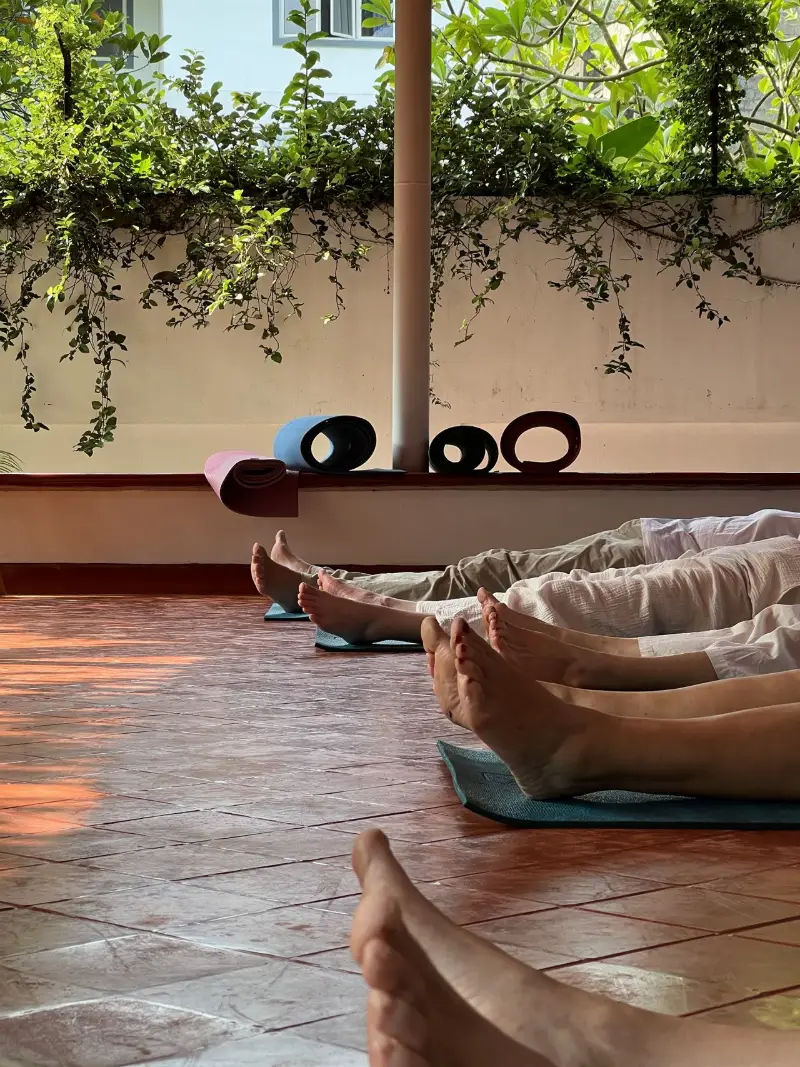
- Savasana, at least five minutes, and longer if you have it.
Notice the shape of it: almost half is breathing and lying down. That is deliberate, and it is where the effect comes from. Savasana is a skill worth learning properly.
Which postures, and which to skip
Helpful: forward bends, gentle twists, child's pose, legs up the wall, supported reclining postures. Anything you can hold while breathing slowly and evenly.
Usually unhelpful when anxious: long holds in demanding standing postures, deep backbends, fast sequences, and anything where you are counting down until it ends. Strong backbends are energising — excellent on a flat morning, unkind on a jittery evening.
The test: if you cannot breathe slowly in a posture, it is the wrong posture for today. That is a better guide than any list.
Making it daily
Fifteen minutes every day does more than ninety minutes once a week. Anxiety is a pattern the nervous system has learned, and patterns are unlearned by repetition, not by intensity.
Attach it to something you already do — after brushing your teeth, before the first coffee, as soon as you close the laptop. Keep it short enough that you will not negotiate with yourself about it. There is a twenty-minute routine here if you want something more structured, and yoga nidra if you would rather be talked through it.
Practising with other people helps too, more than most people expect. Part of it is that somebody else is keeping time, so you cannot cut the relaxation short.
What yoga will not do
We should be plain about this. Yoga is not a treatment for an anxiety disorder, and a yoga teacher is not a clinician. If anxiety is stopping you working, sleeping or leaving the house, or if you are having panic attacks, see a doctor. Practising alongside proper care is sensible; practising instead of it is not.
There is also a smaller caution. For some people — particularly after trauma — closing the eyes and turning attention inwards can feel worse rather than better. If that is you, practise with the eyes softly open, keep the relaxation short, and tell the teacher. Nobody will ask why.
What yoga does well is unremarkable and cumulative: a body that carries less background tension, a breath that is easier to steady, and the experience — repeated often enough to be believed — that an unsettled state can pass. That turns out to be quite a lot.
If you are in Fort Kochi, the afternoon class at 3:30 suits an anxious day better than the morning one; it is slower and the relaxation is longer. Class times are here.
Common questions
Which yoga is best for anxiety?
A slow, traditional style with real breathing practice and a long relaxation — Hatha or Sivananda rather than a fast flow or heated class. The pace matters more than the style name: if you can breathe slowly throughout, the class is doing its job.
How quickly does yoga help anxiety?
A single session of slow breathing usually settles the body within a few minutes. The deeper change — a nervous system that is less quick to fire — comes from daily practice over weeks, not from one class.
Can yoga replace medication or therapy for anxiety?
No. Yoga is not a treatment for an anxiety disorder and a yoga teacher is not a clinician. It sits alongside medical care. If anxiety is affecting your sleep, work or daily life, speak to a doctor.
What breathing exercise is best for panic?
Lengthening the exhale. Breathe in for four and out for six or eight, without straining, for ten rounds. Avoid forceful practices like kapalabhati, which are stimulating by design.

Known to his students as Achu, Aksharanand trained in the Sivananda tradition and holds an Advanced Teacher Training Certificate. He has taught Hatha Yoga, pranayama, meditation and Vedanta philosophy in Fort Kochi for over fifteen years, across more than 5,000 group classes and seventy international teacher training batches.
More about Achu and the school · Book a class or ask a question