
In short
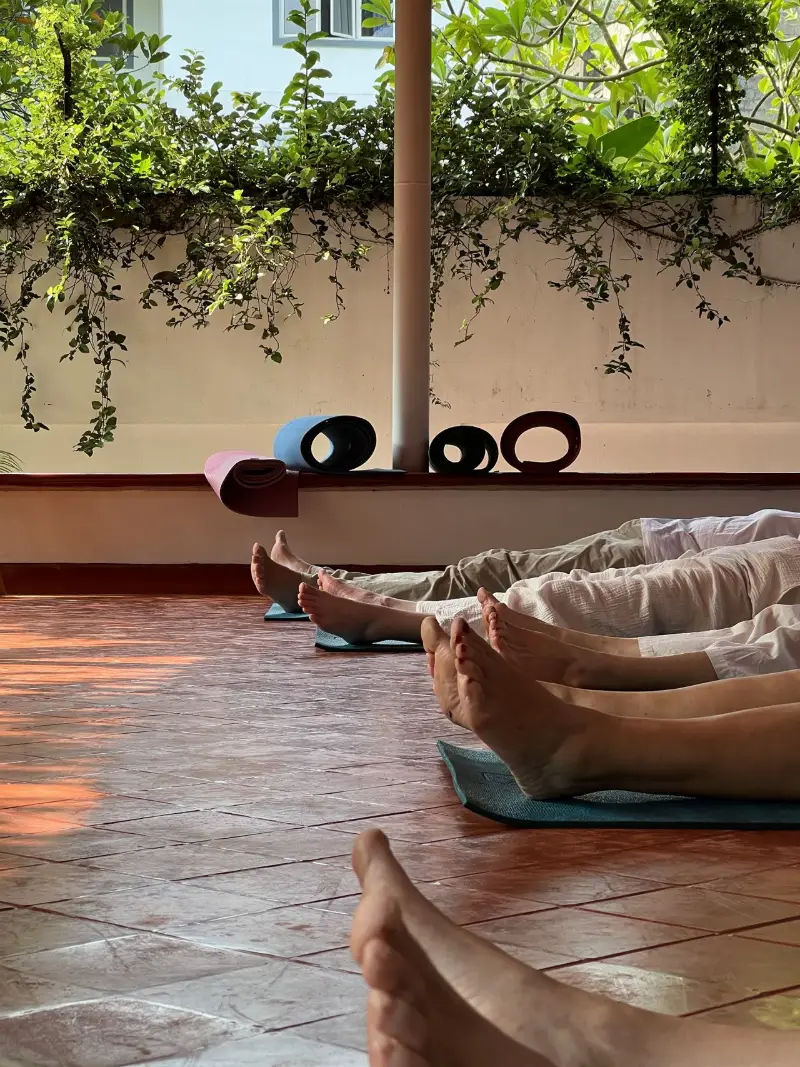
Yoga nidra is a guided practice done lying on your back, awake and completely still, while a teacher moves your attention through the body, the breath and sometimes an intention. A session runs twenty to forty minutes. You do nothing but listen, and the stillness does the rest.
The name translates as yogic sleep, which confuses people. You are not asleep. You are lying in savasana, deliberately doing nothing, while someone speaks — and the practice sits in that narrow band between being awake and falling over the edge.
What it actually is
Traditional yoga nidra as it is taught today was systematised by Swami Satyananda Saraswati of the Bihar School of Yoga, drawing on much older tantric practices. It has a recognisable shape wherever you meet it.
- Settling. You lie down, cover yourself, and get still enough that nothing needs adjusting.
- Sankalpa. A short intention, phrased in the present tense, repeated at the beginning and again at the end.
- Rotation of consciousness. The teacher names body parts in a set order — right thumb, second finger, third finger — and your attention simply visits each one.
- Breath awareness. Often counting breaths backwards, which gives a busy mind something to fail at gracefully.
- Opposites and images. Heaviness and lightness, heat and cold, then sometimes imagery.
- Return. The intention again, then slow movement back.
How a session actually goes
You do not have to concentrate. That is the part people find hardest to believe. If your attention wanders off to lunch, it comes back when the teacher names the next body part; nothing is ruined. There is no posture to hold, nothing to get right, and no way to be bad at it.
Most people find the first ten minutes fidgety and the rest surprisingly quick. Thirty minutes of yoga nidra leaves many practitioners feeling as though considerably more time has passed.
If you fall asleep
You probably will, at least at first, and it does not matter. Sleeping through it means you needed sleep. As the practice becomes familiar, staying awake becomes easier, and that borderland — body asleep, attention awake — is where the practice properly lives.
Trying it at home tonight
- Lie on your back on a mat or a firm bed, feet apart, palms up.
- Cover yourself. Bodies cool quickly when they stop moving, and cold ends the practice early.
- Put something under the knees if your lower back complains.
- Use a recorded guidance for the first few times. Thirty minutes is plenty.
- Do not set an alarm that shocks you awake. If you must, make it gentle.
Evening suits most people. Some practise in the afternoon instead, because a session too close to bedtime can leave you rested rather than sleepy.
What to expect, honestly
Yoga nidra is rest, practised deliberately. People commonly report feeling calmer and sleeping better, and it asks nothing of your flexibility or fitness, which makes it one of the few practices anyone can do on any day.
What it is not is a treatment. If you are dealing with insomnia, trauma or anxiety that affects your life, work with a doctor or therapist; a practice like this can sit alongside that care, not replace it. A teacher who promises otherwise is overselling.
In our classes in Fort Kochi, every session ends in savasana with real time given to it rather than two rushed minutes — the same principle, on a smaller scale. If you would like to go further into stillness, meditation in Fort Kochi covers where to start, and you are welcome to come and ask in person.
Common questions
What is yoga nidra?
A guided practice done lying on your back, awake and still, while a teacher moves your attention through the body, the breath and sometimes an intention. Sessions usually last twenty to forty minutes and require no flexibility or fitness.
Is yoga nidra the same as meditation?
They overlap but are not identical. Meditation is usually practised sitting, with attention held on one object. Yoga nidra is practised lying down and led by a voice, and it aims at deep rest as much as at awareness.
Is it bad to fall asleep during yoga nidra?
No. Falling asleep simply means you needed sleep, and it happens to most beginners. Staying awake becomes easier the more familiar the practice becomes.
How often should I practise yoga nidra?
Even once a week is worthwhile. Many people practise in the evening two or three times a week, and some use a short session on any day that has been demanding.

Known to his students as Achu, Aksharanand trained in the Sivananda tradition and holds an Advanced Teacher Training Certificate. He has taught Hatha Yoga, pranayama, meditation and Vedanta philosophy in Fort Kochi for over fifteen years, across more than 5,000 group classes and seventy international teacher training batches.
More about Achu and the school · Book a class or ask a question