
In short
A block raises the floor so you can reach it without distorting the pose, and has three heights for a reason. A strap lengthens your arms. A folded blanket lifts the hips so the pelvis can tip forward in seated poses, and is the most useful and least used prop in most rooms. A bolster supports resting postures. At home, books, a dressing-gown belt, a folded towel and a firm cushion do all four jobs. Props are not a beginner’s crutch — the alternative to a prop is usually a worse version of the pose.
There is a persistent idea that using a block means you have not got there yet. It is worth killing early, because it costs people years.
A prop does not make a pose easier. It makes the pose possible in its correct shape, which is frequently harder work than the collapsed version you were doing without it.
What props are actually for
Nearly every prop does one of three things:
- Brings the ground up to you. If your hand does not reach the floor in a triangle pose, you have two options: round the spine to get there, or put a block under the hand. One of those is the pose.
- Extends your reach. A strap is a longer arm. It lets you hold a foot without hauling the chest down to meet it.
- Takes weight, so you can stop working. This is what a bolster is for, and it is the whole of restorative practice.
A fourth, less obvious one: props give the nervous system something to trust. A supported body lets go faster than an unsupported one, which is why five minutes over a bolster does more than fifteen minutes of trying to relax.
The block
Its three dimensions are not an accident. Low, medium and high are three different props, and most people only ever use the tallest because they never think to turn it.
| Where | How to use it |
|---|---|
| Triangle, half moon, standing forward bends | Under the lower hand. Start on the tall edge; lower it as the pose opens. The chest should be able to turn open — if it cannot, the block is too low. |
| Seated poses | Sit on it, on the low or medium height, when a blanket is not enough. Hips above knees changes every seated posture. |
| Between the thighs | In bridge, chair pose or a plank, squeezed gently. Teaches the inner thighs and pelvic floor to participate. |
| Under the sacrum | In supported bridge, on the low height, for a passive version you can hold for minutes rather than seconds. |
| Under the hands in lunges | A block under each hand raises the floor so the chest can stay lifted and the back leg stays honest. |
Cork or foam is a matter of preference: cork is heavier, firmer and does not compress; foam is kinder under a bony hip. For sitting on, cork.
The strap
The simplest prop and the one people fight hardest against, because holding your own foot feels like the point. It is not.
- Reclining hand-to-big-toe — supta padangusthasana. Strap around the ball of the foot, lying on your back. The single best hamstring stretch there is, precisely because the floor holds the back flat. Our guide to tight hamstrings leans on it heavily.
- Seated forward bends. Strap around the feet, spine long, hinging from the hips. Without it, almost everyone hauls with the arms and rounds the back.
- Shoulder opening. Hold the strap wide overhead and take the arms back. Gives you a hand position that a bound grip would not.
- Cow-face arms — gomukhasana. Drop the strap down the back so both hands hold something, rather than one hand grasping air.
- Around the thighs in a supported reclining pose, so the legs can be completely passive.
The blanket, which is the important one
If I could give a new student exactly one prop, it would be a firm folded blanket — and it is the prop most often left in the corner of the room.
Under the sitting bones. In any cross-legged posture, on the floor for meditation, in seated forward bends, in bound angle. Sitting flat on the floor tips the pelvis backwards for most people, which rounds the lower back and makes every seated pose a battle. Two inches of height fixes what years of stretching will not.
Other jobs:
- Under the knees in lunges and kneeling poses. There is no virtue in a bruised kneecap.
- Rolled under the heels in a squat, or under the ankles in kneeling, for stiff ankles.
- Under the shoulders in shoulderstand, so the neck keeps its curve — this is a safety matter rather than a comfort one. See how to do shoulderstand.
- Over you in savasana. Body temperature drops when you stop moving, and a cold body will not let go. Even here.
The bolster and the wall
The bolster is for restorative practice, where the aim is to do nothing for several minutes at a time. Over the thighs in child’s pose; lengthways under the spine to open the chest; under the knees in savasana to settle the lower back; under both knees in supported bound angle. You do not need one at home — a firm pillow or a rolled duvet is close enough.
The wall is free, and the most underrated prop of all. Legs up the wall is one of the most restorative postures available and requires nothing. A wall behind you in a standing balance removes the fear of falling, and fear is usually what is wobbling. A wall behind the mat turns headstand practice from a gamble into a progression — see how to do a headstand safely.
What to use at home
Do not buy anything until you know you want it.
| Prop | Use instead |
|---|---|
| Block | A stack of thick books; a sturdy box. Test it takes your weight before you lean on it. |
| Strap | A dressing-gown belt, a scarf, a long towel, a dog lead. Anything that does not stretch. |
| Blanket | A folded bath towel, a cushion, a folded blanket off the bed. Firm beats soft. |
| Bolster | A rolled duvet, or two firm pillows end to end inside a pillowcase. |
| Mat | A rug on a hard floor works for most things. A thick carpet does not — it makes balance harder and wrists less stable. |
Our twenty-minute home routine is written to need nothing but a towel.
The props trap
Two ways props go wrong, and neither is the one people worry about.
Building a nest and then not practising. If arranging the equipment takes longer than the pose, something has drifted. Restorative practice is the exception; everywhere else, one or two props is plenty.
Using a prop to hold a shape you are not ready for. A block under the hand in triangle lets the pose work. A block propping up a pose your hips cannot yet make just means the strain has moved somewhere less visible. The prop should remove a compromise, not hide one.
And the thing people do worry about — that they will need the prop forever — is mostly fine. Some students set the block aside within a year. Others never will, because of the shape of their own bones, and that is not failure. Depth is not the goal.
What we use here
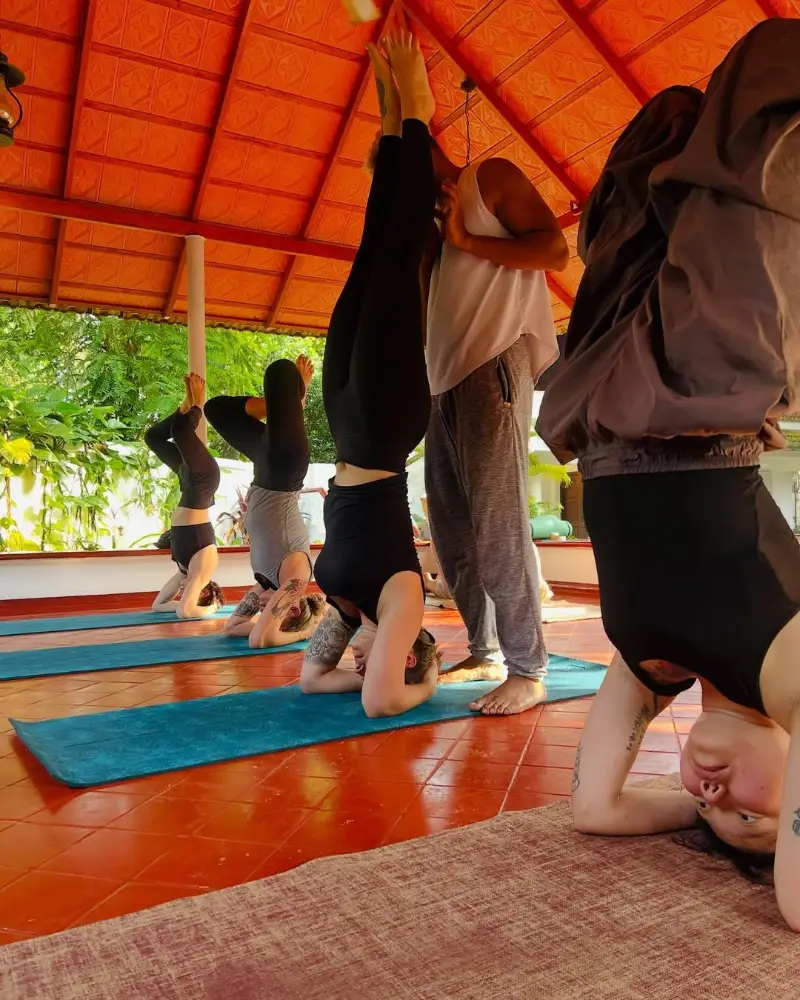
An honest note, since the photographs on this site show a fairly bare pavilion. Traditional hatha in the Sivananda line uses fewer props than an Iyengar room, where the whole method is built around them. In our daily classes you will mostly meet blankets, a few blocks, straps for the reclining hamstring work, and the wall.
Mats and what you need are provided — you do not need to arrive carrying anything. If you have a shoulder, knee or back that needs particular support, say so before class and we will set you up properly, or take a private session and work it out once, properly, rather than every week.
Common questions
Do I need yoga props as a beginner?
No, but a firm folded blanket helps almost everyone immediately, because sitting flat on the floor tips the pelvis backwards and rounds the lower back. Beyond that, improvise: books for a block, a dressing-gown belt for a strap, a rolled duvet for a bolster.
What can I use instead of a yoga block?
A stack of thick books or a sturdy box, tested first to be sure it holds your weight. For sitting on, a firm folded blanket or a cushion is usually better than a block anyway.
Which height should I use my block at?
Start tall and lower it as the pose opens. In triangle, the test is whether your chest can still turn open — if it cannot, the block is too low. The three heights are three different props; most people never turn the block and so only ever use one.
Are yoga props cheating?
No. A prop does not make a pose easier; it makes the pose possible in its correct shape, which is often harder work than the collapsed version. Some students set props aside within a year, others never will because of the shape of their own bones, and neither is failure.
Do I need to bring props to class in Fort Kochi?
No. Mats and what you need are provided. If you have a shoulder, knee or back that needs particular support, mention it before class and the teacher will set you up.

Known to his students as Achu, Aksharanand trained in the Sivananda tradition and holds an Advanced Teacher Training Certificate. He has taught Hatha Yoga, pranayama, meditation and Vedanta philosophy in Fort Kochi for over fifteen years, across more than 5,000 group classes and seventy international teacher training batches.
More about Achu and the school · Book a class or ask a question