
In short
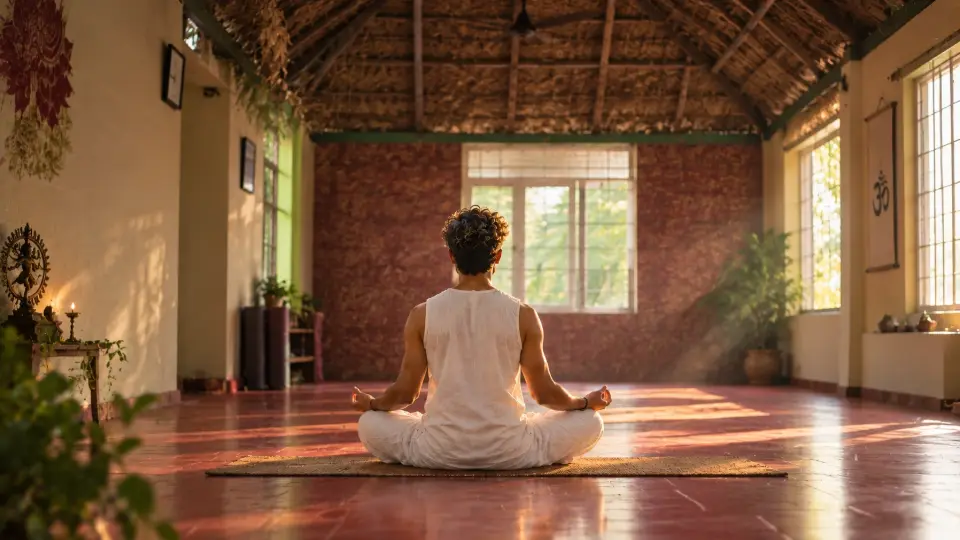
Sit so that your hips are higher than your knees — on a cushion, a folded blanket, a block, a meditation bench, or a chair. That single adjustment solves most back pain in sitting, because it lets the pelvis tip forward and the spine stack above it. Cross-legged, kneeling and sitting on a chair are all correct. Lotus is not the goal and should never be forced: knee pain means come out. Start at five or ten minutes and let the sitting time grow with the practice.
The Yoga Sutras give two words for what a sitting posture needs to be: sthira and sukham — steady, and comfortable. That is the whole specification, and it is usually translated into a picture of someone in full lotus, which is where the trouble starts.
The posture is not the practice. It is the thing that lets you forget about your body for twenty minutes.
The one rule
Your hips must be higher than your knees. Almost everything else is preference.
Here is why. Sit flat on the floor cross-legged and, unless you are unusually mobile, your pelvis rolls backwards. The lower back rounds to compensate, the upper back follows, the head comes forward, and within five minutes the muscles down your spine are holding you up by force. That is the ache.
Raise the sitting bones a few inches and the pelvis tips slightly forward instead. The lumbar curve returns, the spine stacks, and the muscles can stop working. The same skeleton, held for the same twenty minutes, with completely different results.
How high? Enough that your knees rest lower than your hip crease without effort. For most people that is two to six inches. Test it by sitting and noticing whether you are being held up or holding yourself up.
Five ways to sit
| Position | How | Suits |
|---|---|---|
| Easy cross-legged Sukhasana | On a firm cushion or two folded blankets, ankles crossed loosely in front, knees lower than hips. Swap which shin is in front between sessions. | Most people, most of the time |
| Kneeling Vajrasana | Kneel and sit back on a cushion placed between the heels, or on a small sloped meditation bench. Takes all the demand off the hips. | Stiff hips; anyone whose knees are fine in flexion |
| Half lotus Ardha padmasana | One foot up on the opposite thigh, the other tucked beneath. Alternate sides, or it builds asymmetry. | Open hips, and only if the knee is silent |
| Full lotus Padmasana | Both feet on the opposite thighs. Extremely stable when it is genuinely available, and available to a minority of adults. | Rarely, and never by force |
| A chair | Feet flat, sitting forward off the backrest, a cushion under the sitting bones tilting you slightly forward. A folded blanket behind the lower back if you need the support. | Anyone. Including me, on a bad knee day |
There is no hierarchy here, whatever the iconography suggests. A person sitting still on a chair for thirty minutes is meditating more successfully than a person in half lotus counting down the seconds.
Why lotus is not the goal
Lotus asks for a large amount of external rotation at the hip. If the hip provides it, the pose is comfortable and famously stable — the shape locks the legs and the spine stands up by itself.
If the hip does not provide it, the rotation has to come from somewhere, and the only joint available is the knee. The knee is a hinge. It bends and straightens; it is not built to twist under load, and the menisci and ligaments are what pay for it.
This is not a theoretical risk. Knee injuries from forced lotus are one of the more common serious injuries in yoga, and they are slow to heal.
The rule: knee pain in a seated posture means come out immediately. Not breathe into it. Hip sensation is negotiable; knee sensation is not.
If you want to work towards lotus, work on the hips — see yoga for tight hips — and let the knee be the thing you protect while you do. Or do not bother. It confers nothing.
The rest of the body
- Spine. Upright without bracing. A useful image: the crown of the head lifting, the shoulders heavy.
- Chin. Very slightly down, so the back of the neck is long. Chin jutting forward is the commonest fault and produces neck ache within ten minutes.
- Shoulders. Roll them back and let them drop. Then forget them.
- Hands. Palms down on the thighs is grounding; palms up is receptive; chin mudra, index finger and thumb touching, is traditional. Any of them. The one thing that matters is that your hands rest somewhere your shoulders do not have to hold them.
- Eyes. Closed, or softly open with the gaze low and unfocused a metre or so in front. Open eyes help if you are sleepy or if closing them makes you anxious.
- Jaw and tongue. Teeth apart, tongue resting behind the upper teeth. People clench without noticing.
- Breath. Leave it alone. This is not pranayama.
When your legs go numb
Almost everyone gets this, and it worries people more than it should.
Pins and needles or numbness in the feet, coming on gradually, is usually simple pressure on the blood supply or on a nerve where it passes near the surface. It resolves within a minute or two of moving, and it is not causing damage.
What to do about it:
- Move. You are allowed. Shifting position is not a failure of concentration; sitting rigidly through numbness is not a virtue.
- Sit higher. Most numbness comes from the thighs being compressed against the floor or against each other. Height solves it.
- Loosen your trousers. Genuinely — tight waistbands and jeans are a common cause.
- Change the crossing of your legs halfway through, or swap to kneeling.
What is not normal: numbness that persists for more than a few minutes after you stand, weakness in the foot, or a sharp shooting pain down the leg. Those are worth mentioning to a doctor.
How long to sit
Start at five minutes. Genuinely five.
The instinct is to sit for thirty because that sounds like meditating, then to find it unbearable, then to conclude you cannot meditate. Five minutes daily builds the habit and the posture tolerance together, and both need time.
A reasonable progression: five minutes for a fortnight, ten for a month, then let it find its own length. Twenty minutes is a good working session for most people. The sitting stops being the obstacle somewhere around week three, which is roughly when most people would have quit.
Set a timer, so you are not checking. Our guide to meditating every day covers what to do once you are sitting; this piece is only about the sitting.
Practical details
- A firm cushion beats a soft one. Soft cushions compress and you sink back to floor height within minutes. A folded wool blanket is excellent and cheap. See our guide to props.
- A wall is fine. Sitting with your back near a wall, not slumped against it, helps while you build endurance.
- Warmth matters. A still body cools. A shawl over the shoulders is standard practice in India for exactly this reason, and you will see it in every meditation hall.
- Same place, same time. The body learns the cue faster than the mind does.
- Sit before you eat, not after. Digestion makes sitting uncomfortable and sleepy.
Learning to sit here
Every class here ends with sitting, and we keep blankets and cushions for it. If you have knees that object, a back that complains, or a hip that will not let you cross your legs at all, say so and you will be set up on a chair without ceremony — that is what it is there for.
We also run a separate meditation class; the timing depends on the season, so ask. Meditation in Fort Kochi covers what is available in the town more broadly, and the teacher training spends real time on posture, because a month of twice-daily sitting sorts out most people’s arrangements one way or another.
Common questions
Do I have to sit cross-legged to meditate?
No. Cross-legged, kneeling on a cushion or bench, and sitting on a chair are all correct. The only requirement is that your hips are higher than your knees, so the pelvis can tip forward and the spine can stack without muscular effort.
Can I meditate sitting on a chair?
Yes, and it is a perfectly good option, not a concession. Sit forward off the backrest with your feet flat and a cushion under the sitting bones to tilt you slightly forward.
Why do my legs go numb when I meditate?
Usually pressure on the blood supply or a surface nerve from the thighs being compressed. It resolves within a minute or two of moving and is not causing harm. Sit higher, loosen tight waistbands, and change position when you need to — moving is allowed. Numbness that persists after standing, or weakness in the foot, is worth a doctor.
How do I learn to sit in lotus?
By opening the hips, not by forcing the legs. Lotus needs a great deal of external rotation at the hip, and if the hip cannot provide it the twist goes through the knee, which is a hinge and is damaged by it. Knee pain means come out immediately. Lotus is not required for meditation and confers nothing.
How long should a beginner sit for?
Five minutes daily, for a fortnight. Then ten for a month, then let it find its own length. Sitting stops being the obstacle at around week three, which is about when most people would otherwise have given up.

Known to his students as Achu, Aksharanand trained in the Sivananda tradition and holds an Advanced Teacher Training Certificate. He has taught Hatha Yoga, pranayama, meditation and Vedanta philosophy in Fort Kochi for over fifteen years, across more than 5,000 group classes and seventy international teacher training batches.
More about Achu and the school · Book a class or ask a question