
In short
Start with five minutes at the same time every day, sitting upright on a cushion or chair with the spine tall. Give attention one thing to rest on — usually the breath — and when you notice you have wandered, return without commentary. Noticing the wandering is the repetition that trains attention. Do a few minutes of slow breathing first, which settles the body and makes sitting far easier, and build the length only once the habit is established.
Meditation has a reputation problem. It is sold as a state — serene, thought-free, faintly glowing — and measured against that, everybody fails immediately.
The tradition it comes from describes something much more ordinary, and much more achievable.
What meditation actually is
In the classical scheme, meditation is the seventh of the eight limbs of yoga. The limb before it, dharana, is concentration: repeatedly bringing attention back to one object. Dhyana, meditation, is what happens when that returning becomes continuous and effortless.
Read that again, because it contains the whole instruction. The practice is the returning. Not the absence of thought — the noticing that you have drifted, and coming back. Every time that happens you have done one repetition. A distracted twenty minutes in which you notice fifty times is fifty repetitions, and it is better training than a placid twenty minutes in which you half-doze.
So the sentence "I cannot meditate, my mind is too busy" describes someone doing the exercise, not someone unable to.
Why breathing comes first
Traditional practice does not ask you to sit down cold. In the eight limbs, posture and breath control come before concentration, and the order is practical rather than ceremonial.
A body that has moved a little sits more comfortably. A breath that has been slowed deliberately for five minutes produces a mind that is markedly easier to settle. Trying to meditate on top of an agitated nervous system is doing the work in the hardest possible order.
So: a few minutes of movement if you have them, then five minutes of slow breathing — alternate-nostril is ideal, and it is described in pranayama for beginners — and then sit. This is why a class here ends with a short meditation rather than beginning with one.
How to sit
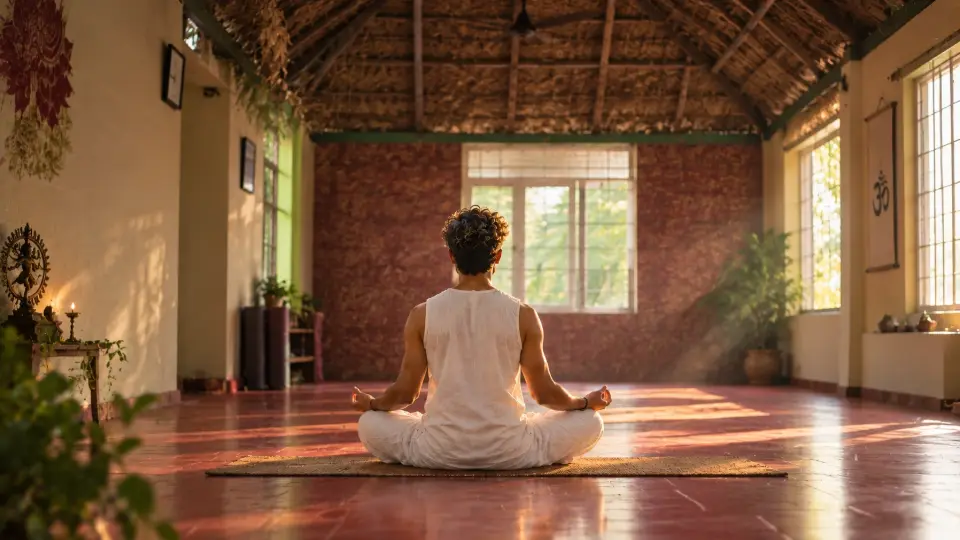
The only requirement is an upright spine that you can hold without strain.
- On the floor: sit on the front edge of a firm cushion so the hips are higher than the knees. This one adjustment solves most people's back complaints. Cross the legs comfortably; lotus is not required and never has been.
- On a chair: entirely acceptable. Feet flat, sit forward off the backrest, spine tall.
- Hands resting on the knees or in the lap. Mudras have their place but are not necessary.
- Eyes closed, or softly open with a low gaze if closing them makes you drowsy or uneasy.
- Chin very slightly down, so the back of the neck is long.
Set a timer so you are not wondering about the time. Put the phone out of reach afterwards.
The method
Give attention one thing to rest on. For most beginners the breath is the best choice, because it is always present and it cannot be done wrong.
- Settle, and take three slower breaths to arrive.
- Let the breath return to normal. Do not manage it.
- Rest attention where the breath is most obvious — the nostrils, or the rise and fall of the belly. Pick one and stay there.
- When you notice you are elsewhere, come back. No commentary, no scoring.
- Repeat until the timer goes.
If the breath is too subtle to hold on to, count: one on the inhale, two on the exhale, up to ten, then start again. Losing count is normal and is simply another opportunity to begin again.
Mantra works the same way, with a repeated sound in place of the breath. Any of these is a complete practice; switching between them weekly is not.
What to do with a busy mind
Nothing. That is the honest answer.
You are not trying to empty the mind, suppress thoughts, or push anything away — pushing is just another kind of engagement. Let thoughts arrive and let them go past. The moment you realise you have been carried off is the valuable moment, not the failure.
Two practical notes. If you are sleepy, open the eyes a little, sit up taller, and do not meditate lying down. If you are agitated, do more breathing before you sit and make the sit shorter — five minutes on a bad day is a win.
And if turning attention inwards consistently makes you feel worse rather than calmer, which happens for some people, practise with the eyes open, keep it brief, and talk to a teacher or a professional rather than pushing through.
Making it daily
This is the part that actually decides whether it lasts.
- Five minutes. Genuinely. Long enough to be a practice, short enough that you will not avoid it.
- Same time, same place. Early morning is traditional and it works, largely because nothing has happened yet to argue with.
- Attach it to something existing — after the kettle goes on, after you get off the mat.
- Keep the seat set up so there is nothing to arrange.
- Missing a day is not the end. Missing a day and deciding you are not a person who meditates is the end. Sit again tomorrow.
Going longer
Add a couple of minutes a week once five feels short rather than long. Twenty minutes is a good destination and many people stay there for years.
Sitting with other people makes longer sits considerably easier — the room does some of the work, and nobody gets up early. If you are in Kerala, there is more on where and how in meditation in Fort Kochi, and the school runs a separate meditation class alongside the daily yoga.
What changes, in the end, is not the twenty minutes. It is that you become slightly quicker to notice where your attention has gone during the other twenty-three hours. That is the whole return on the investment, and it is a large one.
Common questions
How long should a beginner meditate?
Five minutes a day, at the same time, is the right place to start. It is long enough to be a real practice and short enough that you will not talk yourself out of it. Add a couple of minutes a week once five feels short.
What do I do when my mind keeps wandering?
Come back to the breath, without commentary. Noticing that you wandered is the exercise, not a failure of it — a distracted sit in which you notice fifty times is fifty repetitions of exactly the skill you are training.
Do I have to sit cross-legged to meditate?
No. A chair is completely acceptable. The only requirement is an upright spine you can hold without strain. If you do sit on the floor, use a firm cushion so the hips are higher than the knees. How to sit for meditation goes through the five positions in detail.
Should I meditate before or after yoga?
After. Movement and slow breathing settle the body and make sitting much easier, which is why the traditional order puts posture and breath control before concentration, and why a class ends with a short meditation rather than starting with one.

Known to his students as Achu, Aksharanand trained in the Sivananda tradition and holds an Advanced Teacher Training Certificate. He has taught Hatha Yoga, pranayama, meditation and Vedanta philosophy in Fort Kochi for over fifteen years, across more than 5,000 group classes and seventy international teacher training batches.
More about Achu and the school · Book a class or ask a question