
In short
Hips feel tight for several different reasons — sitting, protective muscular tension, weakness, and the shape of your own bones — and only some of them respond to stretching. Six poses do most of the useful work: low lunge, half pigeon, reclining figure-four, bound angle, garland squat and happy baby. Hold each 45 to 60 seconds, four or five days a week, and expect change over weeks rather than days. Pain in the front crease of the hip is a stop sign, not a stretch to breathe into.
"Tight hips" is the second most common complaint in a beginners' class, just behind tight hamstrings, and it is a vaguer phrase than it sounds. The hip is crossed by about twenty muscles. "Tight" could mean any of them, or none of them.
This is what actually helps, what to leave alone, and the one piece of anatomy that would save a great many students a great deal of frustration.
What tightness usually is
Four different things get reported as the same sensation.
- Short hip flexors from sitting. Hours in a chair hold the front of the hip in a shortened position. This is the classic, and it does respond to stretching.
- Protective tension. The nervous system restricts range it does not trust. This is why you are looser at the end of class than at the start, without any tissue having changed length.
- Weakness pretending to be tightness. Hips that cannot control a position often feel stiff in it. Glutes that do not fire leave the small muscles around the joint gripping.
- Bone. Which is the part nobody mentions.
The part about bone
The hip is a ball and socket. How deep the socket is, which way it faces, the angle of the femoral neck and where the thigh bone meets the pelvis vary enormously between people — far more than most students imagine.
What this means in practice: two people doing the same pose with identical effort will stop in different places, and no amount of practice moves that limit, because bone does not stretch. When you feel a hard, sudden end to a movement — a block rather than a pull — that is usually bone meeting bone.
This matters because a student who assumes their limit is muscular will keep pushing into a joint that has already run out of room. Some people have a shape called femoroacetabular impingement, where the bones make contact earlier than usual, and deep hip flexion with rotation is exactly the position that provokes it.
The useful reframe: depth is not the goal, sensation is. If you feel a broad stretch in the muscle, the pose is working, whether your knee is a foot off the floor or resting on it.
Six poses that do the work
| Pose | What it reaches, and how | Hold |
|---|---|---|
| Low lunge Anjaneyasana | The hip flexors at the front — the sitting muscle. Back knee down on a blanket, pelvis tucked slightly under, sink forward. Most people arch the lower back instead and feel nothing. | 60s each side |
| Half pigeon Eka pada rajakapotasana | The outer hip and glute. Front shin angled, hips square, a cushion under the front hip so the pelvis is level. See the caution below. | 60s each side |
| Reclining figure-four Supta kapotasana | The same muscles as pigeon, on your back, with no body weight pressing into the joint. The safest version and, for many people, the better one. | 60s each side |
| Bound angle Baddha konasana | The inner thigh. Sit on a folded blanket, soles together, and let gravity work. Do not press the knees down with the hands. | 90s |
| Garland squat Malasana | Everything at once — ankles, inner thigh, deep hip. Heels on a rolled blanket if they lift. | 60s |
| Happy baby Ananda balasana | Deep hip and lower back, on the floor, entirely controllable. A good one to end on. | 60s |
Warm up first. A few rounds of Surya Namaskar, or do this after a walk. Cold hips are unresponsive and slightly grumpy.
About pigeon pose
Pigeon is the pose everyone means when they say hip opener, and it deserves an honest paragraph.
It asks the front hip to fold and rotate outwards while your body weight presses down into the joint. For a hip with room, that is a strong, effective stretch. For a hip whose bones meet early, it is the precise combination that closes the front of the joint down — and the sensation people then describe is a pinch in the crease at the front, which they interpret as tightness and press further into.
Two practical rules:
- Pinching in the front crease means come out. Not breathe into it. Come out, and use reclining figure-four instead, which gives you the same muscles with no compression.
- Support the hip. If the front hip is off the floor, the pelvis is twisted and the knee takes the strain. A cushion or folded blanket under it changes the pose completely.
Pigeon is not compulsory. Nothing is lost by replacing it permanently.
The half that gets left out
Stretching alone rarely settles a hip that has been complaining for years. Strength through the range matters at least as much, and hips are where this is most neglected.
- Bridge — glutes and the back of the hip, which are usually the weak link in a desk-bound body.
- Chair pose and held warrior II — the hip working while lengthened, which is what it actually has to do when you walk.
- Side-lying leg lifts — the small outer hip muscles that stabilise every step.
- Standing balance, tree pose or simply standing on one leg while cleaning your teeth. Balance is a hip skill.
A hip that is strong through its range keeps the range. A hip that is only stretched tends to tighten again by the following week.
How long, how often
- 45 to 60 seconds a hold, one or two rounds each side.
- Four or five days a week. Frequency beats duration; ten regular minutes beats an hour on Sunday.
- Moderate intensity — four or five out of ten, where the breath stays even.
- Six to eight weeks before you can fairly judge whether it is working, longer if you sit all day.
If you sit for a living, the single most effective intervention is not a longer session. It is standing up more often. Our piece on desk-related pain makes the same argument about shoulders.
When it is not tightness
Three patterns that need a physiotherapist or doctor rather than a deeper stretch:
A pinch or ache deep in the front crease of the hip, especially on squatting or bringing the knee towards the chest, sometimes with clicking or catching. This suggests the bones or the labrum, and stretching aggravates it.
Groin pain that has come on gradually and hurts at the start of activity, or pain that wakes you at night.
Burning, tingling or a sharp line down the back of the leg rather than a broad muscular pull. That is nerve tension, and forward bends and deep hip work make it worse. Yoga for back pain covers this territory.
Yoga is patient. A fortnight spent getting something looked at costs nothing.
If you would rather be watched than read about
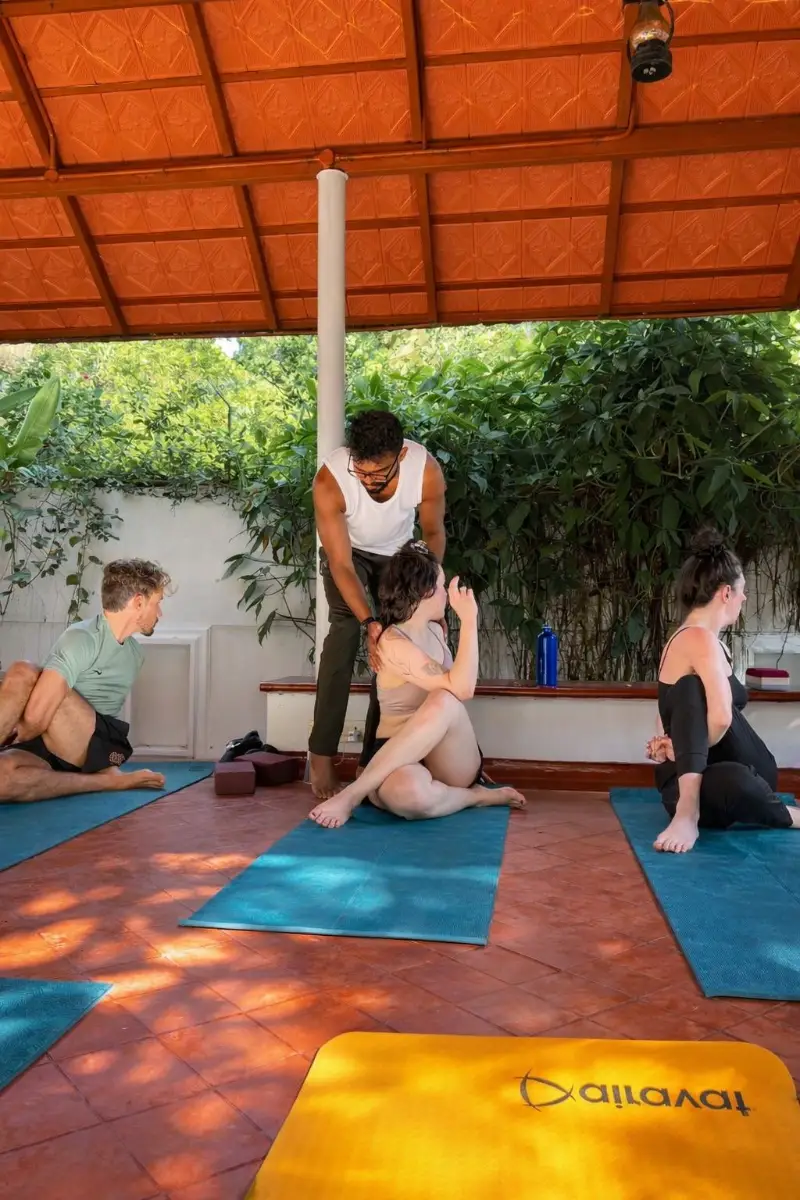
Hips are the clearest case for having someone look at you, because so much of the difficulty is invisible from the inside: you cannot see that your pelvis has rotated, or that the movement you think is coming from the hip is coming from the lower back.
Our daily classes hold postures long enough for this to be corrected, and a private session will tell you in half an hour whether what you have is a muscle that needs work, a joint that needs respecting, or a pelvis that will not move.
Common questions
How do you loosen tight hips with yoga?
Hold six poses — low lunge, half pigeon or reclining figure-four, bound angle, garland squat and happy baby — for 45 to 60 seconds each, four or five days a week, at moderate intensity. Add strength work such as bridges and held standing poses, because hips that are only stretched tend to tighten again.
Is pigeon pose bad for your hips?
Not in itself, but it is not for everyone. It combines deep folding, outward rotation and body weight pressing into the joint, which for a hip whose bones meet early closes down the front of the joint. If you feel a pinch in the front crease, come out and use reclining figure-four instead, which reaches the same muscles without the compression.
Why do my hips feel tight even though I stretch?
Usually because the limit is not muscular. It may be protective tension from the nervous system, weakness that feels like stiffness, or simply the shape of your own hip socket, which does not change with practice. Adding strength work and stretching less aggressively helps more than pushing further.
How long does it take to open tight hips?
You will feel looser within one session, but that is the nervous system settling rather than tissue lengthening. Give it six to eight weeks of regular practice before judging, and longer if you spend the day sitting.
Which yoga poses are best for hip flexors?
Low lunge is the most direct, provided you tuck the pelvis slightly under rather than arching the lower back — that single adjustment is the difference between feeling it and feeling nothing. Add held warrior poses and bridges for the strength side.

Known to his students as Achu, Aksharanand trained in the Sivananda tradition and holds an Advanced Teacher Training Certificate. He has taught Hatha Yoga, pranayama, meditation and Vedanta philosophy in Fort Kochi for over fifteen years, across more than 5,000 group classes and seventy international teacher training batches.
More about Achu and the school · Book a class or ask a question