
In short
A 28-day 200-hour training is a full-time month. Most days start before six with pranayama and a two-hour practice, then classes in philosophy, anatomy and teaching methodology, a second practice in the afternoon, and study or teaching practice in the evening. The four subjects are technique and practice, teaching methodology, anatomy and philosophy. You begin teaching your fellow students in the third week, and assessment is usually a taught class plus a written paper. One day a week is free.
People arrive at a teacher training with two different pictures in their heads. One is a holiday with yoga in it. The other is a month of silent austerity. It is neither. It is closer to a full-time month at college, with an early start and a lot of physical practice, among people you will know very well by the end.
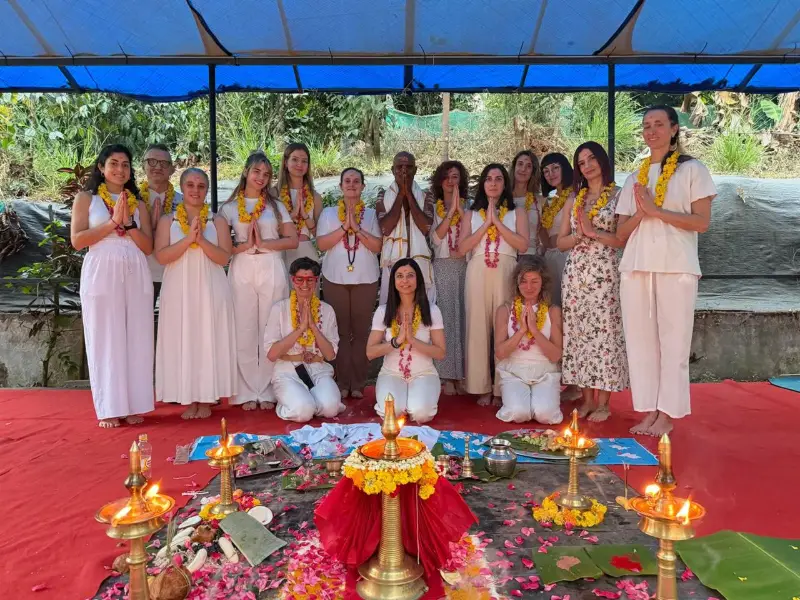
This is what the month is actually like, based on how our own 28-day yoga teacher training in Fort Kochi, Kerala runs and how most traditional schools in India work. If you are still choosing a school, start with the 12-point checklist.
A day, hour by hour
Almost every traditional school in India follows a version of this shape. The times move by half an hour here and there; the rhythm does not.
| Time | What happens |
|---|---|
| 5:30 – 6:00 am | Wake, wash, a cup of tea. No breakfast yet. |
| 6:00 – 6:30 am | Pranayama and meditation, while the mind is still quiet. |
| 6:30 – 8:30 am | The main practice: sun salutations and the posture sequence. |
| 8:30 – 9:30 am | Breakfast. The first food of the day, and the loudest hour. |
| 10:00 – 11:30 am | Philosophy, or anatomy. |
| 11:30 am – 1:00 pm | Teaching methodology: how to sequence, cue, watch and adjust. |
| 1:00 – 3:30 pm | Lunch and rest. In Kerala this is the hot part of the day, and the rest is not optional. |
| 3:30 – 5:30 pm | Second practice, often slower, with posture clinics and adjustments. |
| 5:30 – 7:00 pm | Teaching practice in small groups, or chanting, or a workshop. |
| 7:00 pm | Dinner, then reading, notes, and sleep earlier than you would believe. |
That is around ten hours of contact time a day, six days a week. Two hundred hours sounds abstract until you see it divided up like this.
The four subjects
Whatever the school, a 200-hour syllabus rests on four legs:
- Technique and practice. The postures themselves, the breathing practices, relaxation and meditation. This is the largest part, and most of it is done on your own mat.
- Teaching methodology. How to build a class, how to say the thing you mean in six words, where to stand, when to touch and when not to, and how to teach a room where one person is stiff and another is bending in half.
- Anatomy and physiology. Enough to keep people safe: the spine, the hips and shoulders, joints that do not like being forced, and the common conditions that walk into a class.
- Philosophy and ethics. The eight limbs, the Yoga Sutras, and what it means to take money for teaching something that was given freely.
Schools differ most in the last one. A course built only on postures and anatomy produces confident teachers with nothing underneath. A course that is all philosophy leaves you unable to run a room.
How the month unfolds
| Week | What it feels like |
|---|---|
| One | Everything is new and everything aches. You sleep badly, the heat is unfamiliar, and you wonder whether you are fit enough. Almost everyone feels this. |
| Two | The body adapts. The timetable stops feeling like an imposition. This is often when the philosophy classes start to land. |
| Three | The hardest week. You start teaching in front of people, you are tired in a deep way, and small irritations grow. It passes. |
| Four | Assessment, the final taught classes, and a strange, full feeling at the end. Most people want another week. |
When you start teaching
Usually in the third week, in groups of three or four: one of you teaches ten minutes, the others practise and then say what worked. It is uncomfortable and it is the single most useful hour of the course.
By the last week you will teach a full class or a substantial part of one, with a teacher watching. Most people discover the same two things: that they talk far too much, and that they forget to look at the room.
Assessment, and whether people fail
Assessment is normally a class you teach, a written paper on philosophy and anatomy, and a mark for attendance and participation. Schools also watch how you treat the people around you for a month, which is harder to fake than a paper.
Outright failure is rare, because a month of daily contact means nobody arrives at the last day as a surprise. Honest schools will, though, hold back a certificate or ask someone to repeat part of the course rather than pass a teacher who is not safe to lead a room. A school that promises certification to everyone, whatever happens, is telling you what the certificate is worth.
The parts nobody mentions
- You are tired in the second week in a way that sleep does not immediately fix.
- Your body will complain somewhere: wrists, hamstrings, a shoulder. Good schools expect this and modify. It is normal to spend a week doing a gentler version of the sequence.
- Group living is intense. Twelve to twenty people, one timetable, one dining table, a month. Friendships form fast, and so does friction.
- Emotions surface. Long practice, little distraction and early mornings do that. It is ordinary, and it usually passes within a day.
- The free day matters. Use it to rest, wash clothes and go to the sea, not to sightsee three towns.
Who a month-long course suits
You do not need advanced postures. You do need about six months of regular practice, so the shapes are familiar and the month can be about teaching rather than surviving. You also need to be able to give the month fully; trying to work remotely alongside it is the most reliable way to have a miserable four weeks.
If that sounds like the wrong shape for you now, a series of private sessions or simply practising daily for a season is a better use of the money. If it sounds right, our six-week preparation plan covers how to arrive ready, and what to pack deals with the rest.
Common questions
How many hours a day is a 200-hour yoga teacher training?
About ten hours of scheduled time a day, six days a week: two practices of around two hours each, roughly three hours of classroom subjects, and teaching practice in the evening. One day a week is free.
Do you need to be advanced to do a yoga teacher training?
No. Around six months of regular practice is enough, so the postures are familiar. You do not need headstand, splits or any advanced posture to train as a teacher, and a good school will not ask for them.
Can you fail a yoga teacher training?
It is rare, because teachers see you every day for a month and correct problems as they appear. A serious school will still withhold or delay a certificate rather than pass someone who is not ready to teach safely.
What is taught in a 200-hour course?
Four subjects: technique and practice, teaching methodology, anatomy and physiology, and philosophy and ethics. Practice is the largest part; teaching methodology is what turns a practitioner into a teacher.

Known to his students as Achu, Aksharanand trained in the Sivananda tradition and holds an Advanced Teacher Training Certificate. He has taught Hatha Yoga, pranayama, meditation and Vedanta philosophy in Fort Kochi for over fifteen years, across more than 5,000 group classes and seventy international teacher training batches.
More about Achu and the school · Book a class or ask a question