
In short
The twelve basic postures of the Sivananda sequence are headstand, shoulderstand, plough, fish, seated forward bend, cobra, locust, bow, half spinal twist, crow or peacock, standing forward bend and triangle. They come after relaxation, pranayama and sun salutations, and before a long final relaxation. The order runs from inversions through forward and backward bends to twist, balance and standing postures, with each posture followed by one that counters it.
Walk into a Sivananda-style class anywhere in the world and you will recognise it within ten minutes. That consistency is deliberate. The sequence was designed so that a student could practise it for a lifetime, and so that each part would prepare the body for the next.
Where the sequence comes from
The twelve basic postures were set out by Swami Vishnudevananda, a disciple of Swami Sivananda of Rishikesh, when he brought the teaching to the West in the 1950s. He framed the whole practice as five points: proper exercise, proper breathing, proper relaxation, proper diet, and positive thinking with meditation. The twelve postures are the first of those five.
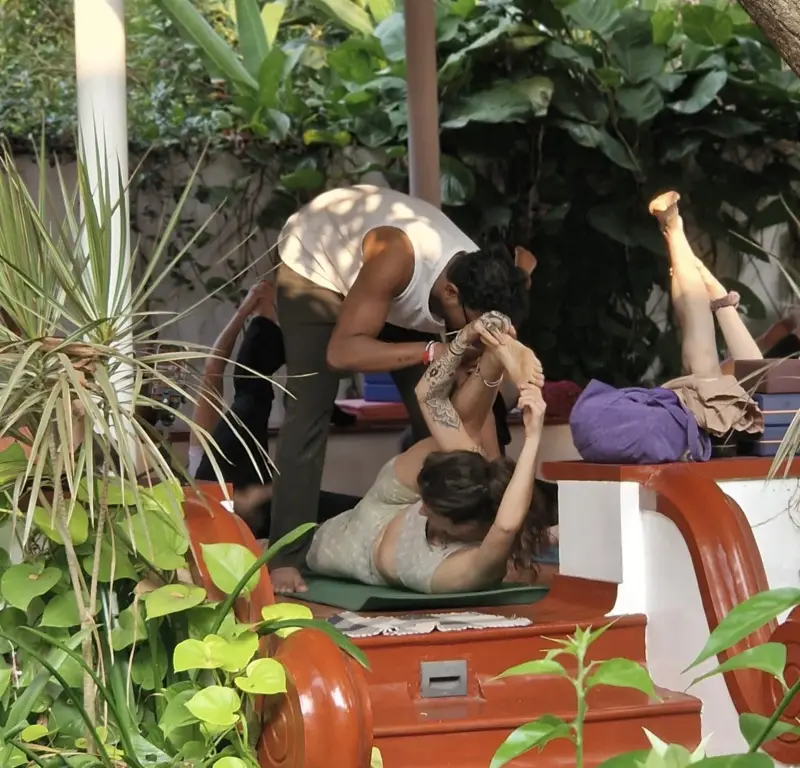
Master Aksharanand trained in this tradition, and the daily classes at the school follow the same shape, adapted to the people in the room. There is more on the lineage itself in Sivananda yoga in Kochi.
What comes before and after
The postures are never the start of the class. Before them come:
- Relaxation lying on the back, to arrive.
- Pranayama: kapalabhati and anuloma viloma, alternate-nostril breathing.
- Sun salutations, to warm the whole body. The twelve positions of surya namaskar.
- Leg raises, to strengthen the abdomen and lower back before inversions.
And after them comes a long final relaxation. Short rests lying in savasana also come between most of the postures. Take those out and you have a different practice.
The twelve, in order
- Headstand — Sirshasana. Called the king of the postures. The forearms carry the weight and the head rests lightly. Learned in stages, never forced. How to learn it safely.
- Shoulderstand — Sarvangasana. The queen, and the "all-limbs" posture. The body rises vertically from the shoulders, supported by the hands. A safe set-up.
- Plough — Halasana. Flows out of shoulderstand, the feet lowering behind the head. A deep stretch through the whole back of the body.
- Fish — Matsyasana. The counterpose to the shoulderstand group: the chest lifts, the crown of the head rests lightly, and the throat opens after being closed.
- Seated forward bend — Paschimothanasana. Legs straight in front, folding forward from the hips. Patience matters more than reach here.
- Cobra — Bhujangasana. The first of three backbends, lying face down. The chest rises with the back muscles doing most of the work.
- Locust — Shalabhasana. Legs lift from the floor. Strengthens the lower back and prepares for the bow.
- Bow — Dhanurasana. Hands hold the ankles and the body lifts into a curve. The strongest of the three backbends.
- Half spinal twist — Ardha Matsyendrasana. A seated twist that restores the spine after bending in both directions.
- Crow — Kakasana, or peacock — Mayurasana. An arm balance. Crow comes first, peacock much later.
- Standing forward bend — Pada Hasthasana. Folding forward from standing, hands towards the feet.
- Triangle — Trikonasana. A lateral stretch that finishes the sequence standing, before lying down again for the final relaxation.
Why this order
The sequence is built on a handful of principles, and once you see them it stops looking arbitrary.
Inversions first, while the body is fresh and the attention sharp. Going upside down asks the most of both.
Every posture has a counter. Shoulderstand and plough bend the neck forward; fish bends it back. Forward bend flexes the spine; the three backbends that follow extend it. The twist then brings the spine back to neutral. Nothing is left pulled in one direction.
The backbends build. Cobra uses the upper back, locust the lower, and bow uses both together. Each prepares for the next.
Standing work comes last, which surprises people used to other styles. By then the body is thoroughly warm and the standing postures become a gentle close rather than a warm-up.
Rest runs throughout. Short relaxations let the heart rate settle and let each posture's effect land before the next one begins.
If you cannot do them yet
Nobody can when they start. Each of the twelve has easier versions, and the sequence works with those in place:
- Headstand becomes dolphin, or headstand preparation with the feet on the floor.
- Shoulderstand becomes legs up the wall or half shoulderstand.
- Plough can be done with the feet on a chair behind you.
- The forward bends are done with the knees bent.
- Bow can be practised one side at a time.
- Crow is prepared by squatting with the hands on the floor and simply leaning forward.
The sequence was never meant to be a test you pass. It is a daily practice you grow into, and people who have practised it for thirty years are still working on the same twelve.
Practising it at home
A full class runs about ninety minutes to two hours. A short home version that keeps the shape:
- Five minutes of relaxation and breathing.
- Four to six rounds of sun salutation.
- Half shoulderstand or legs up the wall, then fish.
- Seated forward bend.
- Cobra, then locust.
- Half spinal twist.
- Triangle, each side.
- Ten minutes of final relaxation.
Leave out headstand and full shoulderstand at home until a teacher has shown you the set-up. Everything else here is safe to practise gently from the start. If you are in Fort Kochi, the daily classes walk through the full sequence with hands-on guidance.
Common questions
What are the 12 basic postures in Sivananda yoga?
Headstand, shoulderstand, plough, fish, seated forward bend, cobra, locust, bow, half spinal twist, crow or peacock, standing forward bend and triangle, practised in that order after relaxation, pranayama and sun salutations.
Why does Sivananda yoga start with headstand?
Inversions ask the most of the body and attention, so they come while both are fresh. The rest of the sequence then counters and balances them, ending with standing postures and a long relaxation.
Can beginners do the Sivananda sequence?
Yes. Every posture has an easier preparation — dolphin instead of headstand, legs up the wall instead of shoulderstand, bent knees in the forward bends — and the sequence keeps its shape with those in place.
How long does a full Sivananda class take?
Usually ninety minutes to two hours, including the opening relaxation, pranayama, sun salutations, the twelve postures with short rests between them, and a long final relaxation.

Known to his students as Achu, Aksharanand trained in the Sivananda tradition and holds an Advanced Teacher Training Certificate. He has taught Hatha Yoga, pranayama, meditation and Vedanta philosophy in Fort Kochi for over fifteen years, across more than 5,000 group classes and seventy international teacher training batches.
More about Achu and the school · Book a class or ask a question