
In short
Sivananda yoga is a classical Hatha tradition built on five points: proper exercise, breathing, relaxation, diet, and positive thinking with meditation. Its classes follow a steady sequence of breathing, sun salutations and twelve basic postures with rest between them. The official Sivananda centres in Kerala are in Trivandrum and at Neyyar Dam; in Kochi, you practise with teachers trained in the tradition.
Every week, someone searches for "Sivananda yoga Ernakulam" or "Sivananda yoga Kochi" and finds very little. That is not surprising, because there is no official Sivananda centre in the city. There are, though, teachers here who trained in the tradition, and I am one of them: I trained in the Sivananda tradition and hold its Advanced Teacher Training Certificate.
To be clear from the start: Santhi School of Yoga & Vedanta Studies is an independent school and is not part of the Sivananda organisation. What follows explains the tradition itself, where its official centres in Kerala are, and how its teaching shapes classes like ours. If you just want times and prices, see our guide to yoga in Fort Kochi.
- Tradition
- Classical Hatha Yoga
- Foundation
- Five points of yoga
- Core sequence
- Twelve basic postures
- Official centres in Kerala
- Trivandrum and Neyyar Dam
- In Kochi
- Teachers trained in the tradition
- Pace
- Held postures, rest between
Where Sivananda yoga comes from
The tradition takes its name from Swami Sivananda of Rishikesh, a physician who became a monk and one of the most influential yoga teachers of the twentieth century. His teaching joined the physical practice of Hatha Yoga with philosophy, devotion, selfless service and meditation.
His disciple Swami Vishnudevananda founded the Sivananda Yoga Vedanta Centres and shaped that teaching into a form that ordinary students could practise every day: five simple points, and a class built around twelve basic postures. That structure is what most people mean today when they say "Sivananda yoga".
The five points of yoga
| Point | What it means in practice |
|---|---|
| 1. Proper exercise — asana | Postures that keep the spine supple and the body strong, practised slowly and held |
| 2. Proper breathing — pranayama | Full, conscious breathing, and specific breathing practices at the start of class |
| 3. Proper relaxation — savasana | Deliberate rest between postures and at the end, so the body absorbs the practice |
| 4. Proper diet — vegetarian | Simple, fresh, vegetarian food that supports a calm, clear mind |
| 5. Positive thinking and meditation — Vedanta and raja yoga | Training the mind: study, reflection and regular meditation |
Only the first three happen on the mat. The point of the tradition is that yoga does not stop when the class ends. The fifth point draws on Vedanta, and the wider path is set out in the eight limbs of yoga.
The twelve basic postures
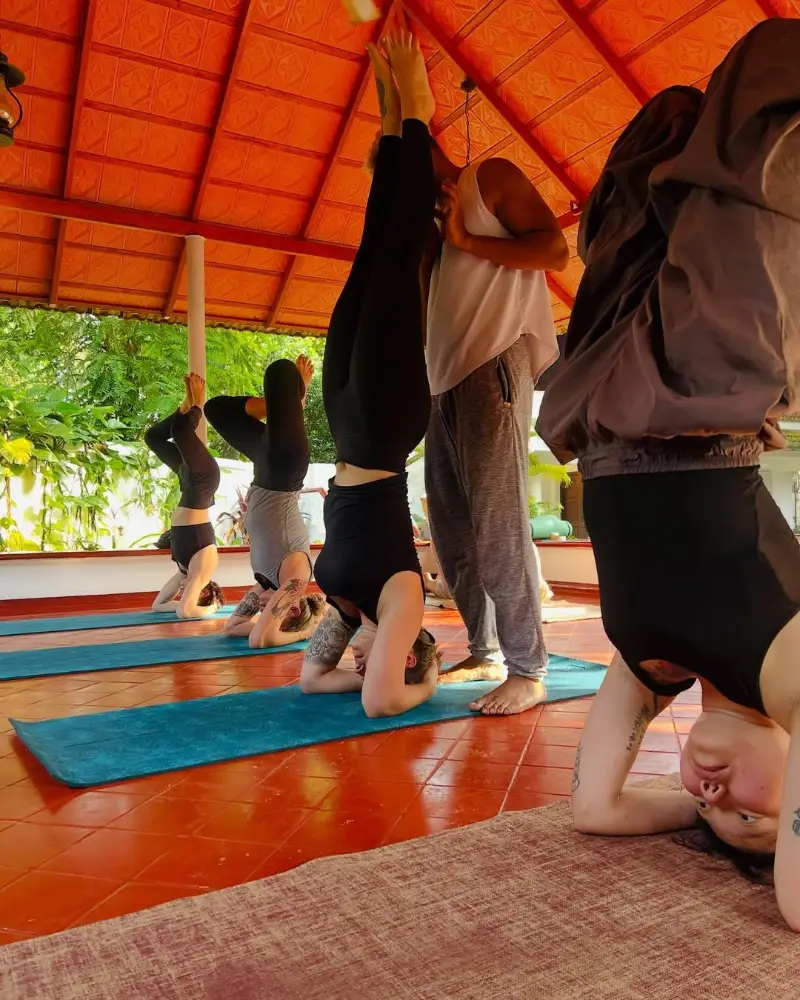
At the heart of a Sivananda class is a sequence of twelve postures, practised in a set order so that every part of the body is moved and then counterbalanced. Beginners work towards them gradually, with easier versions.
- Headstand — Sirsasana
- Shoulderstand — Sarvangasana
- Plough — Halasana
- Fish — Matsyasana
- Seated forward bend — Paschimottanasana
- Cobra — Bhujangasana
- Locust — Salabhasana
- Bow — Dhanurasana
- Half spinal twist — Ardha Matsyendrasana
- Crow — Kakasana
- Standing forward bend — Pada Hastasana
- Triangle — Trikonasana
What a class in the tradition involves
A class shaped by Sivananda teaching is recognisable by its rhythm rather than its difficulty:
- Settling and relaxation, often with a short chant.
- Breathing practices, such as kapalabhati and alternate nostril breathing.
- Sun salutations to warm the body — we have written out the Sivananda Sun Salutation step by step.
- The postures, held rather than flowed through, with short rests between.
- A long final relaxation.
Compared with a Vinyasa class, it is slower, quieter and more systematic. That is precisely why it suits beginners, and why many experienced practitioners come back to it.
Where to practise Sivananda yoga in Kerala
| Where | What it is | From Kochi |
|---|---|---|
| Sivananda Yoga Vedanta Dhanwantari Ashram, Neyyar Dam | The organisation's official ashram in Kerala, with residential courses and yoga vacations | Near Trivandrum, about 230 km south |
| Sivananda Yoga Vedanta Centre, Trivandrum | The official city centre, with classes and courses | Trivandrum, about 200 km south |
| Teachers trained in the tradition, in Kochi | Independent classes rooted in Sivananda training, such as ours in Fort Kochi | Local |
If you want the full, official experience — a residential stay, the complete daily schedule, the organisation's own teacher training — go to Neyyar Dam. Details and current programmes are on the Sivananda Yoga India website. If you want to practise regularly in Kochi, a teacher trained in the tradition is the practical choice.
Practising in the tradition in Fort Kochi
Our classes follow the traditional rhythm I was trained in: an opening relaxation to settle the body and mind, then pranayama and Surya Namaskar, then postures for every level, and a deep final relaxation. They run for two hours, mornings 7:30–9:30 am and afternoons 3:30–5:30 pm, in English, with all levels welcome. A drop-in class is ₹500 (a limited-time offer; normally ₹600, and ₹700 from November 2026).
We teach in our own way, as an independent school, and we do not use the Sivananda name for our courses. But if what drew you to Sivananda yoga was its patience, its breath-led pace and its sense that yoga is more than exercise, you will recognise it here.
Practise with us in Fort Kochi
Traditional two-hour Hatha Yoga classes, mornings 7:30–9:30 am and afternoons 3:30–5:30 pm. All levels, no booking needed. Message us for the day’s schedule.
The twelve postures at the heart of the tradition are set out one by one, with the reasoning behind their order, in the 12 basic postures of Sivananda yoga.
Common questions
Is there a Sivananda yoga centre in Kochi or Ernakulam?
Not an official one that we are aware of. The official Sivananda Yoga Vedanta centres in Kerala are the city centre in Trivandrum and the ashram at Neyyar Dam. In Kochi you can practise with independent teachers trained in the tradition.
What are the five points of Sivananda yoga?
Proper exercise (asana), proper breathing (pranayama), proper relaxation (savasana), proper diet (vegetarian), and positive thinking and meditation (Vedanta and raja yoga), as set out by Swami Vishnudevananda.
What are the 12 basic postures in Sivananda yoga?
Headstand, shoulderstand, plough, fish, seated forward bend, cobra, locust, bow, half spinal twist, crow, standing forward bend and triangle, practised in that order with rest between them.
Is Sivananda yoga good for beginners?
Yes. Its slow, systematic pace, the rest between postures and the emphasis on breathing make it one of the most beginner-friendly traditions. Harder postures such as headstand are approached gradually, with easier versions first.
How is Sivananda yoga different from Vinyasa?
Sivananda classes hold postures and rest between them in a largely fixed sequence. Vinyasa links postures into continuous flowing movement that changes from class to class, so it feels faster and more like a workout.
Is Santhi Yoga a Sivananda centre?
No. Santhi School of Yoga & Vedanta Studies is an independent school. Our teacher, Master Aksharanand A S, trained in the Sivananda tradition and holds its Advanced Teacher Training Certificate, and that training shapes how he teaches.

Known to his students as Achu, Aksharanand trained in the Sivananda tradition and holds an Advanced Teacher Training Certificate. He has taught Hatha Yoga, pranayama, meditation and Vedanta philosophy in Fort Kochi for over fifteen years, across more than 5,000 group classes.