
In short
The best yoga class in Fort Kochi is the one whose length, style and group size match what you actually want. A traveller with one free morning, a beginner with a stiff back and someone training to teach are all looking for different rooms. Judge a class on group size, how long it runs, whether the teacher corrects you by hand, and whether they ask about injuries before you start.
Search for the best yoga in Fort Kochi and you get listings, star ratings and a handful of sponsored results. None of them tell you the thing that matters: whether that particular room, on that particular morning, suits you.
I have taught in the same quarter of Fort Kochi for over fifteen years, so I am not a neutral voice here. What follows is still the advice I give people who message us and turn out to be looking for something we do not offer.
What "best" means depends on why you are asking
Four people ask this question in a week, and they want four different answers.
- The traveller with one free morning. You want a class you can walk into today, without booking, where nobody minds that you have never done yoga.
- The beginner who is nervous. You want a small group, a teacher who watches you, and permission to stop.
- The experienced practitioner. You want depth: real pranayama, held postures, and someone who can tell you something you did not already know.
- The person thinking about teaching. You want to sit in a room and work out whether you would want to spend twenty-eight days with this teacher.
A class built for the first person is rarely right for the third. That is not a failing; it is a different room.
What you will actually find in Fort Kochi
Fort Kochi is small, and the yoga in it falls into a few broad kinds.
- Small independent schools with daily classes, usually taught by the person who owns them.
- Hotel and homestay sessions arranged for guests, often an hour, often private.
- One-off sessions booked through travel platforms, priced for holidaymakers and usually booked days ahead.
- Teacher training schools, which also run daily classes between courses.
All four can be good. They are not interchangeable. A platform-booked sunrise session on a rooftop is a lovely thing to do once; it is not where you learn to breathe properly.
Six things worth judging
These are the questions I would ask if I were choosing a class in a town I did not know.
- How long is the class? A traditional Hatha class needs time: postures held rather than rushed, rest between them, breathing at both ends. Ours run two hours. Sixty minutes is a different practice, not a shorter version of the same one.
- How many people are in the room? Nobody can correct thirty bodies. Small groups are the single thing that makes hands-on teaching possible.
- Does the teacher correct by hand? Being adjusted physically — with your permission — teaches you more in one class than a month of copying someone at the front.
- Does anyone ask about injuries? A teacher who does not ask cannot adapt anything for you.
- Who teaches it? In small schools, ask whether the person named on the website is the person in the room.
- Can you come once? If a school will only sell you a package before you have tried a class, you are taking a bet.
Where our class fits, and who it does not suit
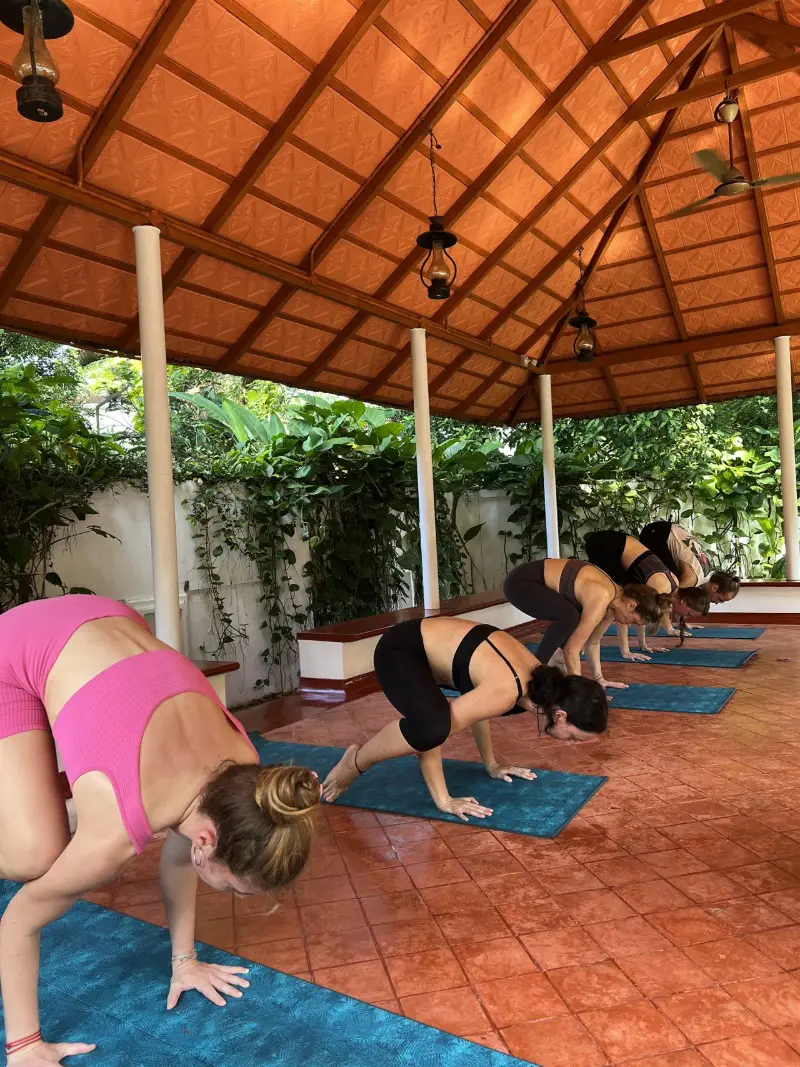
We teach traditional Hatha Yoga in a garden pavilion in Chirattapalam. Classes run every day, 7:30 to 9:30 in the morning and 3:30 to 5:30 in the afternoon, for ₹500 a class — a limited-time offer on the usual ₹600, and ₹700 from November 2026. You walk in; there is nothing to book. Everyone practises in the same room, beginners beside people who have been coming for years.
- Class length
- Two hours
- Times
- 7:30–9:30 am, 3:30–5:30 pm
- Drop-in
- ₹500 (a limited-time offer; normally ₹600, and ₹700 from November 2026)
- Private session
- ₹1,500 (₹2,000 from November 2026)
- Where
- House No 1/1790, Chirattapalam Road, Fort Kochi, Kochi, Kerala 682001, India
We are a poor choice if you want a sweaty power flow, a sixty-minute class before breakfast, heated rooms, or a certificate recognised by Yoga Alliance. We are not a Yoga Alliance Registered Yoga School, and we say so before you ask.
We are a good choice if you want held postures, real pranayama, hands-on correction, and philosophy taught in plain language alongside the practice.
What to ask before you go anywhere
Message any school with these four questions. The answers, and how quickly they come, tell you most of what you need.
- How long is the class, and how many people usually come?
- Who is teaching this week?
- I have [this injury or limitation] — can I still join?
- Can I come to one class before deciding anything?
If you would like ours answered, send us a message — it takes about a minute, and Achu replies himself.
Still planning? Our guide to yoga in Fort Kochi has class times and what to expect in the room, and what yoga costs in Kochi puts the prices side by side.
Come and judge ours for yourself
One class tells you more than any list can. Message us the evening before and we will say where the morning class is and what time to arrive. No booking, no commitment.
Common questions
Which is the best yoga class in Fort Kochi?
There is no single best class. The right one depends on what you want: a walk-in class if you are passing through, a small traditional class if you want to be corrected by hand, or a teacher training if you want to learn to teach. Judge a class on length, group size, whether the teacher adjusts students physically, and whether anyone asks about injuries before you begin.
Can I join a yoga class in Fort Kochi without booking?
At our school, yes. Classes run every day at 7:30–9:30 am and 3:30–5:30 pm, cost ₹500 a class (normally ₹600), and need no booking. Many schools aimed at visitors do ask you to book ahead, so message before you walk over.
How much does a yoga class in Fort Kochi cost?
Our two-hour drop-in class is ₹500 (a limited-time offer; normally ₹600, and ₹700 from November 2026), and a private session is ₹1,500, rising to ₹2,000. Sessions booked through travel platforms usually cost several times more.
Is yoga in Fort Kochi suitable for complete beginners?
Yes. Beginners are welcome in every class we teach, and so are stiff bodies, older bodies and people returning after injury. Tell the teacher before you start and the practice adapts around you.
What is the difference between a yoga studio and a yoga school?
A studio usually sells classes by the hour, often several styles taught by a rota of teachers. A school teaches one tradition in depth and keeps the same teacher in front of you: here that means Hatha Yoga with pranayama, meditation and Vedanta philosophy, and a teacher training for students who want to go further. Neither is better in the abstract — a studio suits someone collecting a workout, a school suits someone learning a practice.
Do classes in Fort Kochi include pranayama, or only postures?
Ask, because it varies. Shorter studio classes are often postures alone. Our two-hour class always includes pranayama and rest between postures, which is part of why it runs long — the breathing practice is not an add-on at the end.
Should I book a yoga retreat instead of joining daily classes?
If you are in Fort Kochi anyway, daily drop-in classes cost far less and let you judge the teaching before committing. A retreat makes sense when you want accommodation, food and practice arranged as one week — ours run through our retreat project, Samya Retreats, in Fort Kochi and Munnar.

Known to his students as Achu, Aksharanand trained in the Sivananda tradition and holds an Advanced Teacher Training Certificate. He has taught Hatha Yoga, pranayama, meditation and Vedanta philosophy in Fort Kochi for over fifteen years, across more than 5,000 group classes and seventy international teacher training batches.
More about Achu and the school · Book a class or ask a question