
In short
Practise regularly for at least six months, complete a 200-hour teacher training, then start teaching small groups while you keep studying. India has no government licence for yoga teachers; a 200-hour certificate from a school you respect, plus your own daily practice, is what the work is built on.
The short version
- Practise steadily for six months or more, ideally with one teacher.
- Choose a 200-hour training, and choose the teacher before the location.
- Spend the month there properly — it is more demanding than most people expect.
- Receive your certificate, and register with Yoga Alliance if the places you want to teach ask for it.
- Teach small, cheap or free classes until you are good, then charge properly.
1. Practise first, properly
The single best predictor of how much a training gives you is how much practice you bring to it. Six months of regular classes is a sensible minimum; a year is better. You do not need advanced postures. You need to know what a daily practice feels like when it is dull, because most of teaching is helping people through the dull parts.
2. Choosing a course
India has hundreds. The differences that matter are small in number:
- Who teaches it, and whether that person is in the room every day or appears twice a week.
- Group size. Twelve students and thirty students are entirely different courses at the same price.
- Style. Traditional Hatha, Ashtanga, Vinyasa, or a mix — decide what you want to teach.
- Where. Rishikesh, Goa, Mysore, Kerala. Climate, cost and atmosphere all differ; our Kerala and Rishikesh comparison covers the two most common choices.
- Yoga Alliance registration, if you intend to teach where it is asked for.
Our longer guide, how to choose a 200-hour training, lists the questions worth asking a school before you pay a deposit.
3. What the month is actually like
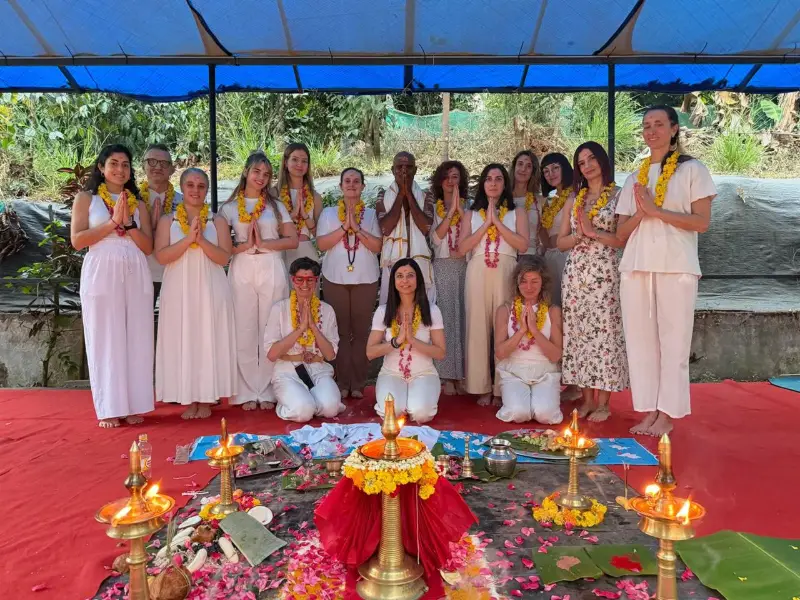
On a residential course, expect to be up before six and practising within the hour. A typical day holds two practice sessions, philosophy, anatomy, teaching methodology, and enough repetition that postures you thought you knew start behaving differently. Twenty-eight days is short for the material and long for the body.
Most people hit a wall in the second week, usually a physical one, occasionally an emotional one. That is normal, and a good school expects it.
4. Certification, plainly
Your school issues the certificate. Yoga Alliance is a voluntary American registry, not a licensing body: if a school is registered with them, graduates may pay to be listed as RYT 200. Studios in North America, Europe and Australia often ask for it; in India it is asked for far less.
We say this on every page where it matters: Santhi School of Yoga & Vedanta Studies is not a Yoga Alliance Registered Yoga School. Graduates receive our own 200-hour certificate and cannot register as RYT 200. If that credential is essential to your plans, train with a registered school — and our piece on 200 versus 300 hours explains the rest of the ladder.
5. Teaching your first classes
- Start with people who forgive you: friends, family, colleagues at lunchtime.
- Teach small groups, where you can see everyone.
- Say less than you planned. New teachers over-talk.
- Keep practising with a teacher of your own. Teaching is not practice.
- Get insured before you charge anybody.
What it costs, in time and money
A residential 200-hour course in India commonly runs from roughly €700 at the simpler end to several thousand for a resort programme; our cost guide breaks the figures down. Ours is €899 for 28 days, all-inclusive of accommodation, three sattvic meals a day, study materials, Ayurvedic tea and cultural excursions, with four batches in 2027.
Budget also for flights, visa, insurance and a month away from earning. And expect the real cost to be the two or three years of teaching afterwards, which is when you actually learn the job. What that teaching pays is set out in how much yoga teachers earn.
See our 200-hour yoga TTC in Fort Kochi or ask us about a batch.
Two practical next steps: preparing for a teacher training, and 200-hour or 300-hour.
Common questions
Do I need a licence to teach yoga in India?
No. India has no government licence for yoga teachers. Schools issue their own certificates, and Yoga Alliance registration is voluntary. What matters most to employers and students is the school you trained with and your own practice.
How long does it take to become a yoga teacher?
A 200-hour residential course takes about four weeks. Most schools expect at least six months of regular practice beforehand, and becoming a genuinely good teacher takes a few years of teaching after that.
How much does yoga teacher training cost in India?
Residential 200-hour courses commonly range from roughly €700 to several thousand euros depending on accommodation and group size. Ours is €899 for 28 days, including accommodation, three sattvic meals a day, study materials and excursions.
Can beginners join a 200-hour teacher training?
Most schools, including ours, ask for some regular practice first rather than a particular level of flexibility. Six months of classes is a reasonable minimum; the course is far more rewarding if you arrive with a practice rather than starting one.

Known to his students as Achu, Aksharanand trained in the Sivananda tradition and holds an Advanced Teacher Training Certificate. He has taught Hatha Yoga, pranayama, meditation and Vedanta philosophy in Fort Kochi for over fifteen years, across more than 5,000 group classes and seventy international teacher training batches.
More about Achu and the school · Book a class or ask a question