
In short
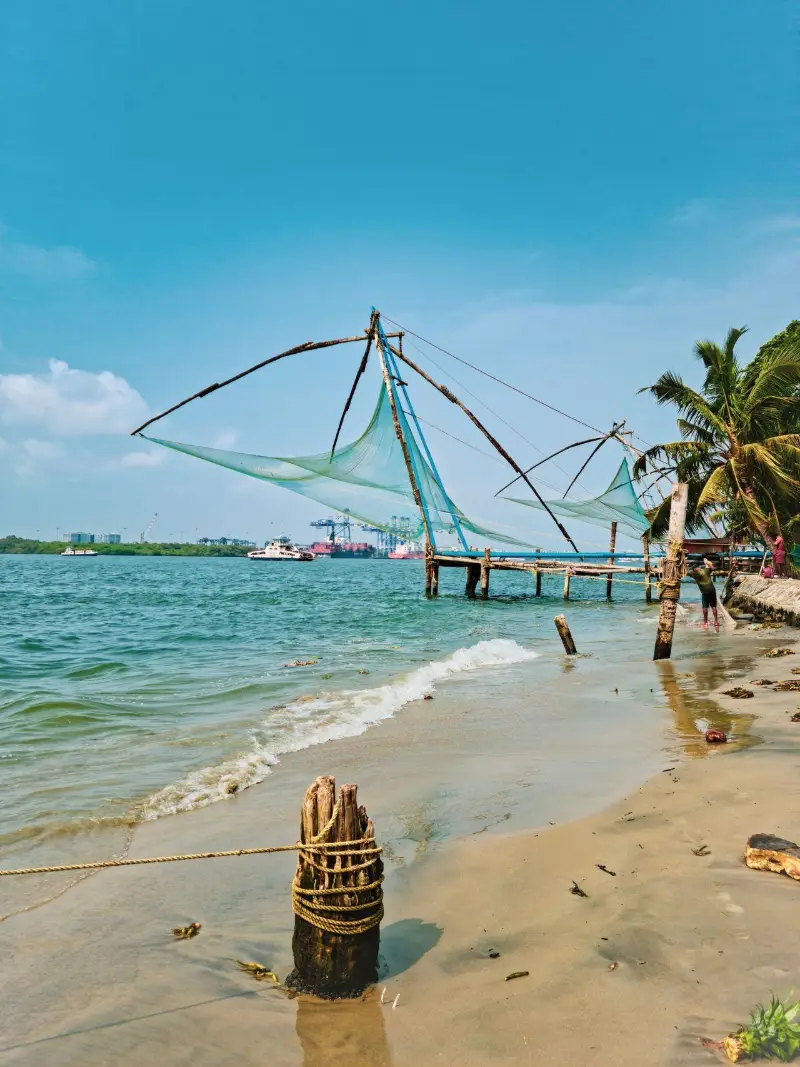
The Chinese fishing nets, or cheena vala in Malayalam, are huge shore-operated lift nets on the Fort Kochi waterfront, each about 10 metres high and worked by a crew of four to six fishermen using rocks as counterweights. They are usually said to have arrived with Chinese traders or the fleets of Admiral Zheng He in the early 1400s. Go early in the morning to watch them worked in soft light, or at sunset for the silhouette. Watching is free.
Walk to the northern end of the Fort Kochi waterfront at first light and you will hear the nets before you see them clearly: a rhythmic chant as a crew hauls on ropes, the creak of timber, then a splash as a great web of net rises out of the water with whatever the tide has brought in.
They are the most photographed thing in Kochi, and it is easy to treat them as scenery. They are not. They are working equipment, owned and run by families of fishermen, and they have been part of this shoreline for several hundred years.
How the nets work
Each net is a giant lever. A tall frame of teak and bamboo poles, about 10 metres high, is mounted on a pivot at the water’s edge. At the sea end, a square net of 20 metres or so hangs from the frame. At the shore end, large rocks are tied to ropes as counterweights.
- The crew walk out along the main beam, and their weight, with the frame’s own, lowers the net into the water.
- The net is left down for a short while, usually a matter of minutes.
- The crew then work the ropes and shift the counterweights, and the whole structure tips back, lifting the net clear of the water.
- The catch is scooped out with a long-handled net, and the cycle begins again.
The fishing depends on the tide, so a net can be busy for an hour and then quiet for the next. The catch is usually modest: small fish, prawns, sometimes crabs. It is a way of fishing that suits the shallow, sheltered waters of the harbour mouth, not the open sea.
Where did they come from?
The honest answer is that nobody knows for certain.
The most common account, repeated by Kerala Tourism, is that the nets were brought from China in the late fourteenth or early fifteenth century, perhaps by traders connected to the court of Kublai Khan, or by the fleets of the Ming admiral Zheng He, who made seven great voyages across the Indian Ocean between 1405 and 1433 and called at the Kerala coast. Similar shore-operated lift nets are still used in southern China, which supports the idea.
Some historians point instead to the Portuguese, who arrived in Kochi in 1500 and may have brought the design from their trading posts in the east. What is not in doubt is the name. In Malayalam they are cheena vala, “Chinese nets”, and Kochi has used that name for as long as anyone can remember.
The best time to see them
| Time | What you will see |
|---|---|
| 6–8 am | The best hour. Crews at work, soft light, cool air, few people. Ideal before a 7:30 yoga class if you are an early riser, or straight after it. |
| Late morning | Nets still worked as the tide allows. Busier, and hot by 11. |
| Midday | Often quiet. Harsh light and little shade. |
| Sunset | The classic photograph: the nets in silhouette against an orange sky. Crowded and cheerful. |
From June to September, monsoon rain and rough water mean fewer nets are worked on some days. The season from November to February is the most reliable.
Helping to haul a net
You will often be invited onto a net to help pull the ropes. It is a genuinely fun few minutes, and the crews are used to visitors. Two things to know:
- A tip is expected. This is fair: you are on someone’s workplace, and the catch is small. Agree an amount before you step on, so nobody is surprised afterwards.
- Be careful. The beams are narrow, wet and moving. Wear sandals with grip or go barefoot, keep your hands clear of the ropes when told to, and do what the crew say.
If you would rather just watch, say so politely. Nobody will mind.
Buying fish from the nets
Next to the nets, a row of stalls sells the day’s catch, from the nets and from the boats: seer fish, pomfret, prawns, crab, squid, sometimes lobster. The custom is that you choose your fish, then take it to one of the small restaurants across the road, which will cook it for a fee.
- Agree the price per kilo and see it weighed before paying.
- Agree the cooking charge with the restaurant before you hand the fish over.
- Ask how it will be cooked. Fried with a Kerala masala is the usual way, and very good.
As a yoga school we eat vegetarian, so this is advice we pass on rather than follow. If you are vegetarian too, our guide to vegetarian food in Fort Kochi has you covered.
Combining the nets with a class
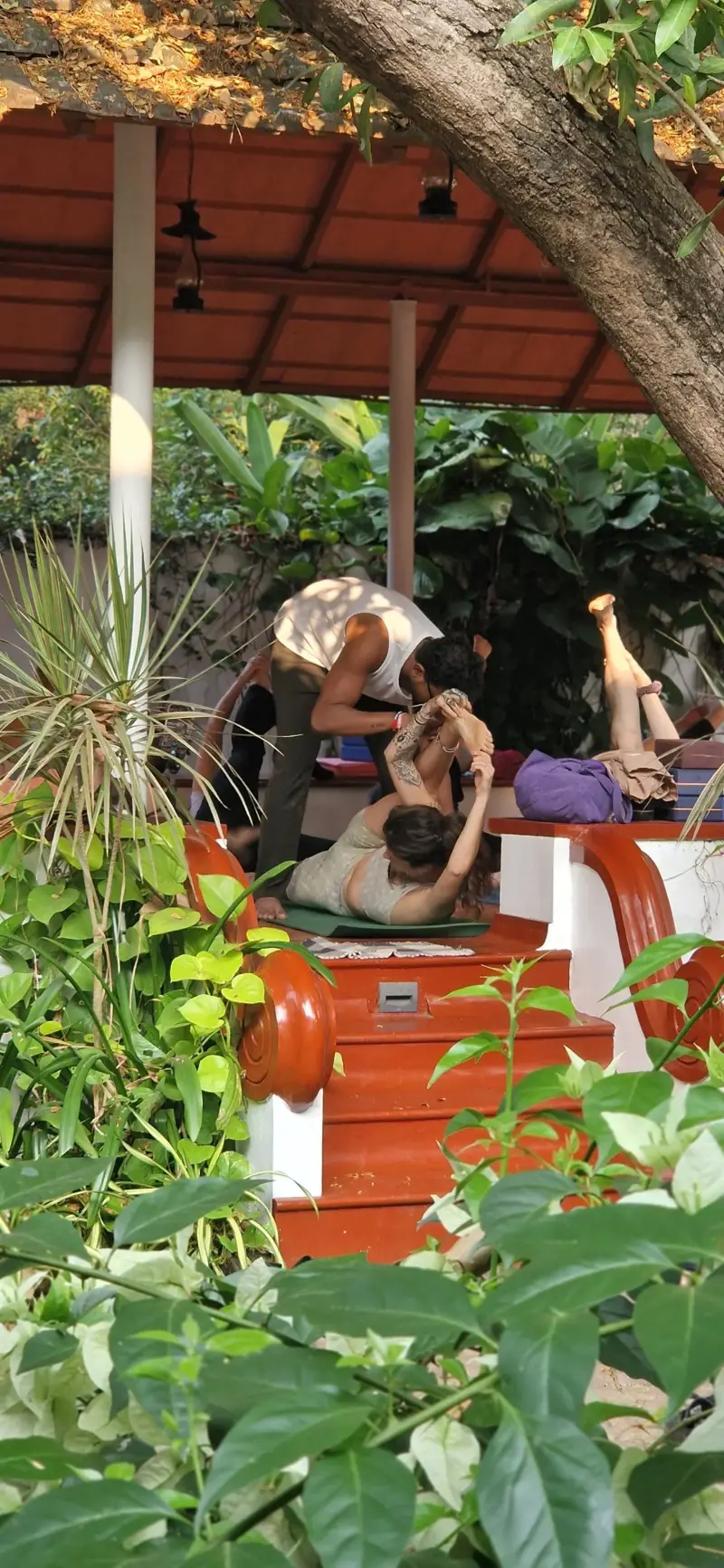
The nets and a yoga class suit the same hour. The morning class runs from 7:30 to 9:30, so you can walk to the nets at 6:30 and then come to class, or come to class first and reach the waterfront by 10 while the nets are still being worked. The school is about twenty minutes’ walk inland, or five minutes by auto-rickshaw.
In the afternoon, the 3:30 class ends at 5:30, in good time for the sunset.
Nets at dawn, then a class
Traditional Hatha Yoga every day, 7:30–9:30 am or 3:30–5:30 pm. ₹500 a class (a limited-time offer; normally ₹600, and ₹700 from November 2026). No booking and no experience needed; mats provided. Message us the evening before a morning class.
Seeing more of the town? Fort Kochi Beach starts where the nets end, and things to do in Fort Kochi covers the rest, with the Friday closures that catch most visitors out.
Common questions
Why are they called Chinese fishing nets?
In Malayalam they are called cheena vala, meaning Chinese net. The usual account is that the design came from China in the late 1300s or early 1400s, with traders or with the fleets of Admiral Zheng He. Some historians credit the Portuguese instead; the origin is not certain.
What is the best time to see the Chinese fishing nets?
Early morning, from about 6 to 8 am, when the crews are working and the light is soft. Sunset is best for photographs of the nets in silhouette, though it is much busier.
Is there a fee to see the Chinese fishing nets?
No, watching is free. If a crew invites you onto a net to help haul, a tip is expected, so agree the amount before you step on.
How many people operate a Chinese fishing net?
Usually a crew of four to six fishermen, who use their own weight and a set of rock counterweights to lower and raise the net.
Can I buy fish from the Chinese fishing nets?
Yes. Stalls next to the nets sell the day’s catch, and small restaurants nearby will cook what you buy for a fee. Agree both prices before anything is weighed or cooked.

Known to his students as Achu, Aksharanand trained in the Sivananda tradition and holds an Advanced Teacher Training Certificate. He has taught Hatha Yoga, pranayama, meditation and Vedanta philosophy in Fort Kochi for over fifteen years, across more than 5,000 group classes and seventy international teacher training batches.
More about Achu and the school · Book a class or ask a question