
In short
Kalaripayattu is Kerala’s traditional martial art, practised in a sunken earthen arena called a kalari. Training moves through four stages: body conditioning sequences, wooden weapons, metal weapons — including the urumi, a flexible sword worn as a belt — and finally bare hands. In Fort Kochi, hour-long shows for visitors run most evenings at venues including the Kerala Kathakali Centre and the Kochi Folklore Odeum on Napier Street. Short courses for beginners exist, and the art shares real ground with yoga in its breath work, its stretches and its associated massage.
Most visitors to Fort Kochi find their way to a Kathakali performance. Rather fewer find kalaripayattu, which is a pity, because it is the more visceral of the two and often performed in the same venues on the same evenings.
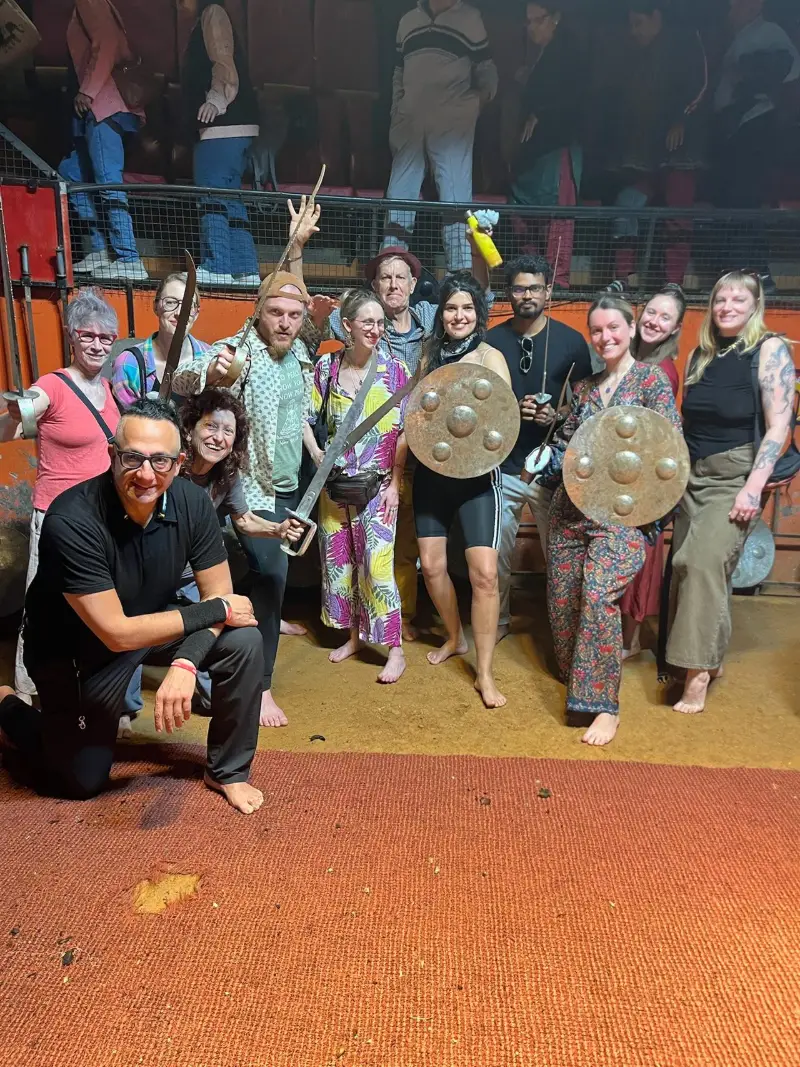
Our teacher training students are taken to one most batches. They come back quiet.
What it is
Kalari means the arena or training ground; payattu means fight or practice. Together: the practice done in the kalari.
It is a complete martial system — conditioning, weapons, unarmed combat, and a healing tradition attached to it — developed in what is now Kerala and carried down through family lineages and teacher-student succession.
You will read everywhere that it is the oldest martial art in the world, and that the sage Parasurama, who legend says raised Kerala from the sea, taught it to the first masters. Treat both as tradition rather than history. The documented record is clearer from around the twelfth century onwards, in a period when Kerala was divided into small warring principalities that kept trained fighters. The claim to be the oldest is unverifiable and, frankly, not needed — what survives is remarkable enough without it.
The art nearly died. After the rebellion led by Pazhassi Raja, the British banned the carrying of weapons and weapons training in 1804, and most of the major kalaris closed. It survived in a handful of families who went on teaching quietly, and a revival began in the 1920s around Thalassery, alongside the wider rediscovery of Indian cultural forms.
Inside a kalari
A traditional kalari is a specific building, and the specifics are the point.
- It is sunk into the ground, typically a few feet below the surface, in a rectangle with the long axis running east to west. The earth floor is soft enough to fall on and cool in the middle of the day.
- A seven-tiered platform in the south-west corner, the poothara, holds an oil lamp and flowers. Students salute it entering and leaving.
- Weapons are kept along the walls, and a student touches the guru’s feet and the ground before beginning.
- The teacher is the gurukkal, and the relationship is closer to apprenticeship than to a class on a timetable.
Students train barefoot, usually in a kachakettu, a long strip of cloth wrapped tightly around the waist and hips to support the lower back. Before training in the serious seasons, students are massaged with warm oil — sometimes by the guru’s feet, the practitioner suspended by ropes overhead.
The four stages
Training progresses in a fixed order, and a beginner does not touch a weapon for a long time.
| Stage | What it is |
|---|---|
| Meithari body practice | Conditioning sequences — kicks, leaps, twists, low stances and the extraordinary flexibility work that makes the rest possible. Months to years. This is the stage that most resembles yoga. |
| Kolthari wooden weapons | The long staff, the short stick, and the curved otta, a wooden weapon shaped like an elephant’s tusk used to strike the vital points. |
| Ankathari metal weapons | Dagger, sword and shield, spear, and finally the urumi — a flexible steel whip-sword, worn coiled around the waist, so dangerous to the wielder that it is taught last. |
| Verumkai bare hands | Unarmed combat, including locks, throws and strikes to the marma points. Taught only to those who have come through the rest. |
Alongside all of it runs kalari chikitsa, the associated healing tradition: massage, oils and bone-setting, closely related to Ayurveda. A gurukkal is expected to be able to repair what the training breaks.
What you will see at a show
A performance for visitors lasts around an hour and is staged rather than a real training session, but the skill is entirely real.
Expect, roughly in order: a salutation to the lamp; body sequences and kicks; leaps and flips; the long staff; sword and shield, with real steel and real contact; some fire work; and the urumi last, because it is the one that makes an audience gasp.
What tends to stay with people is not the weapons but the flexibility — a fighter dropping into a full split from standing, or kicking above his own head without any apparent preparation. That is the meithari stage showing.
In Fort Kochi, kalaripayattu is staged most evenings at the Kerala Kathakali Centre on K.B. Jacob Road and at the Kochi Folklore Odeum on Napier Street, among others, usually in the early evening and often on the same bill as Kathakali. (Do not confuse the Odeum with the Kerala Folklore Museum, which is a fine collection but sits in Thevara, some nine kilometres away.) Timings shift with the season and the tourist calendar, so check on the day — any guesthouse in Fort Kochi will know, and most will book for you. Tickets are bought at the door.
Practical notes: the seating is close to the action, which is part of the appeal and means the front row is occasionally showered with sand. Photography is generally allowed. An hour is genuinely enough.
How it relates to yoga
The two are not the same thing, and the claim sometimes made that kalaripayattu is the ancestor of yoga — or of all Asian martial arts, via Bodhidharma — is folklore rather than established history.
What is genuinely shared is more interesting than the origin story:
- The stretches are recognisable. Watch the warm-up sequences and you will see lunges, forward folds and backbends that would not be out of place in a hatha class.
- Breath is trained deliberately, coordinated with movement, in a way any yoga student would recognise.
- The marma points — the vital points struck in combat and treated in massage — overlap conceptually with the subtle anatomy of yoga, and both sit inside the same Ayurvedic framework.
- The oil massage of kalari chikitsa is close kin to abhyanga, the daily self-massage of the Ayurvedic routine.
- The relationship to the teacher is the same shape: one person, watched over years, rather than a syllabus.
Where they part company: kalaripayattu is a fighting art with a conditioning regime to match, and its aims are external. Yoga is turned the other way.
Can visitors train?
Yes, and several schools in and around Kochi run short courses for beginners and visitors, from a single introductory session to a few weeks.
Realistic expectations. In a week you will learn some conditioning sequences, a few stances and kicks, and you will be sore in places you did not know about. You will not touch a sword. The flexibility that makes the art look the way it does is the work of years, started in childhood in most traditional lineages.
If you are here for the month-long teacher training, a short kalari course alongside it is more than most bodies want in one month — twice-daily yoga practice is already a substantial load. Better to see a performance during the course and come back for the training afterwards, if it grips you.
Fitting it into an evening
Fort Kochi is small, and the classical performances all run in the same early-evening window, which is the one scheduling problem worth knowing about.
The usual shape of a good evening: afternoon yoga class from 3:30 to 5:30, walk down to the fishing nets for sunset, eat early, and take a seat at seven. If you want both the kalaripayattu and the Kathakali make-up, arrive early enough for the latter — it is applied in view of the audience and is half the pleasure.
Our slow morning in Fort Kochi covers the other end of the day, and the seven-day itinerary puts the whole town in context.
Common questions
Where can I see kalaripayattu in Fort Kochi?
Shows run most evenings at venues including the Kerala Kathakali Centre on K.B. Jacob Road and the Kochi Folklore Odeum on Napier Street — not the Kerala Folklore Museum, which is a different place in Thevara. Shows are usually in the early evening and often on the same bill as Kathakali. Timings change with the season, so check on the day — any guesthouse in Fort Kochi will know and most will book for you.
How long is a kalaripayattu show?
About an hour, which is enough. You will see body sequences and kicks, leaps, the long staff, sword and shield, some fire work, and the flexible urumi sword last.
Is kalaripayattu really the oldest martial art in the world?
It is often described that way, and the claim cannot be verified. Traditional accounts trace it to the sage Parasurama; the documented record is clearer from around the twelfth century. It is genuinely old and was nearly lost under a nineteenth-century British ban, which is remarkable enough without the superlative.
Can beginners learn kalaripayattu in Kerala?
Yes. Several schools around Kochi run short courses for visitors, from one session to a few weeks. Expect conditioning sequences, stances and kicks, and considerable soreness. You will not be handed a weapon — that comes after months or years of body training.
Is kalaripayattu related to yoga?
They share real ground: recognisable stretches, breath coordinated with movement, the marma points, an Ayurvedic massage tradition, and a one-to-one relationship with a teacher. But kalaripayattu is a fighting art, and the claim that it is the ancestor of yoga or of Asian martial arts generally is folklore rather than history.

Known to his students as Achu, Aksharanand trained in the Sivananda tradition and holds an Advanced Teacher Training Certificate. He has taught Hatha Yoga, pranayama, meditation and Vedanta philosophy in Fort Kochi for over fifteen years, across more than 5,000 group classes and seventy international teacher training batches.
More about Achu and the school · Book a class or ask a question