
In short
Most knee trouble in yoga comes from forcing rotation the hip will not give, and the fix is almost always to open the hips, raise the seat, and stop pursuing lotus. Kneeling postures need padding, standing postures need the knee tracking over the foot, and sharp or inner-joint pain means stop rather than adjust.
A knee does one thing well: it bends and straightens. It tolerates a small amount of rotation when bent and almost none when straight. Nearly every yoga knee injury I have seen came from asking it for rotation anyway.
Why knees complain
The hip is a ball and socket and can turn in every direction. The ankle has real mobility too. The knee sits between them as a hinge, and when either neighbour is stiff, the knee is the joint that gives.
So when a student tells me their knee hurts in a seated posture, I look at their hips. When it hurts in a lunge, I look at the ankle and the foot. The knee is usually the messenger.
Sitting without pain
This is the quickest win in all of yoga, and it costs one cushion.
Sit up on a folded blanket, a bolster or a block, high enough that your hips are clearly above your knees. The thigh bones then angle downwards, the pelvis can tip forward, the spine stacks itself, and the knees stop being asked to make up the difference.
If the knees still hang unsupported and ache, put a cushion under each one. Supported weight is comfortable weight. Sitting for meditation goes further into this.
The lotus problem
Padmasana is beautiful, useful for long sitting, and responsible for more yoga knee injuries than any other posture. The reason is simple: it demands a great deal of external rotation at the hip, and if the hip cannot supply it, the shin is levered across the knee joint instead.
The damage is often silent at the time. People come out of a forced lotus feeling fine and find two days later that something on the inside of the knee is unhappy.
Our position is unambiguous. Nobody in our classes is placed into lotus. If it arrives, it arrives from the hips over months or years, and half lotus, or simple cross-legged sitting on a cushion, serves every practical purpose in the meantime.
Standing postures
- In warrior and lunges, the bent knee tracks over the second toe — never drifting inwards — and should not travel beyond the ankle.
- In triangle and the straight-leg postures, keep a soft bend rather than locking the joint back. Hyperextension is felt as stability and is not.
- In tree, place the foot above or below the standing knee, never against it.
- In chair, the weight belongs in the heels. If you cannot see your toes, the knees have taken over.
Kneeling and padding
Kneeling postures — camel, cat, the entry to many others — are a matter of padding rather than technique. Fold the mat, use a blanket, and stop treating discomfort at the kneecap as something to breathe through. It is skin and bone, not a stretch.
Vajrasana, sitting on the heels, is worth building slowly. Start with a rolled blanket behind the knees and take it out when it is no longer needed.
When to stop and see a doctor
Modification is for aching, stiffness and the dull complaints of a joint being asked to work. It is not for everything.
Stop and get advice for sharp pain, pain deep inside the joint, swelling, a knee that locks or catches, a knee that gives way, or pain that persists for days after practice. Meniscus and ligament injuries do not respond to a better cushion.
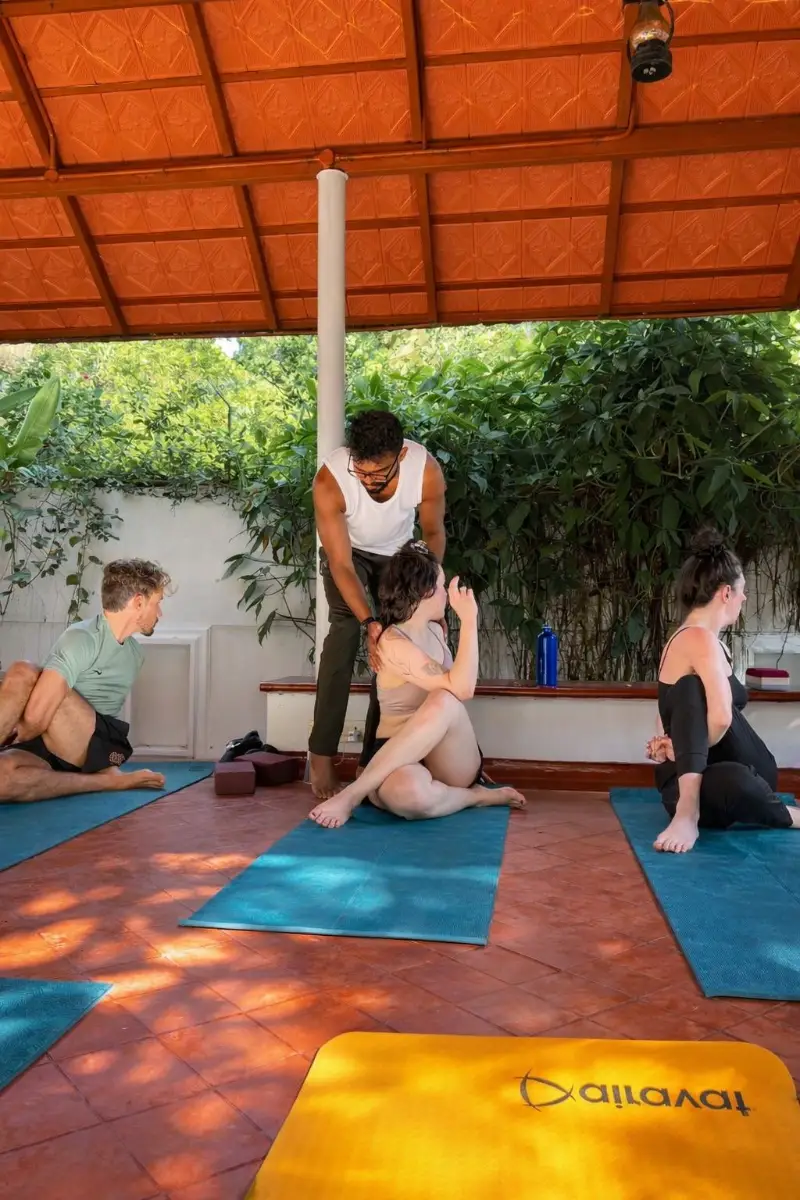
Practised sensibly, though, yoga is generally good for knees — the thighs and hips that support the joint get stronger, and the hips that caused the trouble slowly open. Yoga for tight hips is the companion piece, and in a small class a teacher can see in a moment what takes a paragraph to describe.
Common questions
Why do my knees hurt in cross-legged sitting?
Usually because the hips are tight, so the thigh bones cannot rotate outwards and the rotation is taken by the knee instead. Sitting up on a cushion or block so the hips are above the knees resolves it for most people immediately.
Should you do yoga with knee pain?
Often yes, with modifications, and it can help — stronger hips and thighs support the joint. But sharp pain, pain inside the joint, swelling or a knee that locks or gives way needs a doctor rather than a modification.
Is lotus pose bad for your knees?
Lotus itself is not harmful, but forcing it is a common cause of knee injury in yoga. The rotation must come from the hip. If the hip will not give it, the knee is asked to twist in a direction it is not built for, and the meniscus and ligaments take the load.
How do you protect your knees in standing postures?
Keep the kneecap tracking in line with the second toe, do not let the knee drift inward, and avoid bending past the ankle in lunges and warrior. In straight-leg postures, keep a soft micro-bend rather than locking the joint back.

Known to his students as Achu, Aksharanand trained in the Sivananda tradition and holds an Advanced Teacher Training Certificate. He has taught Hatha Yoga, pranayama, meditation and Vedanta philosophy in Fort Kochi for over fifteen years, across more than 5,000 group classes and seventy international teacher training batches.
More about Achu and the school · Book a class or ask a question