

In short
Fort Kochi works well for remote work if you plan around three things: backup internet, the midday heat, and a routine. Buy a local SIM with a good data plan as a backup to your accommodation’s Wi-Fi, ask whether your room has power backup, and do your focused work in the hot middle of the day. Many long-stay workers here build the day around a 7:30 am or 3:30 pm yoga class, and anyone practising with us for more than a week gets 30% off.
Some of the travellers who stay longest in Fort Kochi are working: on a sabbatical that turned into a working holiday, or simply taking their job somewhere warmer for a month. Fort Kochi suits them because it is calm, walkable, reasonably priced and has enough cafés and company to stop a long stay becoming lonely.
It is not a purpose-built digital nomad hub, and that is part of the appeal. It does mean you need to set things up yourself. Here is how.
Internet and SIM cards
- Accommodation Wi-Fi varies from excellent to unusable. Before booking a longer stay, ask the host for a speed test screenshot, and ask what happens when the power goes.
- A local SIM is essential as a backup. Mobile data in India is fast and very cheap, and 4G and 5G coverage in Kochi is good. You will need your passport and a photo, and activation can take a day. Buy one at the airport or from an official shop in Ernakulam.
- Hotspotting from your phone is how most people get through a Wi-Fi outage. For important calls, have it ready before you start.
Power cuts and the monsoon
Power cuts in Kochi are usually short, but they happen, especially in storms. Many homes and guesthouses in Kerala have an inverter, a battery backup that keeps lights, fans and the Wi-Fi router running. Ask about it when you book. A small power bank for your phone and a charged laptop battery cover the rest.
In the monsoon, from June to September, heavy rain can interrupt connections for a while. The season is also quiet, green and cheaper, and many people love working through it.
Time zones
India runs on IST, UTC +5:30, with no daylight saving.
| Working with | Overlap | A routine that fits |
|---|---|---|
| Europe | Your afternoon and evening | Morning class, focused work late morning, calls from about 1:30 pm |
| UK | Your afternoon and evening | Morning class, focused work until lunch, calls from about 2:30 pm |
| Middle East | Most of the day | Either class; normal hours |
| East Asia, Australia | Your morning | Early calls, then the afternoon class |
| The Americas | Your late evening and night | Morning class, long afternoon rest, calls at night |
A daily routine that works here
The single most useful thing is to stop fighting the climate. Kerala’s day has a shape: cool mornings, hot middays, soft evenings. People who work with it are productive and well. People who try to sightsee at noon and work at night burn out in a week.
| Time | What |
|---|---|
| 7:30–9:30 am | Yoga class, before the heat. Two hours of movement, breath and rest, then you have done something for yourself before the day begins. |
| 9:30–10:30 | A long Kerala breakfast. |
| 10:30 am–1 pm | Focused work, while your head is clearest. |
| 1–3 pm | Lunch, then more work indoors under a fan, or a rest. This is not the time to be outside. |
| 3:30–5:30 pm | Either the afternoon class, if you skipped the morning, or calls and admin. |
| 5:30 pm onwards | Walk to the waterfront for the sunset. Dinner. Evening calls if your team needs them. |
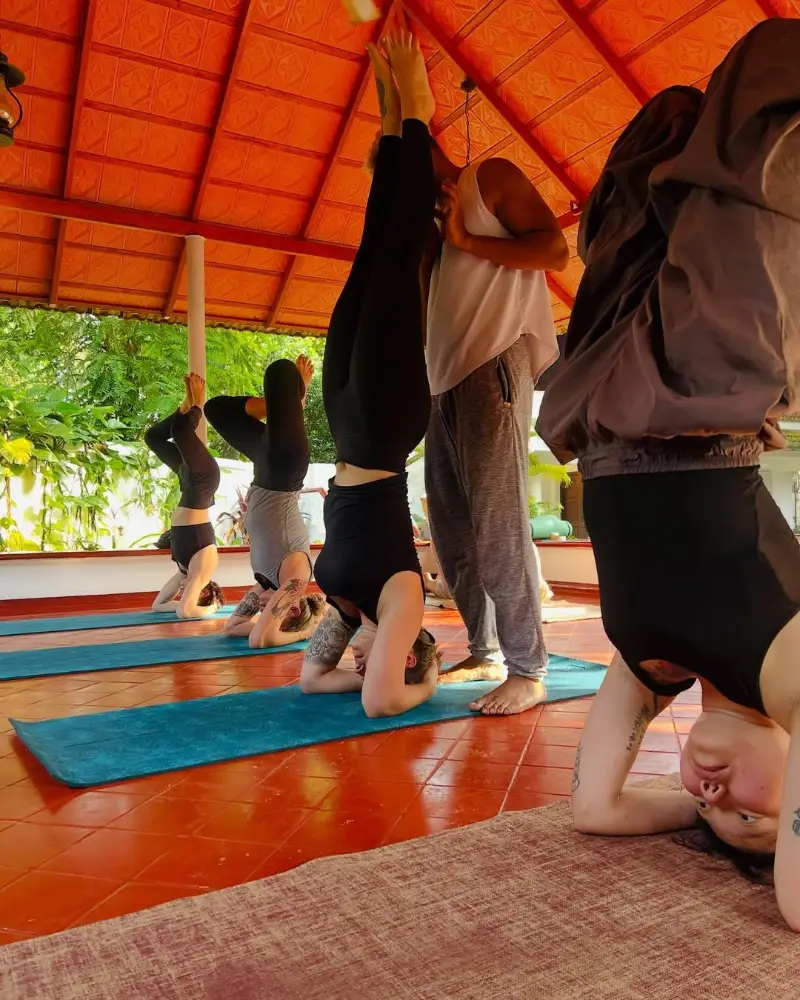
A regular class does more than keep your back working after hours at a laptop. It gives the day an anchor, a reason to be up early, and a group of people who expect to see you. Our guide to neck and shoulder pain at a desk covers what the laptop does to your body, and what helps.
Where to stay for a working stay
- A homestay room with a desk, negotiated for a weekly or monthly rate, is the usual choice. Hosts often give good discounts for stays of a month.
- Serviced apartments exist in and around Fort Kochi and give you a kitchen.
- Location: the quieter residential lanes, such as those around Chirattapalam, are calmer to work in than the waterfront and Princess Street, and still walkable to everything.
Our guide to where to stay compares the areas, and what a month in Fort Kochi costs gives a realistic budget.
Cafés
Fort Kochi’s art cafés are pleasant places to spend a couple of hours with a laptop, especially in the heat of the afternoon. Wi-Fi quality varies and changes, so treat a café as a change of scene rather than your main office, buy something every hour or so, and do not take long calls at the table.
A note on visas
India’s tourist visa and e-visa are for tourism, and the rules on working remotely for a foreign employer while on one are not clear-cut. Check what your visa allows before you travel, particularly for a long stay.
Anchor your working day with a class
Traditional Hatha Yoga every day, 7:30–9:30 am and 3:30–5:30 pm. ₹500 a class (a limited-time offer; normally ₹600, and ₹700 from November 2026), and 30% off once you have been practising with us for more than a week. No booking needed. Message us the evening before a morning class.
Staying a while? A week of yoga in Fort Kochi shows how a longer stay tends to go, and how often should you do yoga explains why daily practice works.
Common questions
Is Fort Kochi good for digital nomads?
It is a good choice for a calm working stay of a week to a few months: walkable, reasonably priced, with good food and cafés. It is not a purpose-built nomad hub, so arrange backup internet and power yourself.
Is the internet good in Fort Kochi?
Accommodation Wi-Fi varies widely, so ask for a speed test before booking. Mobile data is fast and cheap, with good 4G and 5G coverage, and a local SIM is the essential backup.
Are there power cuts in Kochi?
Occasionally, usually short, and more often in storms. Many guesthouses have an inverter battery backup that keeps the fans and Wi-Fi running; ask when you book.
What time zone is Kerala in?
India Standard Time, UTC +5:30, with no daylight saving. It overlaps well with the Middle East, with the afternoon in Europe, and with the late evening in the Americas.
Is there a discount on yoga classes for long stays?
Yes. At Santhi School of Yoga there are no packages or memberships, but students who practise for more than a week get 30% off classes.

Known to his students as Achu, Aksharanand trained in the Sivananda tradition and holds an Advanced Teacher Training Certificate. He has taught Hatha Yoga, pranayama, meditation and Vedanta philosophy in Fort Kochi for over fifteen years, across more than 5,000 group classes and seventy international teacher training batches.
More about Achu and the school · Book a class or ask a question